
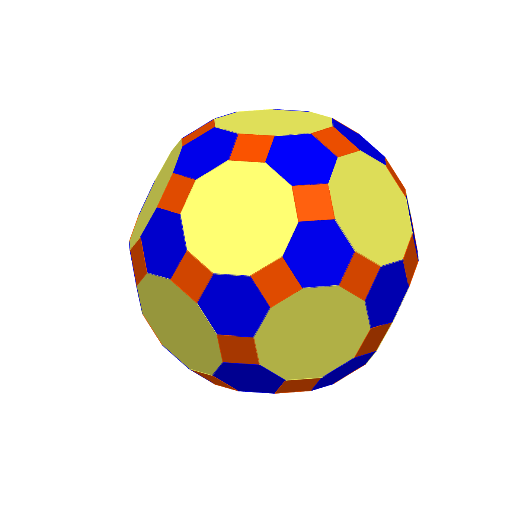
Truncated Icosidodecahedron
Loading the math board and drawing, please wait…
In collections
Archimedean Solids
This example demonstrates the construction of a truncated icosidodecahedron, a polyhedron derived from truncating a regular dodecahedron and a regular icosahedron. Key mathematical concepts include solid geometry and geometric construction. Using GeoGebra commands such as Polygon, Rotate, and Centroid, the truncated icosidodecahedron is constructed. Suitable for high school and above students or educational purposes.
GeoGebra Commands & Parameters
Polygon(A, B, 10, xOyPlane) → poly1, f, p, C, D, E, F, G, H, I, J, g, h, i, j, k, l, m, nPolygon(A, B, 6, xOyPlane) → poly2, q, N, r, s, t, a, b, K, L, MPolygon(B, C, 4, xOyPlane) → poly3, c, d, e, f_1, O, PRotate(poly2, 142.62°, q) → poly2'Rotate(N, 142.62°, q) → N'Rotate(M, 142.62°, q) → M'Rotate(L, 142.62°, q) → L'Rotate(K, 142.62°, q) → K'Rotate(poly3, 148.28°, c) → poly3'Rotate(O, 148.28°, c) → O'Rotate(P, (148.28 * °°), c) → P'Centroid(poly1) → QOrthogonalLine(Q, poly1) → g_1Rotate(poly2', 72°, g_1) → poly2''Rotate(poly2'', 72°, g_1) → poly2'''Rotate(poly2''', 72°, g_1) → poly4Rotate(poly2', -72°, g_1) → poly2''_{1}Rotate(poly3', 72°, g_1) → poly3''Rotate(poly3', 144°, g_1) → poly3''_{1}Rotate(poly3', -72°, g_1) → poly3''_{2}Rotate(poly3''_{2}, -72°, g_1) → q1Rotate(M', -72°, g_1) → M''Rotate(K', -72°, g_1) → K''Rotate(L', -72°, g_1) → L''Rotate(K'', -72°, g_1) → K'''Rotate(N', -72°, g_1) → N''Midpoint(N'', I) → RMidpoint(K''', H) → SLine(R, S) → h_1Midpoint(R, S) → TOrthogonalLine(T, q1) → i_1Intersect(g_1, i_1) → UPlane(U, R, S) → p_1Mirror(poly1, p_1) → poly1'Mirror(poly3''_{1}, p_1) → q2Mirror(poly3''_{2}, p_1) → q3Rotate(poly1', 72°, g_1) → poly1''Rotate(poly1'', 72°, g_1) → poly1'''Rotate(poly1''', 72°, g_1) → poly5Rotate(poly5, 72°, g_1) → poly5'Rotate(q3, 72°, g_1) → q3'Rotate(q3', 72°, g_1) → q3''Rotate(q3'', 72°, g_1) → q3'''Rotate(L', 72°, g_1) → L''_{1}Rotate(M', 72°, g_1) → M''_{1}Rotate(L''_{1}, 72°, g_1) → VRotate(M''_{1}, 72°, g_1) → WRotate(O', 72°, g_1) → O''Rotate(K', 72°, g_1) → K''_{1}Rotate(K''_{1}, 72°, g_1) → ZRotate(V, 72°, g_1) → V'Rotate(W, 72°, g_1) → W'Centroid(poly1') → A_1OrthogonalLine(A_1, poly1') → j_1Rotate(M'', -72°, j_1) → M'''Rotate(M'', -36°, j_1) → M'''_{1}Rotate(M''', -36°, j_1) → B_1Rotate(B_1, -36°, j_1) → C_1Rotate(C_1, -36°, j_1) → D_1Rotate(D_1, -36°, j_1) → E_1Rotate(E_1, 72°, g_1) → F_1Rotate(F_1, 72°, g_1) → G_1Rotate(M'''_{1}, 72°, g_1) → H_1Rotate(G_1, 72°, g_1) → I_1Rotate(H_1, 72°, g_1) → J_1Rotate(I_1, 72°, g_1) → K_1Rotate(J_1, 72°, g_1) → L_1Rotate(L_1, 72°, g_1) → M_1Rotate(M''', 144°, g_1) → N_1Rotate(M''', -72°, g_1) → O_1Rotate(M''', -144°, g_1) → P_1Rotate(B_1, 72°, g_1) → Q_1Rotate(M''', 144°, g_1) → R_1Rotate(B_1, -72°, g_1) → S_1Rotate(M''', -144°, g_1) → T_1Rotate(C_1, 72°, g_1) → U_1Rotate(C_1, 144°, g_1) → V_1Rotate(C_1, -72°, g_1) → W_1Rotate(C_1, -144°, g_1) → Z_1Rotate(D_1, 72°, g_1) → A_2Rotate(D_1, 144°, g_1) → B_2Rotate(D_1, -72°, g_1) → C_2Rotate(D_1, -144°, g_1) → D_2Rotate(M''', 72°, g_1) → E_2Rotate(M''', 144°, g_1) → F_2Rotate(M''', -72°, g_1) → G_2Rotate(M''', -144°, g_1) → H_2Rotate(q2, 72°, j_1) → q2'Rotate(q2, 144°, j_1) → q2'_{1}Rotate(q2'_{1}, 72°, g_1) → q4Rotate(q2'_{1}, 144°, g_1) → q5Rotate(q2', 72°, g_1) → q2''Rotate(q5, 144°, g_1) → q5'Rotate(q5, 72°, g_1) → q5'_{1}Rotate(q2'', 72°, g_1) → q2'''Rotate(q2''', 72°, g_1) → q6Rotate(q6, 72°, g_1) → q6'Rotate(poly4, 72°, j_1) → poly4'Rotate(poly4', 72°, j_1) → poly4''Rotate(poly4'', 72°, j_1) → poly4'''Rotate(poly4', -72°, g_1) → poly4''_{1}Rotate(poly4''_{1}, -72°, g_1) → poly6Rotate(poly6, -72°, g_1) → poly6'Rotate(poly4'', 72°, g_1) → poly4'''_{1}Rotate(poly4'''_{1}, 72°, g_1) → poly7Rotate(poly7, 72°, g_1) → poly7'Rotate(poly7', 72°, g_1) → poly7''Rotate(Q_1, 72°, g_1) → I_2Rotate(I_2, 72°, g_1) → J_2Centroid(poly7'') → K_2OrthogonalLine(K_2, poly7'') → k_1Rotate(W_1, -60°, k_1) → L_2Rotate(L_2, 72°, g_1) → M_2Rotate(L_2, 144°, g_1) → N_2Rotate(L_2, -72°, g_1) → O_2Rotate(L_2, -144°, g_1) → P_2Rotate(L_2, -60°, k_1) → Q_2Rotate(Q_2, 72°, g_1) → R_2Rotate(Q_2, 144°, g_1) → S_2Rotate(Q_2, -72°, g_1) → T_2Rotate(Q_2, -144°, g_1) → U_2Rotate(Q_2, -60°, k_1) → V_2Rotate(V_2, 72°, g_1) → W_2Rotate(V_2, 144°, g_1) → Z_2Rotate(V_2, -72°, g_1) → A_3Rotate(Q_2, -144°, g_1) → B_3Rotate(V_2, -60°, k_1) → C_3Rotate(C_3, 72°, g_1) → D_3Rotate(C_3, 144°, g_1) → E_3Rotate(C_3, -72°, g_1) → F_3Rotate(C_3, -144°, g_1) → G_3Rotate(E_2, 60°, k_1) → H_3Rotate(H_3, 72°, g_1) → I_3Rotate(H_3, -144°, g_1) → J_3Rotate(H_3, -72°, g_1) → K_3Rotate(H_3, -144°, g_1) → L_3Rotate(H_3, 60°, k_1) → M_3Rotate(M_3, 72°, g_1) → N_3Rotate(M_3, -144°, g_1) → O_3Rotate(M_3, 144°, g_1) → P_3Rotate(M_3, -72°, g_1) → Q_3Midpoint(P_2, V_1) → R_3Midpoint(M_3, B_2) → S_3Plane(R_3, S_3, U) → q_1Mirror(poly1''', q_1) → poly8Mirror(q5, q_1) → q5'_{2}Rotate(poly8, 72°, g_1) → poly8'Rotate(poly8', 72°, g_1) → poly8''Rotate(poly8'', 72°, g_1) → poly8'''Rotate(poly8, -72°, g_1) → poly8'_{1}Rotate(q5'_{2}, 72°, g_1) → q7Rotate(q5'_{2}, -72°, g_1) → q8Rotate(q5'_{2}, -144°, g_1) → q9Rotate(q7, 72°, g_1) → q7'Intersect(g_1, poly8') → T_3Centroid(poly8') → U_3OrthogonalLine(U_3, poly8') → l_1Rotate(T_2, -36°, l_1) → V_3Rotate(V_3, 72°, g_1) → W_3Rotate(V_3, 144°, g_1) → Z_3Rotate(V_3, -72°, g_1) → A_4Rotate(V_3, -144°, g_1) → B_4Rotate(V_3, -36°, l_1) → C_4Rotate(C_4, 72°, g_1) → D_4Rotate(C_4, 144°, g_1) → E_4Rotate(C_4, -72°, g_1) → F_4Rotate(C_4, -144°, g_1) → G_4Rotate(C_4, -36°, l_1) → H_4Rotate(H_4, 72°, g_1) → I_4Rotate(H_4, 144°, g_1) → J_4Rotate(H_4, -72°, g_1) → K_4Rotate(H_4, -144°, g_1) → L_4Rotate(H_4, -36°, l_1) → M_4Rotate(M_4, 72°, g_1) → N_4Rotate(M_4, 144°, g_1) → O_4Rotate(M_4, -72°, g_1) → P_4Rotate(M_4, -144°, g_1) → Q_4Rotate(M_4, -36°, l_1) → R_4Rotate(poly7', -72°, l_1) → poly7''_{1}Rotate(poly7''_{1}, 72°, g_1) → poly9Rotate(poly9, 72°, g_1) → poly9'Rotate(poly7''_{1}, -72°, g_1) → poly10Rotate(poly7''_{1}, -144°, g_1) → poly11Rotate(q7, -72°, l_1) → q7'_{1}Rotate(q7'_{1}, 72°, g_1) → q10Rotate(q7'_{1}, 144°, g_1) → q11Rotate(q7'_{1}, -72°, g_1) → q12Rotate(q11, 72°, g_1) → q11'Centroid(poly10) → S_4OrthogonalLine(S_4, poly10) → m_1Rotate(H_4, 60°, m_1) → T_4Rotate(T_4, 60°, m_1) → U_4Rotate(U_4, 72°, g_1) → V_4Rotate(U_4, -72°, g_1) → W_4Rotate(T_4, -72°, g_1) → Z_4Rotate(W_4, -72°, g_1) → A_5Rotate(Z_4, -72°, g_1) → B_5Rotate(A_5, -72°, g_1) → C_5Rotate(B_5, -72°, g_1) → D_5Rotate(D_5, -72°, g_1) → E_5OrthogonalPlane(U, g_1) → p_2Mirror(poly1, p_2) → poly1'_{1}
AI Drawing Prompt Reference
Construct a truncated icosidodecahedron in 3D. Start with a base polygon on a principal disk plane: build a 10-sided polygon as the main truncated face, together with smaller 6-sided and 4-sided polygons to represent adjacent truncation faces. Define a central reference point by taking the centroid of the 10-sided polygon and use a perpendicular line through it to obtain a rotation axis direction. Rotate the 6-sided and 4-sided pieces around that axis by the specific angles used in the construction, creating multiple copies arranged around the center. Use the plane determined by key intersection lines to mirror the base and the rotated faces for symmetry, then use midpoints of corresponding edges to form connecting lines and finish the side faces. Assemble all these pieces to display the full truncated icosidodecahedron shape.
The prompt above was compiled from the original drawing commands and is for reference only.