
3D Surface Built by Symmetry and Rotation
Loading the math board and drawing, please wait…
In collections
intersection: surface-surface, curve-curve
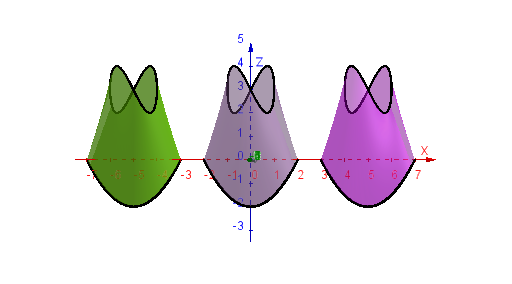
This GeoGebra example demonstrates how to construct and visualize a 3D surface by starting from Cartesian curves and then applying symmetry and rotation to form a coherent, structured shape in space. It highlights key ideas in parameterized geometry: parametric curves as building blocks, surface creation from curve data (Surface), and geometric transformations such as Mirror and Rotate to generate symmetric surface portions and their spatial arrangement. Construction uses CurveCartesian to define the initial curve(s), Surface to generate the 3D surface from the chosen geometric relations, Mirror to create reflected counterparts (e.g., primed objects), and Rotate to spin parts around a specified axis/center to complete the overall symmetric form. The resulting model includes multiple underlying geometric objects/parameters (points, intermediate curve segments, and rotated/mirrored variants). Suitable for upper secondary school through early university, especially for lessons on 3D/solid geometry, geometric construction with technology, and understanding how transformations turn simple curve definitions into rich surfaces.
GeoGebra Commands & Parameters
CurveCartesian(cos(t), sin(t), sin((2 * t)) + 3, t, 0, (2 * pi)) → aCurveCartesian((2 * cos(t)), (2 * sin(t)), cos((2 * t)) - 1, t, 0, (2 * pi)) → bSurface((u * a(t)) + ((1 - u) * b(t)), t, 0, n, u, 0, 1) → cCurveCartesian(cos(t) + 5, sin(t), sin((2 * t)) + 3, t, 0, (2 * pi)) → dCurveCartesian((2 * cos(t)) + 5, (2 * sin(t)) - 1, cos((2 * t)) - 1, t, 0, (2 * pi)) → eSurface((u * d(t)) + ((1 - u) * e(t)), t, 0, n, u, 0, 1) → fMirror(d, zAxis) → d'Mirror(e, zAxis) → e'Surface((u * d'(t)) + ((1 - u) * e'(t)), t, 0, n, u, 0, 1) → iRotate(c, α, xAxis) → c'Rotate(a, α, xAxis) → a'Rotate(b, α, xAxis) → b'Rotate(f, α, xAxis) → f'Rotate(d, α, xAxis) → d'_{1}Rotate(e, α, xAxis) → e'_{1}Rotate(d', α, xAxis) → d''Rotate(e', α, xAxis) → e''Rotate(i, α, xAxis) → i'
AI Drawing Prompt Reference
This is a 3D surface composed of multiple surfaces generated from linear combinations of curves. Symmetry and rotation operations create a symmetric structure. The figure includes original curves and their generated surfaces, as well as symmetric counterparts obtained through mirroring and rotation.
The prompt above was compiled from the original drawing commands and is for reference only.