
Geometric Interpretation of a Calendar Puzzle: Congruence & Conditional Probabil
Loading the math board and drawing, please wait…
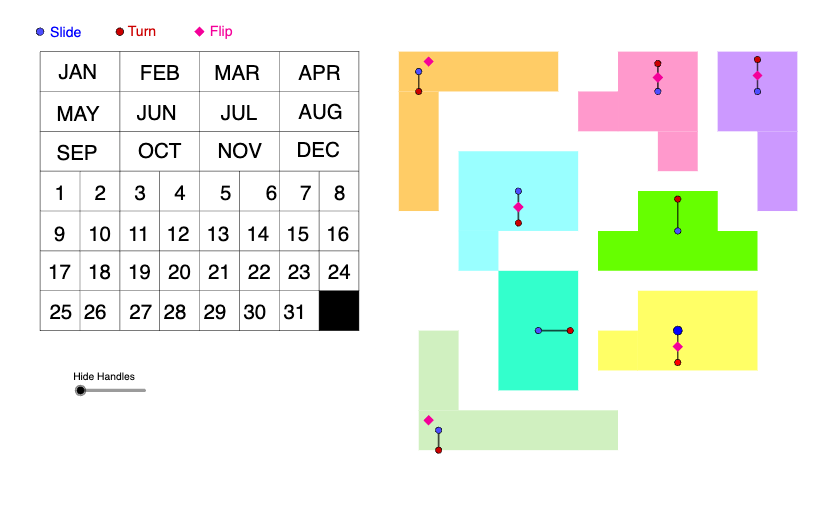
This GeoGebra example visualizes a “Calendar Puzzle” by translating the hidden counting rules into a structured geometric construction, revealing how constrained date patterns lead to predictable outcomes. It centers on combinatorics, the periodic effects of congruence conditions, and conditional probability reasoning under specified constraints. The construction builds a geometric framework using key points and segments, locates intersections and orthogonal directions to pin down critical positions, and then uses circles and polygons to create symmetric constraint regions that model the puzzle’s structure. In GeoGebra, it leverages commands such as Point, Segment, Intersect, Circle, OrthogonalLine, Line, Polygon, and Midpoint, along with many constructed objects (e.g., labeled point sets for the puzzle geometry and derived segments/lines). Suitable for advanced secondary school and early university courses, especially for classroom inquiry, enrichment on congruence-based counting, and geometry-assisted probability thinking.
GeoGebra Commands & Parameters
Point(yAxis) → KPoint(yAxis) → MSegment(J, H) → fSegment(K, M) → gSegment(L, N) → hSegment(G, O) → iSegment(D, C) → kSegment(E, I) → mSegment(F, P) → nSegment(A, B) → pSegment(C, A) → jSegment(D, B) → lPoint(p) → QPoint(p) → RPoint(p) → SIntersect(p, yAxis) → TPoint(p) → UPoint(p) → VPoint(p) → WPoint(i) → A_1Point(i) → B_1Point(i) → C_1Point(j) → D_1Point(j) → E_1Point(l) → G_1Segment(D_1, G_1) → qSegment(E_1, H_1) → rSegment(F_1, I_1) → sSegment(C_1, Q) → tSegment(H, R) → aSegment(B_1, S) → bSegment(M, T) → cSegment(A_1, U) → dSegment(N, V) → eSegment(Z, W) → f_1Circle(J_1, 0.8) → c_1Point(c_1) → K_1Segment(J_1, K_1) → g_1OrthogonalLine(J_1, g_1) → h_1Circle(J_1, 2) → d_1Intersect(d_1, h_1, 2) → L_1Intersect(d_1, h_1, 1) → M_1OrthogonalLine(L_1, h_1) → i_1OrthogonalLine(M_1, h_1) → j_1Circle(L_1, 1) → e_1Circle(M_1, 1) → k_1Intersect(e_1, i_1, 2) → N_1Intersect(e_1, i_1, 1) → O_1Intersect(k_1, j_1, 2) → P_1Intersect(k_1, h_1, 2) → Q_1OrthogonalLine(Q_1, h_1) → l_1Intersect(k_1, j_1, 1) → R_1Line(R_1, h_1) → m_1Line(P_1, h_1) → n_1Intersect(l_1, m_1) → S_1Intersect(l_1, n_1) → T_1Polygon(N_1, T_1, S_1, O_1) → q1, p_1, t_1, s_1, o_1Polygon(P_1, M_1, Q_1, T_1) → q2, q_1, r_1, a_1, b_1Polygon(S_1, R_1, M_1, Q_1) → q3, f_2, g_2, h_2, i_2Midpoint(J_1, K_1) → W_1Circle(U_1, 0.8) → c_2Point(c_2) → Z_1Segment(U_1, Z_1) → j_2OrthogonalLine(U_1, j_2) → k_2Circle(U_1, 1.5) → d_2Intersect(d_2, k_2, 2) → A_2Intersect(d_2, k_2, 1) → B_2Circle(A_2, 1) → e_2OrthogonalLine(A_2, k_2) → l_2Intersect(e_2, l_2, 2) → C_2Intersect(e_2, l_2, 1) → D_2Line(B_2, l_2) → m_2Line(C_2, k_2) → n_2Line(D_2, k_2) → p_2Intersect(m_2, n_2) → E_2Intersect(m_2, p_2) → F_2Polygon(C_2, E_2, F_2, D_2) → q4, q_2, r_2, s_2, t_2Circle(G_2, 0.8) → c_3Point(c_3) → H_2Segment(G_2, H_2) → a_2OrthogonalLine(G_2, a_2) → b_2Circle(G_2, 2) → d_3Intersect(d_3, b_2, 2) → I_2Intersect(d_3, b_2, 1) → J_2Circle(G_2, 1) → e_3Intersect(e_3, b_2, 2) → K_2Intersect(e_3, b_2, 1) → L_2Circle(I_2, 1) → f_3OrthogonalLine(I_2, b_2) → h_3Intersect(f_3, h_3, 2) → M_2Intersect(f_3, h_3, 1) → N_2OrthogonalLine(J_2, b_2) → g_3OrthogonalLine(N_2, h_3) → i_3OrthogonalLine(M_2, h_3) → j_3Intersect(g_3, j_3) → O_2Line(K_2, h_3) → k_3Line(L_2, g_3) → l_3Intersect(i_3, k_3) → P_2Intersect(i_3, l_3) → Q_2Polygon(M_2, I_2, K_2, P_2, Q_2, L_2, J_2, O_2) → poly1, m_3, n_3, p_3, q_3, r_3, s_3, t_3, o_2Circle(R_2, 0.8) → c_4Point(c_4) → S_2Segment(R_2, S_2) → a_3OrthogonalLine(R_2, a_3) → b_3Circle(R_2, 1.5) → d_4Intersect(d_4, b_3, 2) → T_2Intersect(d_4, b_3, 1) → U_2OrthogonalLine(T_2, b_3) → f_4Circle(T_2, 1) → e_4Intersect(e_4, f_4, 2) → V_2Intersect(e_4, f_4, 1) → W_2OrthogonalLine(U_2, b_3) → g_4OrthogonalLine(V_2, f_4) → h_4OrthogonalLine(W_2, f_4) → i_4Intersect(g_4, h_4) → Z_2Intersect(g_4, i_4) → A_3Circle(Z_2, 1) → k_4Intersect(k_4, h_4, 1) → B_3OrthogonalLine(B_3, h_4) → j_4Intersect(i_4, j_4) → C_3Circle(B_3, 1) → p_4Circle(C_3, 1) → q_4Intersect(p_4, j_4, 1) → D_3Intersect(q_4, j_4, 2) → E_3OrthogonalLine(D_3, j_4) → l_4OrthogonalLine(E_3, j_4) → m_4Intersect(g_4, l_4) → F_3Intersect(m_4, g_4) → G_3Polygon(V_2, Z_2, A_3, W_2) → q5, v_2, z_2, n_4, w_2Polygon(D_3, F_3, Z_2, B_3) → q6, r_4, s_4, t_4, a_4Polygon(C_3, A_3, G_3, E_3) → q7, b_4, f_5, g_5, h_5Midpoint(R_2, S_2) → H_3Circle(I_3, 0.8) → c_5Point(c_5) → J_3Segment(I_3, J_3) → i_5OrthogonalLine(I_3, i_5) → j_5Circle(I_3, 1) → d_5Intersect(d_5, j_5, 2) → K_3Intersect(d_5, j_5, 1) → L_3OrthogonalLine(I_3, j_5) → k_5Intersect(d_5, k_5, 2) → M_3Intersect(d_5, k_5, 1) → N_3Line(N_3, j_5) → l_5Line(L_3, k_5) → m_5Line(K_3, k_5) → n_5Line(M_3, j_5) → p_5Intersect(n_5, p_5) → O_3Intersect(l_5, n_5) → P_3Intersect(l_5, m_5) → Q_3Intersect(m_5, p_5) → R_3Circle(R_3, 2) → e_5Intersect(e_5, m_5, 2) → S_3Line(S_3, p_5) → q_5Intersect(k_5, q_5) → T_3Circle(Q_3, 2) → r_5Intersect(r_5, m_5, 1) → U_3Line(U_3, j_5) → s_5Intersect(k_5, s_5) → V_3Polygon(O_3, R_3, Q_3, P_3) → q8, o_3, t_5, a_5, b_5Polygon(N_3, V_3, U_3, Q_3) → q10, i_6, v_3, u_3, j_6Polygon(T_3, M_3, R_3, S_3) → q9, f_6, g_6, h_6, k_6Midpoint(I_3, J_3) → W_3Circle(Z_3, 0.5) → c_6Point(c_6) → A_4Segment(Z_3, A_4) → l_6OrthogonalLine(Z_3, l_6) → m_6Intersect(c_6, m_6, 1) → C_4OrthogonalLine(C_4, m_6) → n_6Circle(C_4, 0.5) → e_6Intersect(e_6, n_6, 2) → D_4Circle(D_4, 4) → d_6Intersect(d_6, n_6, 1) → B_4Line(D_4, m_6) → p_6Intersect(d_6, p_6, 2) → E_4Intersect(c_6, m_6, 2) → F_4Line(F_4, n_6) → q_6Intersect(e_6, n_6, 1) → G_4Line(G_4, m_6) → r_6Line(E_4, q_6) → s_6Intersect(r_6, s_6) → H_4Line(B_4, p_6) → t_6Intersect(q_6, t_6) → I_4Intersect(q_6, r_6) → J_4Polygon(E_4, D_4, G_4, H_4) → q11, a_6, b_6, f_7, g_7Polygon(J_4, G_4, B_4, I_4) → q12, h_7, i_7, j_7, k_7Circle(D_4, 3) → c_7Intersect(c_7, n_6, 2) → K_4Line(K_4, p_6) → l_7Intersect(q_6, l_7) → L_4Intersect(p_6, q_6) → M_4Polygon(L_4, K_4, D_4, M_4) → q13, m_7, n_7, p_7, q_7Midpoint(M_4, Z_3) → N_4Circle(O_4, 0.5) → d_7Point(d_7) → P_4Segment(O_4, P_4) → r_7OrthogonalLine(O_4, r_7) → s_7Intersect(d_7, s_7, 1) → Q_4OrthogonalLine(Q_4, s_7) → t_7Circle(Q_4, 0.5) → e_7Intersect(e_7, t_7, 2) → R_4OrthogonalLine(R_4, t_7) → a_7Circle(R_4, 5) → c_8Intersect(c_8, a_7, 1) → S_4Intersect(e_7, t_7, 1) → T_4Line(T_4, a_7) → b_7Line(S_4, t_7) → f_8Intersect(b_7, f_8) → U_4Circle(R_4, 1) → d_8Intersect(d_8, a_7, 1) → V_4Line(V_4, t_7) → g_8Circle(R_4, 3) → e_8Intersect(e_8, t_7, 1) → W_4Line(W_4, a_7) → h_8Intersect(g_8, h_8) → Z_4Intersect(b_7, g_8) → A_5Polygon(S_4, R_4, T_4, U_4) → q14, i_8, j_8, k_8, u_4Polygon(A_5, Z_4, W_4, T_4) → q15, l_8, z_4, w_4, m_8Circle(R_4, 2) → p_8Intersect(p_8, t_7, 2) → B_5Line(B_5, h_8) → n_8Intersect(g_8, n_8) → C_5Polygon(C_5, B_5, R_4, V_4) → q16, q_8, r_8, s_8, v_4Midpoint(R_4, O_4) → D_5Circle(E_5, 0.7) → t_8Circle(E_5, 1) → c_9Point(t_8) → F_5Segment(E_5, F_5) → a_8OrthogonalLine(E_5, a_8) → b_8Intersect(c_9, b_8, 1) → H_5Intersect(c_9, b_8, 2) → G_5OrthogonalLine(G_5, b_8) → f_9OrthogonalLine(H_5, b_8) → g_9Circle(G_5, 1) → d_9Intersect(d_9, f_9, 2) → I_5Intersect(d_9, f_9, 1) → J_5OrthogonalLine(I_5, f_9) → h_9OrthogonalLine(J_5, f_9) → i_9Intersect(g_9, h_9) → K_5Intersect(g_9, i_9) → L_5Circle(L_5, 1) → e_9Intersect(e_9, g_9, 1) → M_5Intersect(e_9, i_9) → N_5, O_5Intersect(e_9, i_9, 2) → P_5Line(N_5, g_9) → j_9Line(M_5, i_9) → k_9Intersect(k_9, j_9) → Q_5Circle(K_5, 1) → p_9Intersect(p_9, h_9, 2) → R_5Line(R_5, g_9) → l_9Intersect(b_8, l_9) → S_5Polygon(I_5, K_5, L_5, J_5) → q17, m_9, n_9, q_9, r_9Polygon(N_5, Q_5, M_5, L_5) → q18, s_9, t_9, a_9, b_9Polygon(K_5, R_5, S_5, H_5) → q19, f_{10}, g_{10}, h_{10}, i_{10}Intersect(d_9, b_8, 2) → T_5Line(T_5, f_9) → j_{10}Intersect(h_9, j_{10}) → U_5Polygon(U_5, I_5, G_5, T_5) → q20, u_5, k_{10}, l_{10}, m_{10}Intersect(p_9, g_9, 2) → V_5Line(V_5, h_9) → n_{10}Intersect(j_9, n_{10}) → W_5Intersect(h_9, j_9) → Z_5Polygon(W_5, V_5, K_5, Z_5) → q21, w_5, v_5, p_{10}, z_5Midpoint(E_5, F_5) → A_6Intersect(s, f_1) → B_6Polygon(B_6, W, B, I_1) → q22, q_{10}, w, b_{10}, r_{10}
AI Drawing Prompt Reference
Draw a geometric diagram illustrating a calendar puzzle. Start with two perpendicular lines intersecting at a point, creating four quadrants. Mark points on each line and connect them to form multiple segments and triangles. Add circles and squares to create symmetry. Use orthogonal lines to find key points and connect them to form new geometric shapes. The final diagram should reveal periodic patterns and probabilistic relationships under constraints.
The prompt above was compiled from the original drawing commands and is for reference only.