
Constructing Similar Cuboids with 3D Dilation
Loading the math board and drawing, please wait…
In collections
Similar Solids
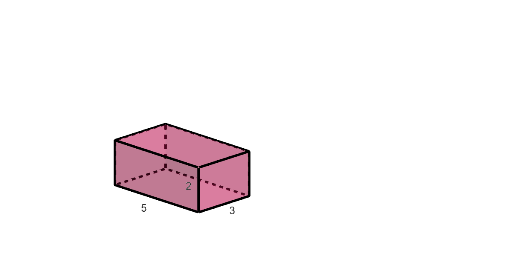
This GeoGebra example demonstrates how to create two similar prisms/cuboids in 3D by using a dilation (geometric scaling) centered at a chosen point. The key mathematical ideas are solid geometry similarity (corresponding edges and faces are proportional) and the dilation transformation that maps one set of vertices to another while preserving the shape up to scale. Construction workflow: Polygon is used to build the base/face polygons (e.g., face1–face4 and faceABCD-type faces), Prism extrudes those polygons into a 3D solid, and Segment draws the corresponding edges (edgeAB, edgeBC, edgeCD, edgeAD and edge1–edge4). PointIn helps specify or verify point locations relative to solids/faces (e.g., reference points such as O, k). Finally, Dilate generates the primed vertex set (A', B', C', D', E', F', G', H', etc.), and the resulting mapped faces/edges form the similar cuboids/prisms. Suitable for high-school advanced geometry and early undergraduate geometry, especially for transformation-based learning and interactive modeling.
GeoGebra Commands & Parameters
Polygon(E, F, G, H) → q1, f, g, h, iPrism(q1, 2) → a, A, edge1, edge2, edge3, edge4, edgeAB, edgeBC, edgeCD, edgeAD, B, C, D, face1, face3, face4, face2, faceABCDPointIn(Polygon[(2.5, -8, 0), (2.5, 0, 0), (0, 0, 0), (0, -8, 0)]) → ODilate(a, k, O) → a'Dilate(A, k, O) → A'Dilate(B, k, O) → B'Dilate(C, k, O) → C'Dilate(D, k, O) → D'Dilate(E, k, O) → E'Dilate(F, k, O) → F'Dilate(G, k, O) → G'Dilate(H, k, O) → H'Segment(O, If[k ≤ 1, A, A']) → jSegment(O, If[k ≤ 1, B, B']) → lSegment(O, If[k ≤ 1, C, C']) → mSegment(O, If[k ≤ 1, D, D']) → nSegment(O, If[k ≤ 1, E, E']) → pSegment(O, If[k ≤ 1, F, F']) → qSegment(O, If[k ≤ 1, G, G']) → rSegment(O, If[k ≤ 1, H, H']) → sDilate(a, k, O) → a''Dilate(E, k, O) → E'_{1}Dilate(F, k, O) → F'_{1}Segment(E'_{1}, F'_{1}) → f'Dilate(F, k, O) → F'_{2}Dilate(G, k, O) → G'_{1}Segment(F'_{2}, G'_{1}) → g'Dilate(G, k, O) → G'_{2}Dilate(H, k, O) → H'_{1}Dilate(F, k, O) → F'_{3}Dilate(B, k, O) → B'_{1}Segment(F'_{3}, B'_{1}) → edge2'
AI Drawing Prompt Reference
In 3D space, first draw a quadrilateral and extrude it to form a prism. Then, select a center point as the scaling center. Apply a dilation transformation to the prism to obtain a similar prism. Draw line segments connecting corresponding vertices to show the correspondence before and after dilation. Finally, connect the dilated vertices with line segments to form a new similar prism, highlighting the center point, corresponding edges, and proportional faces to demonstrate similarity and the effect of the dilation transformation.
The prompt above was compiled from the original drawing commands and is for reference only.