
Geometric Construction of Similar Cones via Dilation
Loading the math board and drawing, please wait…
In collections
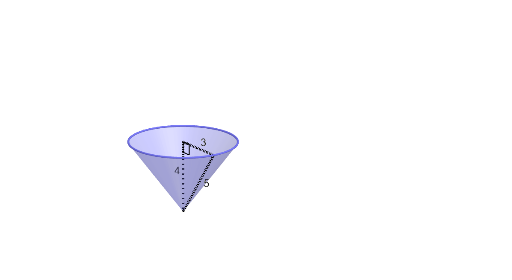
Similar Solids
This example demonstrates how to construct a cone that is similar to a given one by applying a dilation (scaling) transformation. It highlights that the key angular relationships (e.g., the corresponding vertex/top angle or the angle between characteristic line segments) are preserved under the similarity ratio, while the cone’s size changes consistently. The main math ideas are 3D solid geometry, similarity of solids, and geometric transformations—especially dilation about a center. Construction details in GeoGebra: Points are defined with the Point tool to set the needed reference geometry; Cone is used to create the original cone; Dilate generates the corresponding similar cone using a scale factor; Segment provides the defining/visual line segments (such as generators or cross-sections); and Angle is used to measure or display the crucial angles that confirm the similarity behavior. The construction uses objects like the central/reference points and their dilated counterparts (e.g., V, A, B and V', A', B'), along with angle parameters and labels. Suitable for late secondary school through early college, especially for teaching and exploring similarity in solid geometry and transformation-based reasoning.
GeoGebra Commands & Parameters
Point(Segment[(0, -10, 0), (0, 0, 0)]) → OCone(A, V, 3) → a, c, bDilate(V, k, O) → V'Dilate(A, k, O) → A'Dilate(B, k, O) → B'Segment(A', B') → fCone(A', V', f) → d, e, gDilate(C, k, O) → C'Segment(O, If[k ≤ 1, C, C']) → hSegment(O, If[k ≤ 1, V, V']) → iSegment(O, If[k ≤ 1, B, B']) → jSegment(A, B) → lSegment(B, V) → mSegment(V, A) → nSegment(A', V') → pSegment(A', B') → qSegment(B', V') → rAngle(V', A', B') → αAngle(V, A, B) → β
AI Drawing Prompt Reference
Draw a 3D cone with its apex and base center on a vertical line, and mark two points on the base circle. Using the base center as the dilation center, scale the apex and the base reference points by a common factor to create a second, similar cone. Connect corresponding apexes and base points with line segments, and display the angles at the apexes formed by the base reference points to show that the angles are preserved under the similarity transformation.
The prompt above was compiled from the original drawing commands and is for reference only.