
Spherical Ball Structure via Intersecting Circles and Rotations
Loading the math board and drawing, please wait…
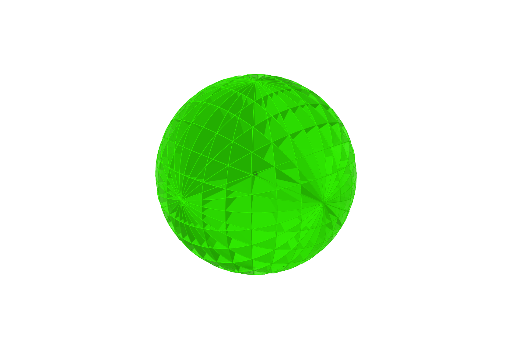
This example demonstrates how to build a symmetric “ball structure” on (or via sections of) a sphere by generating families of intersecting circles and the resulting intersection points and angle relationships. The key mathematical ideas include circle/sphere geometry (using circular sections to represent spherical features), plane–sphere intersection behavior, inscribed-circle concepts via constraints from the geometry, angle formation from intersecting loci, and the way rotational symmetry produces repeated structural patterns. Construction-wise, it uses GeoGebra commands Intersect, Circle, and Rotate: Circle is used to create the initial set of circles (e.g., c, d, e and related objects), Intersect is then applied to compute crucial intersection points that determine the network (such as p, q, r and their corresponding primed variants), and Rotate generates additional circles/points (e′, e″, e‴, f′, c′, d′, d″, d‴, etc.) by rotating existing geometry to form the full symmetric spherical arrangement. Suitable for secondary geometry, contest preparation, and lessons on solid/three-dimensional geometry with construction and transformation.
GeoGebra Commands & Parameters
Intersect(xAxis, yAxis) → ACircle(A, 1, xAxis) → cCircle(A, 1, zAxis) → dCircle(A, 1, yAxis) → eRotate(e, 15°, zAxis) → e'Rotate(e', 15°, zAxis) → e''Rotate(e'', 15°, zAxis) → e'''Rotate(e''', 15°, zAxis) → fRotate(f, 15°, zAxis) → f'Rotate(c, 15°, yAxis) → c'Rotate(c', 15°, yAxis) → c''Rotate(c'', 15°, yAxis) → c'''Rotate(c''', 15°, yAxis) → gRotate(g, 15°, yAxis) → g'Rotate(g', 30°, yAxis) → g''Rotate(g'', 15°, yAxis) → g'''Rotate(g''', 15°, yAxis) → hRotate(h, 15°, yAxis) → h'Rotate(h', 15°, yAxis) → h''Rotate(e, -15°, zAxis) → e'_{1}Rotate(e'_{1}, -15°, zAxis) → kRotate(k, -15°, zAxis) → k'Rotate(k', -15°, zAxis) → k''Rotate(k'', -15°, zAxis) → k'''Rotate(k''', -15°, zAxis) → pRotate(d, 15°, xAxis) → d'Rotate(d', 15°, xAxis) → d''Rotate(d'', 15°, xAxis) → d'''Rotate(d''', 15°, xAxis) → qRotate(q, 15°, xAxis) → q'Rotate(q', 30°, xAxis) → q''Rotate(q'', 15°, xAxis) → q'''Rotate(q''', 15°, xAxis) → rRotate(r, 15°, xAxis) → r'Rotate(r', 15°, xAxis) → r''
AI Drawing Prompt Reference
Draw a symmetric spherical ball structure by generating families of intersecting circles on a sphere. Start with three mutually perpendicular circles, then rotate them around the Z and Y axes to create a series of new circles. Next, find the intersection points of these circles and use them to rotate and generate more circles and points. The final result is a complex network of circles and intersection points that highlights the symmetry and geometric relationships of the sphere.
The prompt above was compiled from the original drawing commands and is for reference only.