
Geometry-based construction for optimization and fitting: cone-related configura
Loading the math board and drawing, please wait…
In collections
Simplifying Radicals: Geometric Thin Slice
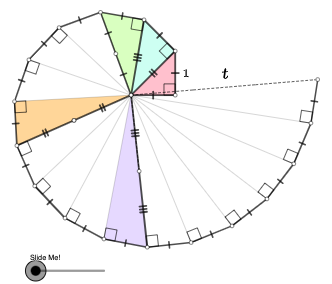
This GeoGebra example uses a sequence of linked geometric constructions and parameter-driven transformations to illustrate how circle/line interactions and polygonal scaffolds can be assembled into a configuration suited for optimization and intuitive fitting (including a linear-regression style modeling mindset). It centers on core ideas such as: constructing intersections between circles and lines, measuring angles, using perpendicular constraints, representing relationships with vectors, and deriving meaningful target quantities from the geometry. Key construction workflow: Polygon, Segment, Line, and Point build the base geometric framework; OrthogonalLine introduces right-angle constraints; Circle together with Intersect computes intersection points; Angle captures critical angular features; Midpoint provides averaged geometric quantities; Rotate, Translate, Dilate, and Vector implement rotation, translation, scaling, and directional relationships. The model also includes parameter-like objects (e.g., A, B, C, t1, c, d, E, I, etc.) to maintain dependencies among quantities so that the configuration evolves consistently, supporting a geometry-to-objective approach. Suitable for high school through early university levels, especially for lessons on geometric construction, solid/solid-to-planar reasoning, and introductory optimization/fitting concepts.
GeoGebra Commands & Parameters
Polygon(A, B, C) → t1, c, a, bOrthogonalLine(C, b) → fCircle(C, 1) → dIntersect(d, f, 1) → DSegment(A, D) → gOrthogonalLine(D, g) → hCircle(D, 1) → eIntersect(e, h, 2) → ESegment(A, E) → iOrthogonalLine(E, i) → jCircle(E, 1) → kIntersect(k, j, 2) → FSegment(A, F) → lOrthogonalLine(F, l) → mCircle(F, 1) → pIntersect(p, m, 2) → GSegment(A, G) → nOrthogonalLine(G, n) → qCircle(G, 1) → rIntersect(r, q, 2) → HSegment(A, H) → sOrthogonalLine(H, s) → tCircle(H, 1) → c_1Intersect(c_1, t, 2) → ISegment(A, I) → f_1OrthogonalLine(I, f_1) → g_1Circle(I, 1) → d_1Intersect(d_1, g_1, 2) → JSegment(A, J) → h_1OrthogonalLine(J, h_1) → i_1Circle(J, 1) → e_1Intersect(e_1, i_1, 2) → KSegment(A, K) → j_1OrthogonalLine(K, j_1) → k_1Circle(K, 1) → p_1Intersect(p_1, k_1, 2) → LSegment(A, L) → l_1OrthogonalLine(L, l_1) → m_1Circle(L, 1) → q_1Intersect(q_1, m_1, 2) → MSegment(A, M) → n_1OrthogonalLine(M, n_1) → r_1Circle(M, 1) → s_1Intersect(s_1, r_1, 2) → NSegment(A, N) → t_1OrthogonalLine(N, t_1) → a_1Circle(N, 1) → c_2Intersect(c_2, a_1, 2) → OSegment(A, O) → b_1OrthogonalLine(O, b_1) → f_2Circle(O, 1) → d_2Intersect(d_2, f_2, 2) → PSegment(A, P) → g_2OrthogonalLine(P, g_2) → h_2Circle(P, 1) → e_2Intersect(e_2, h_2, 2) → QSegment(A, Q) → i_2OrthogonalLine(Q, i_2) → j_2Circle(Q, 1) → k_2Intersect(k_2, j_2, 2) → RSegment(A, R) → l_2Segment(C, D) → m_2Segment(D, E) → n_2Segment(E, F) → p_2Segment(F, G) → q_2Segment(G, H) → r_2Segment(H, I) → s_2Segment(I, J) → t_2Segment(J, K) → a_2Segment(K, L) → b_2Segment(L, M) → f_3Segment(M, N) → g_3Segment(N, O) → h_3Segment(O, P) → i_3Segment(P, Q) → j_3Segment(Q, R) → k_3Angle(C, B, A) → αAngle(D, C, A) → βAngle(E, D, A) → γAngle(F, E, A) → δAngle(G, F, A) → εAngle(H, G, A) → ζAngle(I, H, A) → ηAngle(J, I, A) → θAngle(K, J, A) → ιAngle(L, K, A) → κAngle(M, L, A) → λAngle(N, M, A) → μAngle(O, N, A) → νAngle(P, O, A) → ξAngle(Q, P, A) → οAngle(R, Q, A) → ρSegment(A, B) → l_3Segment(C, B) → m_3Segment(C, A) → n_3RotateText(text1_{1}, atand(Slope[n_3])) → text2RotateText(text3, atand(Slope[g])) → text4Midpoint(f_1) → SMidpoint(n_1) → TRotateText(text5, pi / 4) → text6RotateText(text7, atan(Slope[g])) → text8RotateText(text9, atand(Slope[i])) → text10Rotate(D, If[0 < o ≤ 1, ((-o) * pi / 3), ((-pi)) / 3], E) → D'Rotate(E, If[0 < o ≤ 1, ((-o) * pi / 3), ((-pi)) / 3], E) → E'Segment(D', E') → p_3Rotate(D', If[1 < o ≤ 2, ((-(o - 1)) * pi), (-pi)], D') → D''Rotate(E', If[1 < o ≤ 2, ((o - 1) * pi), pi], D') → E''Segment(D'', E'') → q_3Dilate(A, If[3 < o ≤ 4, 4 - o, 0], I) → A'Vector(A, A') → uTranslate(C, u) → C'Translate(A, u) → A'_{1}Segment(C', A'_{1}) → r_3Translate(C, u) → C'_{1}Angle(A, I, C'_{1}) → σRotate(C', If[4 < o ≤ 5, ((-(o - 4)) * σ), (-σ)], I) → C''Rotate(A'_{1}, If[4 < o ≤ 5, ((-(o - 4)) * σ), (-σ)], I) → USegment(C'', U) → s_3Segment(A, S) → t_3Segment(S, I) → a_3Rotate(C'', If[5 < o ≤ 6, ((o - 5) * pi), pi], S) → C'''Rotate(U, If[5 < o ≤ 6, ((o - 5) * pi), pi], S) → U'Segment(C''', U') → b_3Angle(I, A, M) → τRotate(U', If[7 < o ≤ 8, ((o - 7) * τ), τ], A) → U''Dilate(A, If[7 < o ≤ 8, 8 - o, 0], M) → A'_{2}Vector(A, A'_{2}) → vTranslate(A, v) → A'_{3}Translate(D, v) → D'_{1}Segment(A'_{3}, D'_{1}) → g'Segment(M, T) → c_3Segment(T, A) → d_3Line(M, A) → e_3Point(e_3) → VAngle(D, A, V) → χRotate(A'_{3}, If[8 < o ≤ 9, ((o - 8) * χ), χ], M) → WRotate(D'_{1}, If[8 < o ≤ 9, ((o - 8) * χ), χ], M) → ZSegment(W, Z) → g''Rotate(W, If[9 < o ≤ 10, ((o - 9) * pi), pi], Z) → W'Rotate(Z, If[9 < o ≤ 10, ((o - 9) * pi), pi], Z) → Z'Segment(W', Z') → g'''Polygon(A, B, C) → t2, c_4, a_4, b_4Polygon(A, C, D) → t3, d_4, a_5, c_5Polygon(A, D, E) → t4, e_4, a_6, d_5OrthogonalLine(R, l_2) → f_4Circle(R, 1) → g_4Intersect(g_4, f_4, 2) → A_1Segment(A, A_1) → h_4Segment(A_1, R) → i_4Angle(A_1, R, A) → υCircle(A, Distance[A, C]) → k_4Intersect(k_4, h_4, 1) → B_1Circle(B_1, Distance[A, C]) → p_4Intersect(p_4, h_4, 2) → C_1Segment(A, B_1) → j_4Segment(B_1, C_1) → l_4Segment(C_1, A_1) → m_4Polygon(A, H, I) → t5, i_5, a_7, h_5Polygon(A, L, M) → t6, m_5, a_8, l_5Line(A_1, A) → n_4Point(n_4) → D_1Angle(C, A, D_1) → ϕDilate(A, If[11 < o ≤ 12, 12 - o, 0], C_1) → A'_{4}Vector(A, A'_{4}) → wTranslate(C, w) → C'_{2}Translate(A, w) → A'_{5}Segment(C'_{2}, A'_{5}) → q_4Angle(A_1, A'_{4}, C'_{2}) → ψRotate(C'_{2}, If[12 < o ≤ 13, ((o - 12) * ϕ), ϕ], C_1) → E_1Rotate(A'_{5}, If[12 < o ≤ 13, ((o - 12) * ϕ), ϕ], C_1) → F_1Segment(E_1, F_1) → r_4Rotate(E_1, If[13 < o ≤ 14, ((-(o - 13)) * pi), (-pi)], A'_{5}) → G_1Rotate(F_1, If[13 < o ≤ 14, ((-(o - 13)) * pi), (-pi)], A'_{5}) → H_1Segment(G_1, H_1) → s_4Rotate(E_1, If[14 < o ≤ 15, ((o - 14) * pi), pi], E_1) → I_1Rotate(F_1, If[14 < o ≤ 15, ((o - 14) * pi), pi], E_1) → J_1Segment(I_1, J_1) → t_4RotateText(text12, atand(Slope[l_4])) → text13
AI Drawing Prompt Reference
Start from a base triangle defined by three points, forming a polygon. From one vertex, draw a line perpendicular to the associated side, then construct a circle centered at that vertex with radius 1 and intersect it with the perpendicular line to obtain a new point. Connect this point back to the corresponding original vertex with a segment, erect a perpendicular line to that segment, and again take intersections between the perpendicular line and a circle centered at the new circle point with radius 1 (using the given intersection multiplicity order). Repeat this chained workflow—circle/line intersections, segment connection, then a perpendicular constraint—creating a sequence of points connected by segments emanating from the original reference vertex, capturing the key angle-related geometric configuration for optimization/fitting.
The prompt above was compiled from the original drawing commands and is for reference only.