
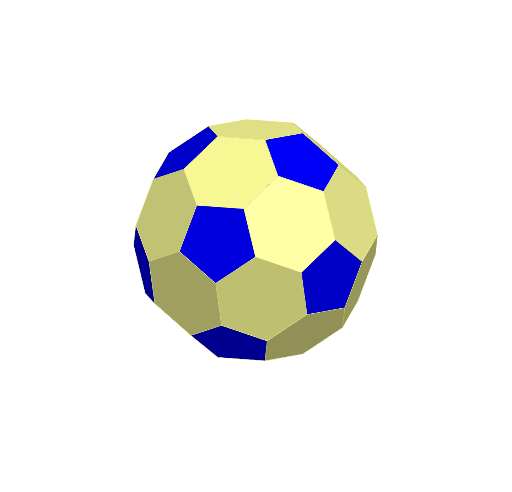
Truncated Icosahedron
Loading the math board and drawing, please wait…
In collections
Archimedean Solids
This example demonstrates the 3D geometric shape of a truncated icosahedron and its properties. Key math concepts include polygons, solid geometry, and geometric construction. Construction highlights involve commands like Polygon, Icosahedron, Sphere, Intersect, Line, and Rotate in GeoGebra. Suitable for high school and above students to learn complex 3D geometric shapes and their construction.
GeoGebra Commands & Parameters
Polygon(A, B, 3, xOyPlane) → poly1, f, g, h, CIcosahedron(poly1, true) → a, D, faceACF, faceAFG, faceADG, faceABD, faceBDH, faceBEH, faceBCE, faceCEI, faceCFI, faceEHK, E, faceEIK, faceIKL, faceFIL, faceHJK, faceJKL, faceGJL, faceFGL, faceDHJ, faceDGJ, edgeAF, F, edgeCF, edgeAG, edgeFG, edgeAD, edgeDG, edgeBD, edgeBH, edgeDH, edgeBE, edgeEH, G, edgeCE, edgeCI, edgeEI, edgeFI, edgeEK, edgeHK, edgeIK, edgeIL, edgeKL, edgeFL, H, edgeJK, edgeHJ, edgeJL, edgeGL, edgeGJ, edgeDJ, I, J, K, LSphere(L, d) → cIntersect(edgeGL, c) → M,Intersect(edgeFL, c) → N,Intersect(edgeJL, c) → O,Intersect(edgeIL, c) → P,Intersect(edgeKL, c) → Q,Line(J, C) → iPolygon(O, Q, P, N, M) → poly2, o, q, p, n, mRotate(poly2, -72°, i) → poly2'Rotate(poly2, -144°, i) → poly2'_{1}Sphere(B, d) → eIntersect(edgeBE, e) → R,Intersect(g, e) → S,Intersect(edgeBH, e) → T,Intersect(edgeBD, e) → U,Intersect(f, e) → V,Polygon(V, S, R, T, U) → poly3, v, s, r, t, uRotate(poly3, 72°, i) → poly3'Rotate(poly3, 144°, i) → poly3'_{1}Rotate(poly3, -72°, i) → poly3'_{2}Sphere(J, d) → jIntersect(edgeGJ, j) → W,Intersect(edgeHJ, j) → Z,Intersect(edgeJK, j) → A_1,Intersect(edgeJL, j) → B_1,Intersect(edgeDJ, j) → C_1,Polygon(W, C_1, Z, A_1, B_1) → poly5, w, c_1, z_1, a_1, b_1Sphere(C, d) → kIntersect(g, k) → D_1,Intersect(h, k) → E_1,Intersect(edgeCE, k) → F_1,Intersect(edgeCI, k) → G_1,Intersect(edgeCF, k) → H_1,Polygon(F_1, D_1, E_1, H_1, G_1) → poly6, f_1, d_1, e_1, h_1, g_1Rotate(M, -72°, i) → M'Rotate(M, -144°, i) → M'_{1}Rotate(Q, -72°, i) → Q'Rotate(Q, -144°, i) → Q'_{1}Rotate(O, -72°, i) → O'Rotate(O, -144°, i) → O'_{1}Rotate(P, -72°, i) → P'Rotate(P, -144°, i) → P'_{1}Rotate(N, -72°, i) → N'Rotate(N', -72°, i) → N''Rotate(N'', -72°, i) → N'''Polygon(Q'_{3}, P'_{3}, N''', M'_{3}, O'_{3}) → poly7, q'_{3}, p'_{3}, n''', m'_{3}, o'_{3}Rotate(N''', -72°, i) → I_1Polygon(Q'_{2}, P'_{2}, I_1, M'_{2}, O'_{2}) → poly8, q'_{2}, p'_{2}, i_1, m'_{2}, o'_{2}Rotate(R, -72°, i) → R'Rotate(R, -144°, i) → R'_{1}Rotate(T, -72°, i) → T'Rotate(T, -144°, i) → T'_{1}Rotate(V, -72°, i) → V'Rotate(V, -144°, i) → V'_{1}Rotate(V, 72°, i) → V'_{2}Rotate(V, 144°, i) → V'_{3}Rotate(V, 72°, i) → V'_{4}Rotate(V, 144°, i) → V'_{5}Rotate(V, -72°, i) → V'_{6}Rotate(V, 72°, i) → V'_{7}Rotate(S, -72°, i) → S'Rotate(S, -72°, i) → S'_{1}Rotate(S, 72°, i) → S'_{2}Rotate(S'_{2}, 72°, i) → K_1Rotate(K_1, 72°, i) → L_1Rotate(poly3'_{2}, -72°, i) → poly4Polygon(M'_{2}, I_1, U''', T'_{1}, P, Q) → poly9, l, j_1, u''', t'_{1}, p_1, q_1Rotate(poly9, -72°, i) → poly9'Rotate(poly9, -144°, i) → poly9'_{1}Polygon(P'_{3}, T, R, V'_{6}, J_1, N''') → poly10, k_1, t_1, r_1, v'_{6}, l_1, m_1Rotate(poly10, -72°, i) → poly10'Rotate(poly10, -144°, i) → poly10'_{1}Polygon(W, O', M', Q'_{1}, O'_{1}, C_1) → poly11, w_1, o', m', q'_{1}, o'_{1}, n_1Rotate(poly11, -144°, i) → poly11'Rotate(poly11, -72°, i) → poly11'_{1}Polygon(K_1, H_1, E_1, S'_{2}, V'_{7}, R'_{3}) → poly12, s_1, f_2, g_2, s'_{2}, v'_{7}, r'_{3}Rotate(poly12, 72°, i) → poly12'Rotate(poly12, -72°, i) → poly12'_{1}Rotate(poly12'_{1}, 72°, i) → poly13Rotate(poly11', -72°, i) → poly11''Rotate(poly11'', -72°, i) → poly11'''Rotate(poly9'_{1}, -72°, i) → poly14Rotate(poly14, -72°, i) → poly14'Rotate(poly12'_{1}, -72°, i) → poly16Rotate(poly16, -72°, i) → poly16'Rotate(poly10'_{2}, -72°, i) → poly15Rotate(poly10, 72°, i) → poly10'_{3}Rotate(poly10'_{3}, 72°, i) → poly17
AI Drawing Prompt Reference
Draw a truncated icosahedron by first creating a triangle and generating an icosahedron, then drawing spheres and finding their intersections with the icosahedron. Rotate and construct multiple pentagons through intersection operations, and finally combine these pentagons to form the complete shape of the truncated icosahedron.
The prompt above was compiled from the original drawing commands and is for reference only.