
Scalar Triple Product to Build the Volume of a Parallelepiped
Loading the math board and drawing, please wait…
In collections
Vector Mechanics & Statics
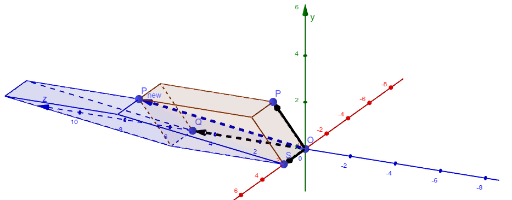
This example demonstrates how the scalar triple product of three vectors determines the volume of a parallelepiped, using shifting/offset vectors to reveal the geometric meaning behind the computed volume. It centers on key ideas such as vector dot and cross products, the definition and interpretation of the scalar triple product, the role of a normal (perpendicular) direction in expressing volume as base area times height, and the construction of a 3D parallelepiped from its generating vectors. Construction-wise, the diagram is assembled from polygons (Polygon) using points like P, S, Q, O, A, B, C, D to form the faces, while vector objects (Vector) such as q, a, s, o, b, c, d encode the directions and shifts that position the vertices consistently. The resulting solid gives an intuitive bridge between vector algebra and solid geometry. Suitable for high school enrichment and early undergraduate linear algebra/solid geometry lessons, as well as self-study and interactive classroom demonstrations.
GeoGebra Commands & Parameters
Polygon(A, S, O, Q) → q1, a, s, o, qPolygon(A, S, C, D) → q2, a_1, s_1, c, dPolygon(O, S, C, P) → q3, o_1, s_2, c_1, pPolygon(B, D, C, P) → q4, b, d_1, c_2, p_1Polygon(Q, O, P, B) → q5, q_1, o_2, p_2, b_1Polygon(Q, A, D, B) → q6, q_2, a_2, d_2, b_2Vector(O, P) → uVector(O, S) → vVector(O, Q) → wVector(O, P_{new}) → ePolygon(E, G, F, P_{new}) → q7, e_1, g, f, p_{new}Polygon(Q, A, G, E) → q8, q_3, a_3, g_1, e_2Polygon(S, A, G, F) → q11, s_4, a_4, g_2, f_2Polygon(Q, A, G, E) → q12, q_5, a_5, g_3, e_4Polygon(O, Q, E, P_{new}) → q9, o_3, q_4, e_3, hPolygon(O, S, F, P_{new}) → q10, o_4, s_3, f_{3}, i
AI Drawing Prompt Reference
Draw a 3D parallelepiped to demonstrate the relationship between scalar triple product and volume. Start with a quadrilateral on the base plane formed by points O, Q, A, and S as vertices. From point O, create three direction vectors pointing to P, S, and Q respectively, which will define the three edges of the parallelepiped. Complete the remaining four faces in space so that the solid is enclosed by six parallelogram faces. Highlight the base area (spanned by two vectors) and the corresponding height (projection of the third vector onto the normal direction) to visually show that volume equals base area times height.
The prompt above was compiled from the original drawing commands and is for reference only.