
Truncated Dodecahedron
Loading the math board and drawing, please wait…
In collections
Archimedean Solids
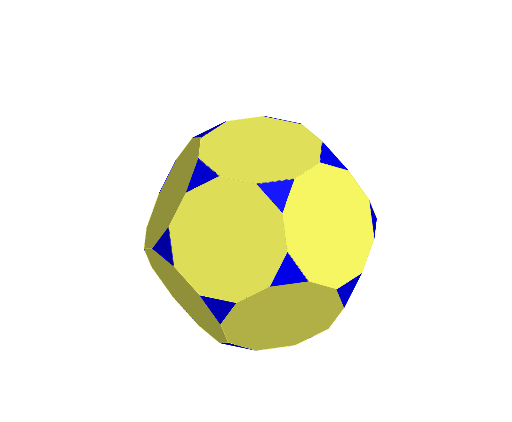
This example demonstrates the construction of a truncated dodecahedron, a polyhedron consisting of 12 regular pentagons and 20 equilateral triangles. Using GeoGebra commands such as Polygon, Line, Rotate, Midpoint, OrthogonalLine, Centroid, and Intersect, the faces of the truncated dodecahedron can be constructed. Suitable for high school mathematics education and students learning solid geometry.
GeoGebra Commands & Parameters
Polygon(A, B, 10, xOyPlane) → poly1, f, p, C, D, E, F, G, H, I, J, g, h, i, j, k, l, m, nPolygon(G, F, 3, xOyPlane) → poly2, q, r, s, KLine(G, F) → tRotate(poly2, 180° - 142.62°, t) → poly2'Rotate(K, 180° - 142.62°, t) → K'Midpoint(H, C) → LOrthogonalLine(L, xOyPlane) → aRotate(poly2', 72°, a) → poly2''Rotate(K', 72°, a) → K''Rotate(poly2', 144°, a) → poly2''_{1}Rotate(K', 144°, a) → K''_{1}Rotate(poly2', -72°, a) → poly2''_{2}Rotate(K', -72°, a) → K''_{2}Rotate(poly2', -144°, a) → poly2''_{3}Line(H, G) → bRotate(poly1, -116.57°, b) → poly1'Rotate(poly1', 72°, a) → poly1''Rotate(poly1', 144°, a) → poly1''_{1}Rotate(poly1', -72°, a) → poly1''_{2}Rotate(poly1', -144°, a) → poly1''_{3}Rotate(J, -116.57°, b) → J'Rotate(A, -116.57°, b) → A'Rotate(B, -116.57°, b) → B'Rotate(C, -116.57°, b) → C'Rotate(D, -116.57°, b) → D'Rotate(E, -116.57°, b) → E'Centroid(poly1'') → MOrthogonalLine(M, poly1'') → cIntersect(a, c) → NOrthogonalPlane(N, a) → p_1Rotate(D', -72°, a) → D''Rotate(C', -72°, a) → C''Rotate(B', -72°, a) → B''Rotate(A', -72°, a) → A''Rotate(E', -72°, a) → E''Rotate(K''_{2}, -72°, a) → ORotate(E'', -72°, a) → E'''Rotate(D'', -72°, a) → D'''Rotate(C'', -72°, a) → C'''Rotate(B'', -72°, a) → B'''Rotate(A'', -72°, a) → A'''Rotate(A', 72°, a) → A''_{1}Rotate(B', 72°, a) → B''_{1}Rotate(C', 72°, a) → C''_{1}Rotate(D', 72°, a) → D''_{1}Rotate(J', 72°, a) → J''Rotate(A''_{1}, 72°, a) → PRotate(B''_{1}, 72°, a) → QRotate(C''_{1}, 72°, a) → RRotate(D''_{1}, 72°, a) → SLine(Q, P) → dRotate(poly1''_{1}, 116.57°, d) → poly3OrthogonalPlane(N, a) → q_1Mirror(poly1, q_1) → poly1'_{1}Rotate(poly3, 72°, a) → poly3'Rotate(poly3', 72°, a) → poly3''Rotate(poly3, -72°, a) → poly3'_{1}Rotate(poly3'_{1}, -72°, a) → poly4Rotate(C'', -36°, c) → C'''_{1}Rotate(C'''_{1}, -36°, c) → TRotate(T, -36°, c) → T'Rotate(T', -36°, c) → T''Rotate(T', 36°, a) → T''_{1}Rotate(T''_{1}, 36°, a) → URotate(U, 36°, a) → U'Rotate(U', 36°, a) → U''Rotate(U'', 36°, a) → U'''Rotate(U''', 36°, a) → VRotate(V, 36°, a) → V'Rotate(V', 36°, a) → V''Centroid(poly3'_{1}) → WOrthogonalLine(W, poly3'_{1}) → eRotate(R, -36°, e) → R'Rotate(R', -36°, e) → R''Rotate(R'', 72°, a) → R'''Rotate(R'', 144°, a) → R'''_{1}Rotate(R'', -72°, a) → R'''_{2}Rotate(R'', -144°, a) → R'''_{3}Rotate(C'''_{1}, 72°, a) → ZRotate(C'''_{1}, 144°, a) → A_1Rotate(C'''_{1}, -72°, a) → B_1Rotate(C'''_{1}, -144°, a) → C_1Polygon(A''_{1}, J'', S) → t1, s_1, a''_{1}, j''Rotate(t1, 72°, a) → t1'Rotate(t1, 144°, a) → t1'_{1}Rotate(t1, -72°, a) → t1'_{2}Rotate(t1, -144°, a) → t1'_{3}Polygon(C'''_{1}, C'', B'') → t2, b'', c'''_{1}, c''Rotate(t2, 72°, a) → t2'Rotate(t2, 144°, a) → t2'_{1}Rotate(C'', -72°, a) → C'''_{2}Rotate(t2, -144°, a) → t2'_{2}Rotate(t2'_{2}, 72°, a) → t3Polygon(V, R'', V') → t4, v', v, r''Rotate(t4, 72°, a) → t4'Rotate(t4, 144°, a) → t4'_{1}Rotate(t4, -72°, a) → t4'_{2}Rotate(t4, -144°, a) → t4'_{3}
AI Drawing Prompt Reference
Draw a truncated dodecahedron consisting of 12 regular pentagons and 20 equilateral triangles. Start by creating a regular pentagon, then rotate a combination of one pentagon and one triangle around one of its edges to form a face adjacent to the pentagon. Continue rotating this combination around the pentagon at equal intervals to build the basic structure of the truncated dodecahedron. Finally, adjust the positions and angles of the faces to form a complete polyhedron.
The prompt above was compiled from the original drawing commands and is for reference only.