
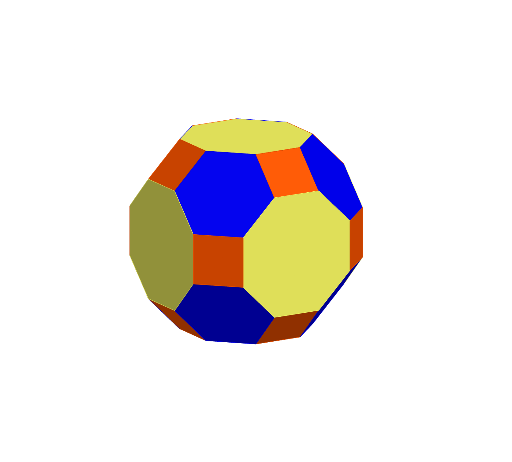
Truncated Cuboctahedron
Loading the math board and drawing, please wait…
In collections
Archimedean Solids
This example demonstrates the construction of a truncated cuboctahedron, a polyhedron formed by truncating the vertices of a cube. Key mathematical concepts include solid geometry and geometric construction. Commands used include Polygon, Line, Rotate, Ray, Sphere, Intersect, Centroid, OrthogonalLine, Plane, Midpoint, OrthogonalPlane, Mirror. Suitable for high school or university solid geometry courses.
GeoGebra Commands & Parameters
Polygon(A, B, 8, xOyPlane) → poly1, f, D, E, F, G, H, g, h, i, j, k, l, m, CLine(D, C) → nRotate(H, -135°, n) → H'Rotate(G, -135°, n) → G'Ray(D, G') → pRay(C, H') → qSphere(D, C) → aSphere(C, D) → bIntersect(p, a) → I,Intersect(q, b) → J,Polygon(I, J, C, D) → q1, i_1, j_1, c, dCentroid(poly1) → KOrthogonalLine(K, poly1) → rRotate(q1, 90°, r) → q1'Rotate(q1, 180°, r) → q1'_{1}Rotate(q1, 270°, r) → q1'_{2}Rotate(I, 90°, r) → I'Rotate(I, 180°, r) → I'_{1}Rotate(I, 270°, r) → I'_{2}Rotate(J, 90°, r) → J'Rotate(J, 90°, r) → J'_{1}Rotate(J, 180°, r) → J'_{2}Rotate(J, 270°, r) → J'_{3}Plane(J'_{2}, G, F) → p_1Plane(J'_{2}, F, I') → q_1Midpoint(J'_{2}, I') → LOrthogonalLine(L, q_1) → sRotate(J'_{2}, -60°, s) → MRotate(J'_{2}, -120°, s) → NPolygon(J'_{2}, G, F, I', N, M) → poly2, j'_{2}, g_1, f_1, i', n_1, m_1Rotate(poly2, 90°, r) → poly2'Rotate(poly2, 180°, r) → poly2'_{1}Rotate(poly2, 270°, r) → poly2'_{2}Rotate(N, -90°, r) → N'Rotate(M, -90°, r) → M'Rotate(N', -90°, r) → N''Rotate(M', -90°, r) → M''Rotate(M'', -90°, r) → M'''Rotate(N'', -90°, r) → N'''Plane(N'', I'_{2}, J'_{3}) → r_1Centroid(poly2') → OOrthogonalLine(O, poly2') → tIntersect(t, r) → POrthogonalLine(L, poly2) → eOrthogonalPlane(P, r) → p_2Mirror(poly1, p_2) → poly1'Mirror(poly2'_{2}, p_2) → poly3Mirror(poly2'_{1}, p_2) → poly4Mirror(q1', p_2) → q1''Mirror(q1, p_2) → q1'_{3}Mirror(poly2, p_2) → poly2'_{3}Mirror(q1'_{1}, p_2) → q2Mirror(poly2', p_2) → poly2''Mirror(q1'_{2}, p_2) → q3Mirror(M', p_2) → M''_{1}Mirror(N', p_2) → N''_{1}Mirror(I, p_2) → I'_{3}Mirror(J, p_2) → J'_{4}Mirror(N'', p_2) → N'''_{1}Mirror(M'', p_2) → M'''_{1}Mirror(J'_{3}, p_2) → QMirror(I'_{2}, p_2) → RMirror(M''', p_2) → SMirror(N''', p_2) → TMirror(I'_{1}, p_2) → UMirror(J'_{2}, p_2) → VMirror(M, p_2) → M'_{1}Mirror(N, p_2) → N'_{1}Mirror(I', p_2) → I''Mirror(J'_{1}, p_2) → WMirror(E, p_2) → E'Mirror(F, p_2) → F'Mirror(G, p_2) → G'_{1}Mirror(D, p_2) → D'Mirror(C, p_2) → C'Mirror(B, p_2) → B'Mirror(A, p_2) → A'Mirror(H, p_2) → H'_{1}Polygon(J'_{4}, M'''_{1}, M'', J, I, N', N''_{1}, I'_{3}) → poly5, j'_{4}, m'''_{1}, m'', j_2, i_2, n', n''_{1}, i'_{3}Rotate(poly5, 90°, r) → poly5'Rotate(poly5, 180°, r) → poly5'_{1}Rotate(poly5, 270°, r) → poly5'_{2}Polygon(T, N''', M''', S) → q4, t_1, n''', m''', s_1Rotate(q4, 90°, r) → q4'Rotate(q4, 180°, r) → q4'_{1}Rotate(q4, 270°, r) → q4'_{2}
AI Drawing Prompt Reference
Draw a truncated cuboctahedron by starting with a regular octagon in the xy-plane, connecting midpoints of opposite sides to form a cube, and truncating each vertex to create the polyhedron, focusing on symmetry and geometric construction.
The prompt above was compiled from the original drawing commands and is for reference only.