
Taylor Series Approximation of e^x
Loading the math board and drawing, please wait…
In collections
Taylor and Maclaurin Series
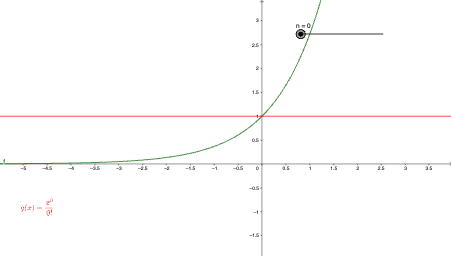
This example demonstrates how to build polynomial approximations of the exponential function e^x by summing the terms of its Taylor series and comparing the resulting curves as the series order changes. The key concepts include Taylor series (power-series expansion about a point), partial sums as polynomial approximants, and the idea of representing a transcendental function using finite polynomial sums. Construction in GeoGebra is based on the Sum command, using objects such as a function/term definition f, the number of terms n, a summation structure g, and a text object (text2) to display parameters or results. It is well suited for calculus lessons on series expansion, convergence intuition, and for students/learners who want an interactive visualization of how higher-order terms improve approximation accuracy.
GeoGebra Commands & Parameters
Sum(Sequence[x^(i) / i!, i, 0, n, 1]) → g
AI Drawing Prompt Reference
Draw a graph showing Taylor series approximations of the exponential function e^x. Start with the curve of e^x as a reference. Then, for a variable number of terms n, plot the partial sum of the series, where each term is x^i divided by i factorial, summed from i=0 to n. Show multiple approximation curves for different n values, and include a text label displaying the current n. The curves should demonstrate how higher-order polynomials more closely match the exponential curve.
The prompt above was compiled from the original drawing commands and is for reference only.