
Taylor Series for ln(x): Polynomial Approximation via Partial Sums
Loading the math board and drawing, please wait…
In collections
Taylor and Maclaurin Series
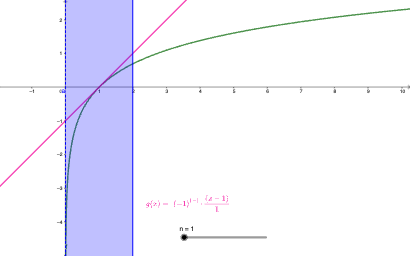
This GeoGebra example demonstrates how the function ln(x) can be approximated near a chosen expansion point by a finite Taylor polynomial, letting learners visually compare the approximation quality as the series order changes. The key mathematical concepts include Taylor series expansion, local representation of functions, power series, convergence behavior, and constructing partial sums of an infinite series. Construction-wise, the example is built around the GeoGebra Sum command to compute the series partial sum from its terms, using objects such as f, n, g, a, and text2 to assemble the Taylor polynomial and display the associated expression/annotation. It is suitable for high school advanced topics and early undergraduate calculus courses, especially for lessons on series and function approximation.
GeoGebra Commands & Parameters
Sum(Sequence[((-1)^(i - 1) * (x - 1)^(i) / i), i, 1, n, 1]) → g
AI Drawing Prompt Reference
Draw the graph of the natural logarithm function and its Taylor polynomial approximation near a chosen expansion point. Show the original logarithmic curve, and overlay a polynomial curve that approximates it locally. The polynomial degree should be adjustable, with higher degrees giving closer fit. Mark the expansion point on the x-axis)Skip. Display the polynomial expression as text, updating with the degree. Illustrate how the approximation improves as more terms are added, demonstrating convergence of the series.
The prompt above was compiled from the original drawing commands and is for reference only.