
Picard Iteration for y²: Visualizing the Uniqueness Theorem
Loading the math board and drawing, please wait…
In collections
Differential equation Material
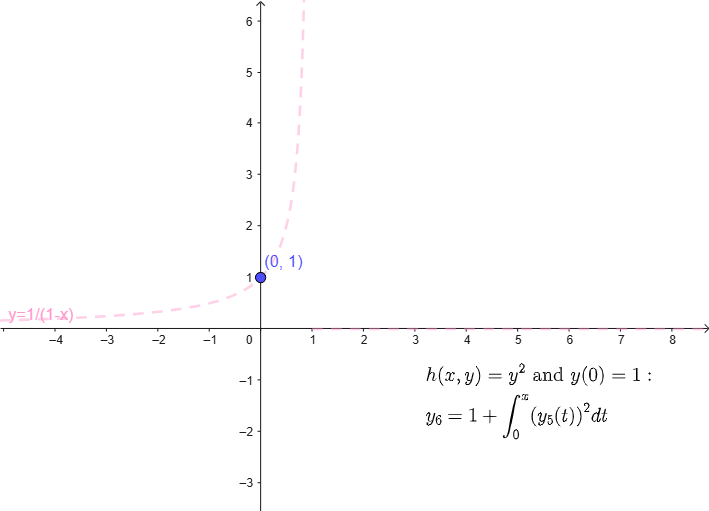
This GeoGebra example dynamically illustrates the Picard iteration sequence for a first-order ordinary differential equation, demonstrating the convergence process and the geometric meaning of the uniqueness theorem. The core mathematical concept is Picard's iterative method, where a sequence of functions is constructed via an integral equation to approximate the solution, and uniqueness is guaranteed under Lipschitz conditions. The construction uses objects such as l1, n, f, g, A, m, h, and text1, with a slider n controlling the number of iterations, and functions f and g representing the initial and target functions. This resource is ideal for university-level courses in differential equations or numerical analysis, helping students visualize how successive approximations converge to the unique solution, and can also serve as a teaching aid for iterative methods in mathematical modeling.
GeoGebra Commands & Parameters
{1, 1 + x, 1 + x + x^(2) + x^(3) / 3, 1 + x + x^(2) + x^(3) + ((2 * x^(4))) / 3 + x^(5) / 3 + x^(6) / 9 + x^(7) / 63, 1 + x + x^(2) + x^(3) + x^(4) + ((13 * x^(5))) / 15 + ((2 * x^(6))) / 3 + ((29 * xNumeric n(6)f(x) = l1(n, x)y = 1(0, 1)n - 1h(x) = If[x < 1, 1 / (1 - x), 0]
AI Drawing Prompt Reference
Draw a horizontal line y=1 and mark the initial point at (0,1). Show multiple function approximation curves from Picard iteration, starting with the initial function and progressively approaching the true solution through iterative integration. Include a slider controlling the iteration count n; as n increases from 1 to 6, display a series of polynomial approximations that gradually converge. In the region where x<1, the target solution has the form 1/(1-x), and the iterative curves should progressively approach this target function, demonstrating the geometric meaning of the uniqueness theorem.
The prompt above was compiled from the original drawing commands and is for reference only.