
Uniqueness Theorem for y^(1/2) using Picard Iteration
Loading the math board and drawing, please wait…
In collections
Differential equation Material
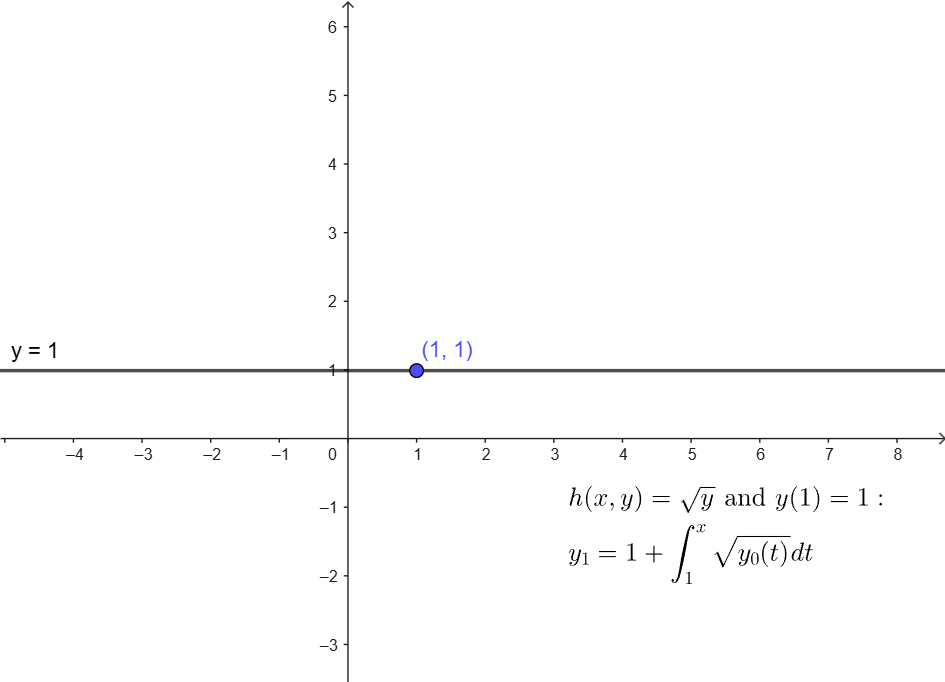
This example demonstrates the use of Picard iteration to solve the uniqueness theorem for y^(1/2). The math concepts involved include Picard iteration and uniqueness theorem. The construction of the graph involves using GeoGebra commands to create the graph, with objects l1, n, f, g, A, m, and text1 being used. This example is suitable for middle school math and college math.
GeoGebra Commands & Parameters
{1, x, (1 + (2 * x^(3 / 2))) / 3, (1 / 15 * (6 + (5 * x) + (4 * x^(5 / 2)))), (1 / 210 * (75 + (84 * x) + (35 * x^(2)) + (16 * x^(7 / 2)))), (700 + (675 * x) + (378 * x^(2)) + (105 * x^(3)) + (32 * x^Numeric n(1)f(x) = l1(n, x)y = 1(1, 1)n - 1
AI Drawing Prompt Reference
On a coordinate plane, illustrate an iterative approximation to a uniqueness-type problem for the function y^(1/2): plot the first iteration function curve derived from the given formula, and also plot the next iteration function curve using its parameter form in the same axes. Add the reference horizontal line y=1 and include the point (1,1) to show the target intersection. Indicate that the iteration is initialized at n=1 and then changes to n-1 for subsequent steps, emphasizing how the initial value and the iterative functions relate to each other. Keep the axes and curves clearly distinguishable.
The prompt above was compiled from the original drawing commands and is for reference only.