
Simple Harmonic Motion of a Vertical Spring
Loading the math board and drawing, please wait…
In collections
El dominio del Tiempo (cinemática intuitiva)
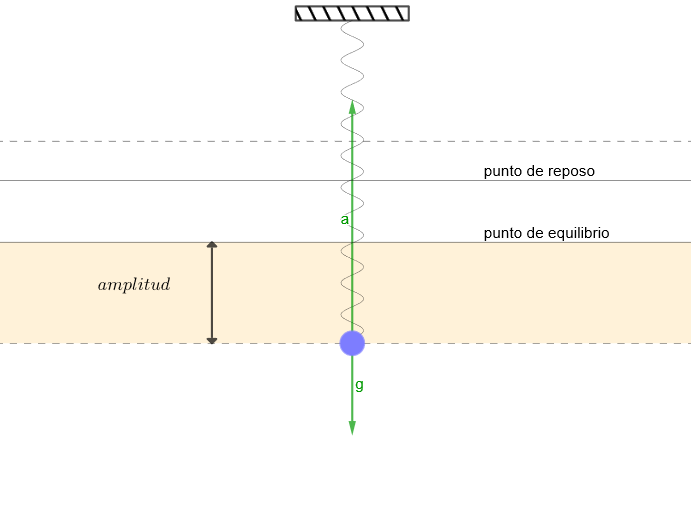
This example demonstrates the simple harmonic motion of a vertical spring. The core mathematical concepts involved are kinematics and mechanics. The construction uses GeoGebra commands such as Point, If, Circle, Segment, and CurveCartesian. It is suitable for middle school or high school students to learn the basic concepts of kinematics and mechanics.
GeoGebra Commands & Parameters
Point(Segment[(2 * O') - P', O']) → QIf(Length[reg] ≟ 1, {reg(1)}, Sequence[reg(k) - reg(k + 1), k, 1, Length[reg] - 1]) → regDifmean(regDif) → TCircle(M, r) → cir_{1}Segment((x(B) + 0.1, y(Q)), (x(B) + 0.1, y(O'))) → jCircle(M, abs(g)) → cirCurveCartesian((1.2 * sin(((20 * pi) * (t - (y(M) + 0.5)) / (y(P0) - (y(M) + 0.5))))), t, t, y(M), y(P0)) → muelle
AI Drawing Prompt Reference
Draw a diagram of simple harmonic motion of a vertical spring. Show the vertical up-and-down motion of the spring. Include the spring, the suspension point, the end point of the spring, and the motion trajectory. The trajectory should be represented by a curve, and the stretching and compression of the spring should be clearly shown. The overall diagram should be simple and clear, suitable for learning basic mechanics concepts.
The prompt above was compiled from the original drawing commands and is for reference only.