
Vertical Launch
Loading the math board and drawing, please wait…
In collections
El dominio del Tiempo (cinemática intuitiva)
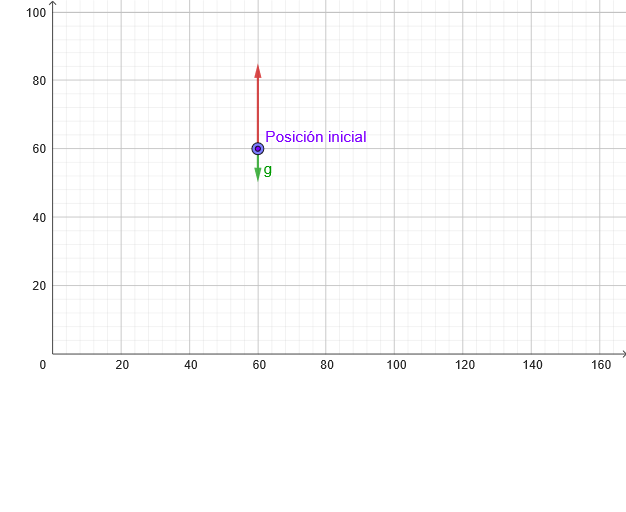
This example demonstrates a vertical launch, showing the trajectory of an object in flight. Key mathematical concepts include parabolas and limits. Construction points include using GeoGebra's PointIn, Segment, Vector, and Textfield commands. Suitable for middle school and high school math education, particularly in geometry and dynamics teaching.
GeoGebra Commands & Parameters
PointIn(x ≥ 0 ∧ y ≥ 0) → PSegment(P, (x(P), 0)) → hAbajoVector((x(M), y(P)), (x(M) + vx, y(P))) → vx_{1}Vector((x(P), y(P)), (x(P), y(P) + vy)) → vy_{1}Vector(M, (x(M), y(M + v))) → vvSegment(P, (x(P), y(P) + vy^(2) / ((2 * abs(g))))) → hArribaTextfield(vy) → CasillaDeEntrada2
AI Drawing Prompt Reference
Create a diagram of a vertical launch projectile motion. Show a point in the first quadrant representing the launch position. Draw a vertical line segment from this point down to the x-axis to represent height. Add horizontal and vertical vector arrows from the point to represent velocity components. Draw another vertical line segment extending upward from the point to the maximum height calculated from velocity squared divided by twice gravitational acceleration. The diagram illustrates the relationship between height and velocity in parabolic motion.
The prompt above was compiled from the original drawing commands and is for reference only.