
Autoduality
Loading the math board and drawing, please wait…
In collections
Teselaciones regulares
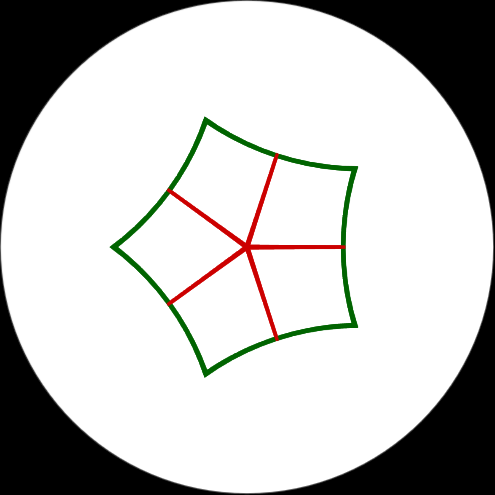
This example demonstrates the application of autoduality in geometry. It involves the autoduality of geometric shapes, core mathematical concepts include symmetry, properties of geometric shapes and autoduality in geometry. The construction uses GeoGebra commands such as Circle, Intersect, Sequence, Flatten, and objects c, p, q, P0, V. Suitable for middle school math, geometry and math exploration
GeoGebra Commands & Parameters
Circle((0, 0), 1) → cIntersect(Circle[((1 - (sin(pi / p) / cos(pi / q))^(2))^(-1 / 2), 0), ((cos(pi / q) / sin(pi / p))^(2) - 1)^(-1 / 2)], Ray[(0, 0), Rotate[(1, 0), pi / p]], 1) → P0Sequence(Rotate[P0, ((k * 2) * pi / p)], k, 0, p - 1) → VCircle(Mirror[V(p), c], V(p), V(1)) → hc1Flatten(Join[{{Vac(p)}, {Vac \ {Vac(p)}}}]) → VacpFlatten(Join[{{Vac \ {Vac(1)}}, {Vac(1)}}]) → Vac2Intersect(hc1, Ray[(V(1) + V(p)) / 2, (0, 0)]) → V0,CircumcircleArc(V(p), V0, V(1)) → arcoCeldaJoin(Sequence[Rotate[Sequence[Point[arcoCelda, s], s, 0, 0.9, 0.1], ((2 * k) * pi / p)], k, 0, p - 1]) → celda0Sequence({Vac(k), q - 1, ncActual}, k, 3, p - 1) → VplusIf(floor(p / 2) ≠ p / 2 ∧ q ≟ 3, 4, floor(q / 2) ≟ q / 2, 2, 3) → ncSequence({V(k), q - 1, 0}, k, 1, p) → vert0Sequence(Polygon[auto(1, k)], k, 1, 5) → autodual1Sequence(Polygon[auto(2, k)], k, 1, 5) → autodual2Sequence(Polygon[auto0(1, k)], k, 1, 5) → autodual01Sequence(Polygon[auto0(2, k)], k, 1, 5) → autodual02Flatten(Join[{{Vac \ {Vac(1), Vac(2)}}, {Vac(1), Vac(2)}}]) → Vac2'Flatten(Join[{{Vac(p - 1), Vac(p)}, {Vac \ {Vac(p - 1), Vac(p)}}}]) → Vacp'