
Square and Octagon
Loading the math board and drawing, please wait…
In collections
Cutting up squares
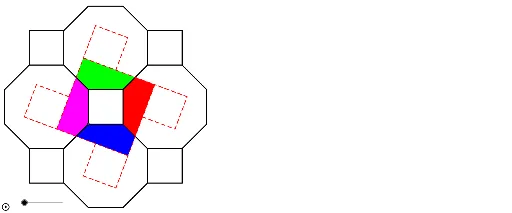
This example demonstrates the geometric construction and relationships between a square and an octagon. Key math concepts include polygon construction, vector operations, and geometric transformations. GeoGebra commands used are Intersect, Point, Polygon, Midpoint, Circle, Segment, Vector, and Translate. Suitable for high school mathematics teaching to understand polygon properties and transformation applications.
GeoGebra Commands & Parameters
Intersect(xAxis, yAxis) → APoint(xAxis) → BPolygon(A, B, 4) → poly1, a, b, c, d, C, DPolygon(C, B, 8) → poly2, c_1, F, G, H, I, J, b_1, e, f, g, h, i, j, EPolygon(D, C, 8) → poly3, d_1, L, M, N, O, P, c_2, k, l, m, n, p, q, KPolygon(A, D, 8) → poly4, a_1, R, S, T, U, V, d_2, r, s, t, e_1, f_1, g_1, QPolygon(B, A, 8) → poly5, b_2, Z, A_1, B_1, C_1, D_1, a_2, h_1, i_1, j_1, k_1, l_1, m_1, WPolygon(R, Q, 4) → poly7, r_1, q_1, s_1, t_1, G_1, H_1Polygon(D_1, C_1, 4) → poly9, d_3, c_3, g_2, h_2, K_1, L_1Midpoint(A, B_1) → I_3Midpoint(A, C) → J_3Circle(I_3, 0.7071067811865476) → t_5Circle(J_3, 1.5537739740300374) → c_6Midpoint(R, W) → K_3Midpoint(G_1, K) → L_3Midpoint(K, L_1) → M_3Circle(K_3, 0.7071067811865476) → d_6Circle(L_3, 0.7071067811865476) → e_6Circle(M_3, 0.7071067811865476) → f_6Intersect(t_5, c_6) → N_3, O_3, ,Intersect(d_6, c_6) → P_3, Q_3, ,Intersect(c_6, e_6) → R_3, S_3, ,Intersect(f_6, c_6) → T_3, U_3, ,Segment(R_3, U_3) → a_6Segment(U_3, O_3) → g_6Segment(O_3, Q_3) → i_6Segment(Q_3, R_3) → j_6Intersect(d_6, j_6, 2) → V_3Polygon(Q_3, V_3, 4) → poly22, q_6, v_3, k_6, l_6, W_3, Z_3Intersect(t_5, i_6, 2) → A_4Intersect(f_6, g_6, 2) → B_4Intersect(e_6, a_6, 2) → C_4Polygon(R_3, C_4, 4) → poly23, r_6, c_7, m_6, p_6, D_4, E_4Polygon(U_3, B_4, 4) → poly24, u_3, b_7, s_6, t_6, F_4, G_4Polygon(O_3, A_4, 4) → poly25, o_3, a_7, d_7, e_7, H_4, I_4Intersect(a_6, j) → E_1Intersect(g_6, b_1) → F_1Intersect(g_1, a_2) → I_1Intersect(j_6, q) → J_1Intersect(i_6, g_1) → M_1Polygon(R_3, E_1, C, D, J_1) → poly6, r_3, e_2, c_4, d_4, j_2Polygon(C, E_1, U_3, F_1, B) → poly8, c_5, e_3, u_1, f_2, b_3Polygon(B, F_1, O_3, M_1, A) → poly10, b_4, f_3, o_1, m_2, a_3Polygon(Q_3, M_1, A, D, J_1) → poly11, q_3, m_3, a_4, d_5, j_3Polygon(D, C, B, A) → poly12, d_8, c_8, b_5, a_5Vector(B, I) → uTranslate(B, v1) → B'Translate(F_1, v1) → N_1Translate(O_3, v1) → O_1Translate(M_1, v1) → P_1Translate(A, v1) → A'Polygon(B', N_1, O_1, P_1, A') → poly10', b', n_1, o_2, p_1, a'Vector(A, G) → vTranslate(Q_3, v2) → Q_1Translate(M_1, v2) → R_1Translate(A, v2) → A'_1Translate(D, v2) → D'Translate(J_1, v2) → S_1Polygon(Q_1, R_1, A'_1, D', S_1) → poly11', q_2, r_2, a'_1, d', s_2Vector(R_3, B_4) → wTranslate(R_3, v3) → T_1Translate(E_1, v3) → U_1Translate(C, v3) → C'Translate(D, v3) → D'_1Translate(J_1, v3) → V_1Polygon(T_1, U_1, C', D'_1, V_1) → poly6', t_2, u_2, c', d'_1, v_1Polygon(J, I, 4) → poly13, j_4, i_2, k_2, l_2, W_1, Z_1Polygon(Z, V, 4) → poly14, z, v_2, n_2, p_2, A_2, B_2