
Geometric Construction of a Sine Transformation
Loading the math board and drawing, please wait…
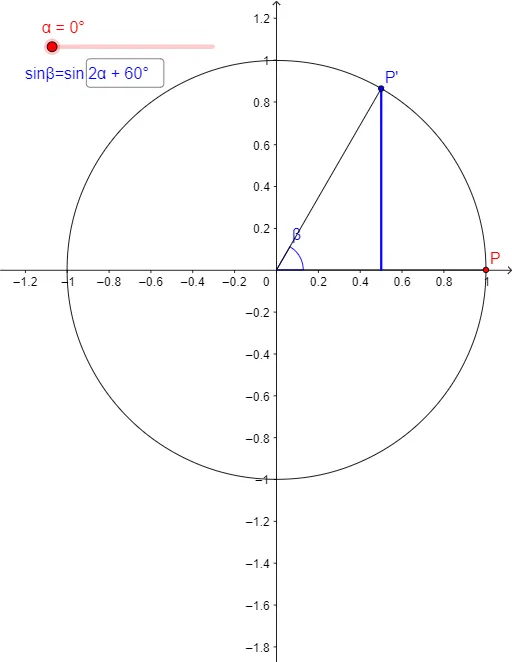
This example uses a geometric construction to demonstrate how a “sine transformation” maps an angle moving on a circle to a corresponding length or projection value, revealing the resulting periodic behavior. The key concepts are trigonometry—especially the sine function—together with angle measurement, circular geometry, and how geometric operations (rotation and orthogonal projection) produce the same functional relationship. Construction-wise, it uses Intersect and Circle to determine key circles and intersection points, Rotate to move points by changing the angle position around a center, Angle to label and measure angles (e.g., α, β), Segment to build the line segments representing sine-related quantities, and OrthogonalLine to generate the perpendicular/projection component. Textfield is used to input parameters or angles, while Text annotations mark important derived values (e.g., δ, ε). The scene includes constructed points such as A, B, C_1, D, and a moving point pair (P and P'), along with the segments and angles created by the transformation. Suitable for high school advanced learners and early university prep, as well as for interactive classroom demonstrations and exploratory modeling.
GeoGebra Commands & Parameters
Intersect(xAxis, yAxis) → ACircle(A, 1) → cRotate(B, α, A) → PAngle(B, A, P) → βSegment(A, P) → C_1Segment(P, D) → aRotate(B, γ, A) → P'Angle(B, A, P') → δTextfield(γ) → inputBox1Segment(P', A) → bOrthogonalLine(P', xAxis) → dIntersect(d, xAxis) → GSegment(P', G) → eAngle(B, A, P') → ε
AI Drawing Prompt Reference
Draw a unit circle centered at the origin. Mark a point on the circle and connect it to the center with a radius. Rotate this point by two different angles to create two moving points, each connected to the center by a radius. Label the two rotation angles. From one moving point, drop a perpendicular to the horizontal axis, and connect the point to the foot of the perpendicular with a vertical segment, whose length represents the sine value. Include an input box to adjust the second rotation angle and display its value. Show how changing the angle affects the vertical segment length, illustrating the geometric meaning of the sine function.
The prompt above was compiled from the original drawing commands and is for reference only.