
Tracing Sine and Cosine with the Unit Circle
Loading the math board and drawing, please wait…
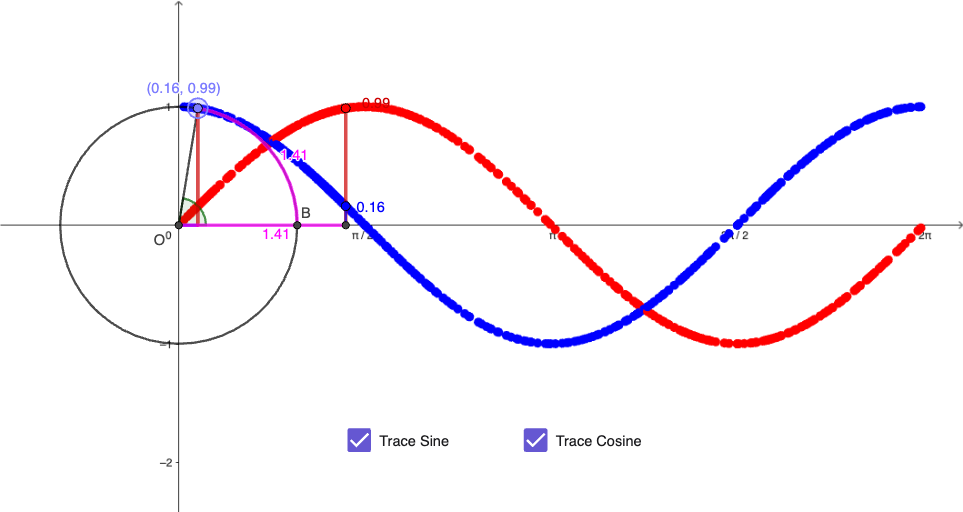
This example demonstrates how to trace the sine and cosine functions by using the unit circle: a rotating ray determines a point on the circle, and orthogonal projections translate that geometric position into sin(θ) and cos(θ). The key math concepts are trigonometric functions (sine and cosine), the unit-circle definition, angle-to-arc relationships, 2D vector interpretation via projections, and visual mapping that may resemble graphing/area/bar-style representations. Construction-wise, it leverages GeoGebra commands such as Point and Intersect to create essential points and intersection results, Segment to form connecting lines, OrthogonalLine to drop perpendiculars that produce the sin/cos projections, Angle to mark and control θ, and CircleArc to represent the corresponding circular arc. The construction organizes geometric objects (points, lines, arcs) together with on-screen text labels to communicate angle/function values. Ideal for secondary school and early undergraduate instruction on trigonometry, unit-circle reasoning, and connecting function graphs with geometric meaning.
GeoGebra Commands & Parameters
Point(eq1) → PIntersect(xAxis, yAxis) → OSegment(P, O) → fOrthogonalLine(P, xAxis) → gIntersect(g, xAxis) → CSegment(O, C) → hSegment(P, C) → iPoint(xAxis) → AAngle(A, O, P) → αIntersect(eq1, xAxis, 2) → BCircleArc(O, B, P) → cSegment(O, D) → jSegment(E, D) → kSegment(D, F) → l
AI Drawing Prompt Reference
Draw a unit circle centered at the origin. Take a point P on the circle and draw a ray from the origin through P as a rotating radius. From P drop a perpendicular to the x-axis, meeting it at point C. Connect the origin to C and point P to C, forming line segments representing cosine and sine. Pick another point A on the x-axis to mark angle AOP indicating the current rotation angle. Identify point B where the circle intersects the x-axis, and draw an arc from B to P along the circle. The overall display shows how a rotating point on the unit circle generates sine and cosine values through orthogonal projections.
The prompt above was compiled from the original drawing commands and is for reference only.