
Square and Equilateral Triangle
Loading the math board and drawing, please wait…
In collections
Cutting up squares
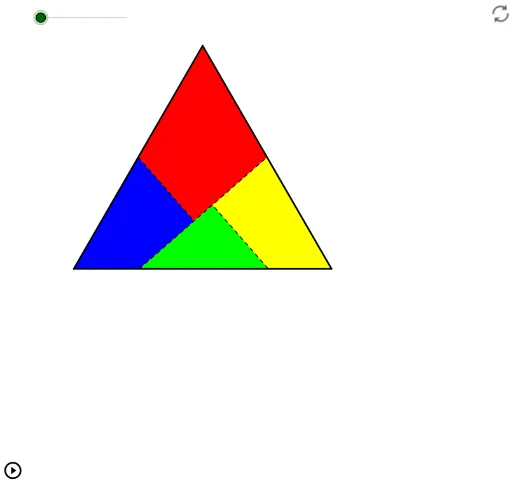
This example demonstrates the geometric relationship and construction between a square and an equilateral triangle. It involves core mathematical concepts such as polygons, geometric transformations, symmetry, and angles. The construction uses GeoGebra commands and objects like Intersect (intersection), Point, Polygon, Segment, Midpoint, Circle, Ray, OrthogonalLine, Rotate, and Line, as summarized. It is suitable for high school mathematics teaching on geometric construction and transformations.
GeoGebra Commands & Parameters
Intersect(xAxis, yAxis) → APoint(xAxis) → BPolygon(A, B, 3) → poly1, a, a_1, b, CSegment(A, B) → cSegment(B, C) → dSegment(C, A) → eMidpoint(d) → DMidpoint(e) → ECircle(D, C) → fRay(A, D) → gIntersect(f, g) → F_1, FMidpoint(A, F) → GCircle(G, F) → hRay(B, C) → iIntersect(h, i) → H,Circle(D, H) → kIntersect(k, c, 1) → JCircle(J, Segment[C, D]) → pIntersect(p, c, 1) → KSegment(J, D) → jOrthogonalLine(E, j) → lIntersect(l, j) → NOrthogonalLine(K, j) → mIntersect(m, j) → RSegment(E, N) → nSegment(K, R) → qPolygon(C, D, N, E) → poly2, c_1, d_1, n_1, e_1Polygon(D, B, K, R) → poly3, d_2, b_1, k_1, rPolygon(J, K, R) → poly4, r_1, j_1, k_2Polygon(A, J, N, E) → poly5, a_2, j_2, n_2, e_2Rotate(C, (-α), D) → C'_1Rotate(D, (-α), D) → D'Rotate(N, (-α), D) → N'_1Rotate(E, (-α), D) → E'_1Polygon(C'_1, D', N'_1, E'_1) → poly2', c', d', n', e'_1Rotate(J, α, K) → J'_1Rotate(K, α, K) → K'Rotate(R, α, K) → R'Polygon(J'_1, K', R') → poly4', r', j', k'Rotate(A, α, K') → A'Rotate(J, α, K') → J'Rotate(N, α, K') → N'Rotate(E, α, K') → E'Polygon(A', J', N', E') → poly5', a', j'_1, n'_1, e'Intersect(b, e) → IIntersect(a_1, d) → LIntersect(b, e) → MIntersect(a_1, d) → OPoint(poly1) → PLine(N, R) → sCircle(D', N') → tLine(N, D') → f_1Circle(D', N) → g_1Intersect(g_1, f_1, 2) → QPolygon(Q, R, 4) → poly6, q_1, r_2, h_1, i_1, S, TCircle(Q, D') → p_1Point(poly6) → UPolygon(D', Q, U, B) → poly7, d'_1, q_2, u, b_2Circle(K', J) → s_1Point(poly6) → VPolygon(K', V, S) → poly8, s_2, k'_1, vPolygon(B, U, T, V) → poly9, b_3, u_1, t_1, v_1Rotate(B, α - 360°, V) → B'Rotate(U, α - 360°, V) → U'Rotate(T, α - 360°, V) → T'Rotate(V, α - 360°, V) → V'Polygon(B', U', T', V') → poly9', b', u', t', v'