
Spherical Coordinates
Loading the math board and drawing, please wait…
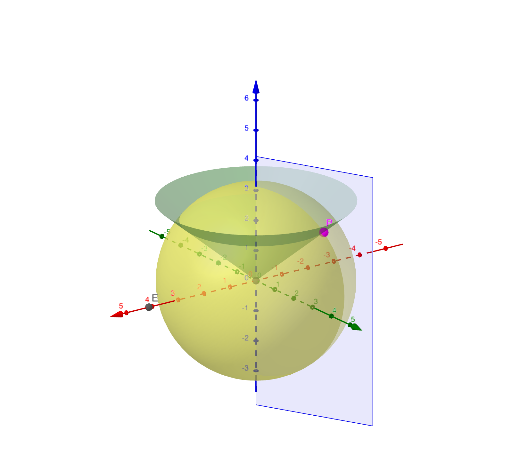
This example demonstrates the representation of points in spherical coordinates and the drawing of 3D shapes like spheres and cones in space; core math concepts include spherical coordinates (ρ, θ, ϕ), solid geometry, and analytical geometry; construction highlights from the summary involve GeoGebra commands/objects such as Intersect, Sphere, Polygon, Rotate, Ray, Segment, Line, and Cone; suitable for high school students and math enthusiasts learning spatial geometry and coordinate transformations.
GeoGebra Commands & Parameters
Intersect(xAxis, yAxis) → ASphere(A, ρ) → aPolygon(C, B, F, D) → q1, c, b, f, dRotate(C, ϕ, yAxis) → C'Ray(A, C') → gSegment(C, B) → hIntersect(g, h) → GSegment(C, G) → iLine(C', xAxis) → jIntersect(j, d) → HSegment(H, C') → kCone(H, A, k) → e, p, lRotate(q1, θ, zAxis) → q1'Rotate(A, θ, zAxis) → A'Rotate(C', θ, zAxis) → C''Ray(A', C'') → g'Intersect(g', a, 1) → P
AI Drawing Prompt Reference
Draw a sphere and a cone in 3D space. The sphere is centered at the origin with radius ρ. The cone's vertex is on the sphere, and its base intersects the sphere. Construct by first drawing the sphere, then determining the cone's vertex. Next, draw the cone and ensure its base intersects the sphere. Finally, use rotation and intersection to verify the relationship between the cone and the sphere.
The prompt above was compiled from the original drawing commands and is for reference only.