
Dürer 2 Math Example
Loading the math board and drawing, please wait…
In collections
circles, ovals, ellipses and architecture
This example demonstrates complex geometric constructions and transformations based on Dürer's geometry; involves core math concepts like cosine, sphere, complex numbers, coordinate geometry, quadrilaterals; constructed using GeoGebra commands such as Point, Semicircle, Polygon, Sequence, Intersect, Midpoint, Conic, Focus, Translate; suitable for high school students and geometry enthusiasts exploring advanced geometric constructions and higher math applications.
GeoGebra Commands & Parameters
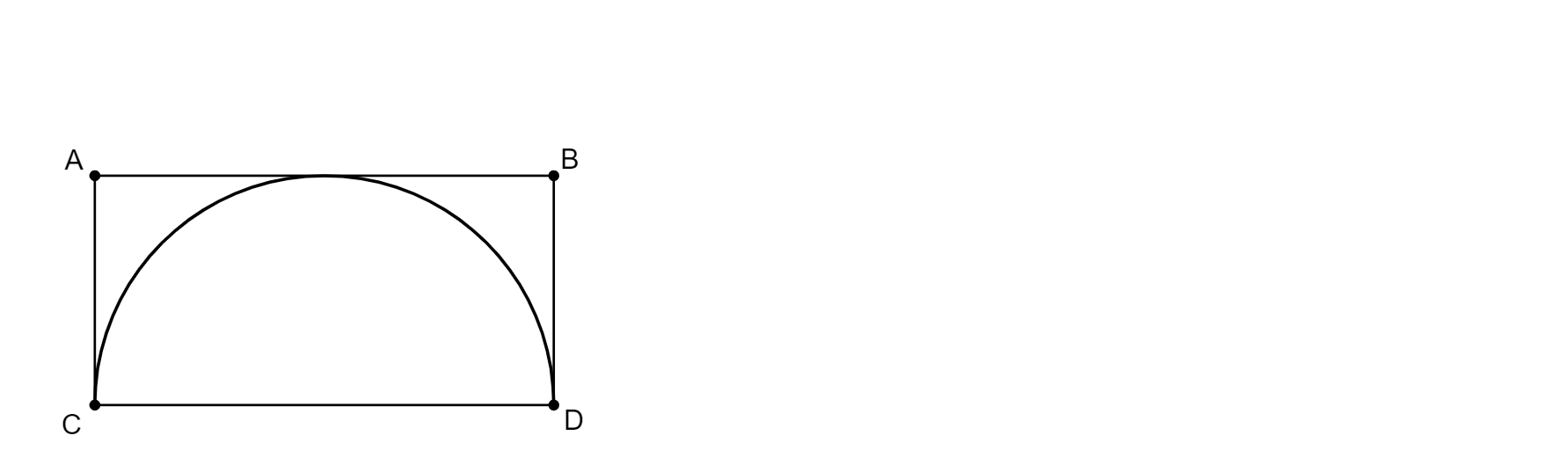
Point(xAxis) → DPoint(xAxis) → CSemicircle(C, D) → cPoint(yAxis) → BPolygon(A, B, D, C) → vierhoek1, a, b, d, c_1Sequence(Segment[(-12 + nn, 0), (-12 + nn, 6)], nn, 1, 11) → l1Point(xAxis) → EPoint(Ray[(14, 0), (15, 0)]) → HPolygon(E, F, G, H) → vierhoek2, e, g, h, fSequence(Segment[(2 + (nn * f / 12), 0), (2 + (nn * f / 12), 6)], nn, 1, 11) → l2Sequence(Intersect[c, l1(nn)], nn, 1, 5) → l3Sequence(Segment[l3(nn), (x(H), y(l3(nn)))], nn, 1, 5) → l4Intersect(l4(1), l2(1)) → IIntersect(l4(1), l2(11)) → JIntersect(l4(2), l2(2)) → KIntersect(l4(2), l2(10)) → LIntersect(l4(3), l2(3)) → MIntersect(l4(3), l2(9)) → NIntersect(l4(4), l2(4)) → OIntersect(l4(4), l2(8)) → PIntersect(l4(5), l2(5)) → QIntersect(l4(5), l2(7)) → RMidpoint(F, G) → SConic(E, I, K, M, O) → kFocus(k) → T, UMidpoint(E, H) → VTranslate(p, Vector[D, V]) → p_{1}
AI Drawing Prompt Reference
Draw a complex geometric figure based on Dürer's geometry, including a semicircle and two quadrilaterals with intersecting line segments. Start by creating points D and C on the x-axis and drawing a semicircle c with C and D as endpoints. Then create point B on the y-axis and draw quadrilateral vierhoek1 with vertices A, B, D, and C. Next, create point E on the x-axis and point H on a ray, and draw quadrilateral vierhoek2 with vertices E, F, G, and H. Construct a series of line segments and find intersection points I, J, K, L, M, N, O, P, Q, and R. Draw an ellipse k with vertices E, I, K, M, and O, and find foci T and U. Finally, find the midpoint V of E and H, and translate point D to V.
The prompt above was compiled from the original drawing commands and is for reference only.