
Islamic Geometric Octagons
Loading the math board and drawing, please wait…
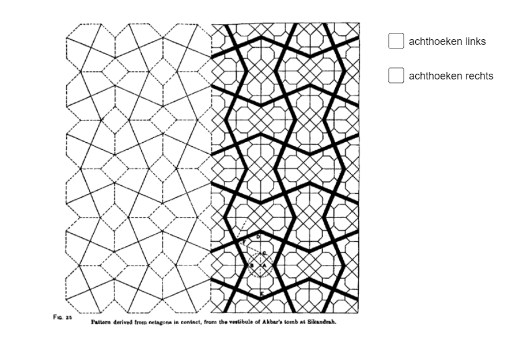
This example demonstrates the construction of intricate Islamic geometric patterns using octagons through rotation and geometric transformations. Key math concepts include symmetry, polygon construction, vector operations, transformation logic, and integral concepts. GeoGebra commands like Rotate, Polygon, Vector, and Translate are used, involving points, vectors, and polygons. Suitable for high school and above, exploring geometric transformations, symmetry, and design principles.
GeoGebra Commands & Parameters
Rotate(C, 45°) → C'Polygon(C, C', 8) → veelhoek1, f, E, F, G, H, I, g, h, i, j, k, l, m, DVector(C, E) → uTranslate(veelhoek1, u) → veelhoek1'Translate(veelhoek1, Vector[(-u)]) → veelhoek1'_1Translate(veelhoek1, v) → veelhoek1'_2Translate(veelhoek1, Vector[u + v]) → veelhoek1'_3Translate(veelhoek1, Vector[(-u) + v]) → veelhoek1'_4Translate(veelhoek1, Vector[(-u) + (2 * v)]) → veelhoek1'_5Translate(veelhoek1, Vector[u + (2 * v)]) → veelhoek1'_6Translate(veelhoek1, Vector[(2 * v)]) → veelhoek1'_7Translate(veelhoek1, Vector[(-u) + (3 * v)]) → veelhoek1'_8Translate(veelhoek1, Vector[u + (3 * v)]) → veelhoek1'_9Translate(veelhoek1, Vector[(3 * v)]) → veelhoek1'_{10}Translate(veelhoek1, Vector[(-u) - v]) → veelhoek1'_{11}Translate(veelhoek1, Vector[u - v]) → veelhoek1'_{12}Translate(veelhoek1, Vector[(-v)]) → veelhoek1'_{13}Translate(veelhoek1, Vector[(-u) - (2 * v)]) → veelhoek1'_{14}Translate(veelhoek1, Vector[u - (2 * v)]) → veelhoek1'_{15}Translate(veelhoek1, Vector[(-2 * v)]) → veelhoek1'_{16}Translate(l1, Vector[(-3 * uu)]) → l1'
AI Drawing Prompt Reference
Create an Islamic geometric design centered on an octagon. Start with a chosen center point and generate the octagon’s corner points by rotating around the center by 45°, then connect the corners to form a regular octagon. Compute direction vectors from the octagon’s key vertices, then repeatedly translate the entire octagon by several vector steps obtained from linear combinations of these directions (including positive and negative multiples). Place each translated copy next to the previous ones so multiple neighboring octagons form a symmetric, ring-like expansion around the original.
The prompt above was compiled from the original drawing commands and is for reference only.