
Regular Polygons and Equivalent Triangles
Loading the math board and drawing, please wait…
In collections
Euclidean Geometry
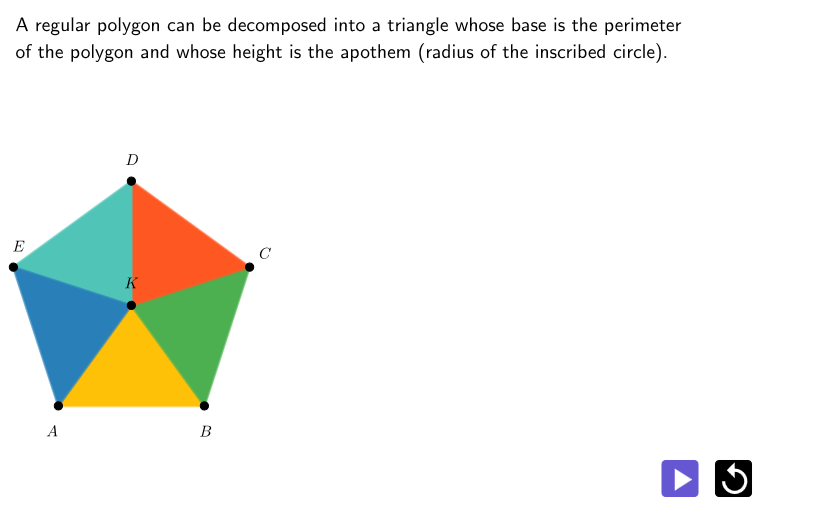
This example demonstrates the equidecomposability of a regular pentagon and an equivalent triangle through animation. Key mathematical concepts include area equivalence, geometric transformations, and figure decomposition. Construction involves GeoGebra commands such as Polygon, Centroid, Rotate, and Translate. Suitable for middle or high school mathematics education to understand geometric transformations and area calculations.
GeoGebra Commands & Parameters
Polygon(A, B, 5) → poly1, f, g, h, i, j, C, D, ECentroid(poly1) → FSegment(F, H) → apotCircle(F, Distance[F, H]) → inCPolygon({A, B, F}) → tri1Polygon({B, C, F}) → tri2Polygon({C, D, F}) → tri3Polygon({D, E, F}) → tri4Polygon({E, A, F}) → tri5Line(A, B) → kDistance(A, B) → ellRotate(tri2, ((-bSli) * 72°), B) → tri2'Rotate(C, ((-bSli) * 72°), B) → C'Translate(Rotate[D, ((-bSli) * 144°), C], Vector[C, C']) → D'Translate(Rotate[E, ((-bSli) * 216°), D], Vector[D, D']) → E'Vector(E, E') → vecEVector(C, C') → vCTranslate(Rotate[tri3, ((-bSli) * 144°), C], vC) → tri3'Vector(D', DF) → vDVector(D, D') → vecDTranslate(Rotate[tri4, ((-bSli) * 216°), D], vecD) → tri4'Vector(E', EF) → vETranslate(Rotate[tri5, ((-bSli) * 288°), E], vecE) → tri5'Translate(F2, Vector[(cSli * Vector[F2, F])]) → F2'Translate(F3, Vector[(cSli * Vector[F3, F])]) → F3'Translate(F4, Vector[(cSli * Vector[F4, F])]) → F4'Translate(F5, Vector[(cSli * Vector[F5, F])]) → F5'Polygon(B, CF, F2') → tri2f, f2', b, cfPolygon(CF, DF, F3') → tri3f, f3', l, dfPolygon(DF, EF, F4') → tri4f, f4', m, efPolygon(EF, EF + (ell, 0), F5') → tri5f, f5', n, p
AI Drawing Prompt Reference
Draw a regular pentagon and construct its center, then use the segment from the center to the foot associated with a side to define a circle with that radius. Decompose the pentagon into five triangles by connecting the center to each pair of consecutive vertices. Next, select specific triangles and reposition them by rotating them about the appropriate vertices by multiples of 72° so they align in an equivalent configuration. Finally, translate the rotated pieces to distinct locations so the resulting combined triangles form an area-equivalent triangle arrangement.
The prompt above was compiled from the original drawing commands and is for reference only.