
Matrix-Based Transformations of Triangles
Loading the math board and drawing, please wait…
In collections
Coordinate Geometry
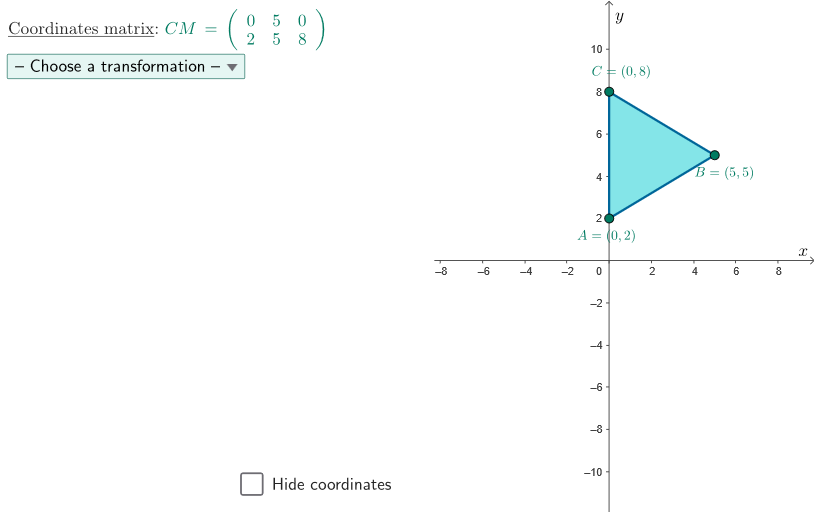
This GeoGebra example demonstrates how geometric transformations of a triangle—such as dilation, reflection/symmetry, and angle-driven rotation—can be implemented and explained through matrix multiplication. It builds an initial triangle (using vertices A, B, C and polygon objects) and then applies a 2D transformation matrix to obtain the transformed vertices A′, B′, C′. The key concepts are linear/algebraic representation of transformations, similarity transformations, correspondence of vertices under transforms, and parameter control using real numbers (e.g., a scale factor and an angle). Construction-wise, it uses GeoGebra commands such as ApplyMatrix to map coordinates, Point and Polygon to define and draw the triangles, and Join plus SelectedIndex to manage composed objects and selected elements. Adjustable parameters (matrix entries like a11, a12, a21, a22 and sliders such as ratio and θ) link the geometric effect directly to the underlying matrix entries, making it suitable for students learning how geometry and matrices connect, from late secondary school to introductory university linear algebra.
GeoGebra Commands & Parameters
ApplyMatrix(T, O) → O'Join(Sequence[Sequence[(j, k), j, -6, 6, 1], k, -8, 8, 1]) → bigGridPoint(bigGrid) → APoint(bigGrid) → BPoint(bigGrid) → CPolygon({A, B, C}) → poli1ApplyMatrix(T, poli1) → poli1'SelectedIndex(scelte) → isApplyMatrix(T, A) → A'ApplyMatrix(T, B) → B'ApplyMatrix(T, C) → C'
AI Drawing Prompt Reference
Create a coordinate grid area, pick three grid points as the vertices of a triangle, and draw the triangle by connecting the three points. Define a single 2D transformation rule and apply it consistently to the triangle: map each of the three original vertices to new positions to form a transformed triangle. Display the original triangle and the transformed one together so the correspondence of vertices under the same matrix-based transformation is clearly visible.
The prompt above was compiled from the original drawing commands and is for reference only.