
Proving Triangle Congruence with One-Step Transformations
Loading the math board and drawing, please wait…
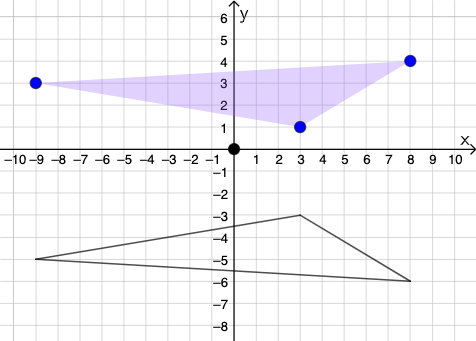
This GeoGebra example demonstrates how to establish triangle congruence by applying a single, well-chosen geometric transformation to an original triangle and then matching corresponding vertices and sides in the transformed triangle. It focuses on the math ideas behind congruence and the invariance properties of geometric transformations—especially reflections (and the broader viewpoint of translation/rotation-style one-step moves). Construction-wise, the model uses Polygon to draw the original triangle and its image triangle (points such as A, B, C and A′, B′, C′), Segment to define and compare corresponding sides, and Mirror to generate the transformed configuration (including mirror-related helper objects like t1, c, a, b and their primed counterparts, producing additional constructed points such as D). The interactive setup is suited for middle and high school geometry classes, as well as for students practicing proof techniques through visualization.
GeoGebra Commands & Parameters
Polygon(A, B, C) → t1, c, a, bMirror(A, y = -1) → A'_{1}Mirror(B, y = -1) → B'_{1}Mirror(C, y = -1) → C'_{1}Polygon(A'_{1}, B'_{1}, C'_{1}) → t1', c', a', b'Segment(C'_{1}, B'_{1}) → fSegment(B'_{1}, A'_{1}) → gSegment(A'_{1}, C'_{1}) → h
AI Drawing Prompt Reference
On a coordinate plane, draw a triangle ABC. Reflect the triangle across the horizontal line y = -1 to obtain the image triangle A′B′C′, using the mirrored points. Then draw the three sides of the reflected triangle by connecting C′ to B′, B′ to A′, and A′ to C′, labeling them as corresponding segments f, g, and h. Display the original triangle and its reflected triangle side by side to show the vertex and side correspondence.
The prompt above was compiled from the original drawing commands and is for reference only.