
Marion’s Theorem: Constructing Similarity and Area Relations
Loading the math board and drawing, please wait…
In collections
Besondere Punkte/Special Points
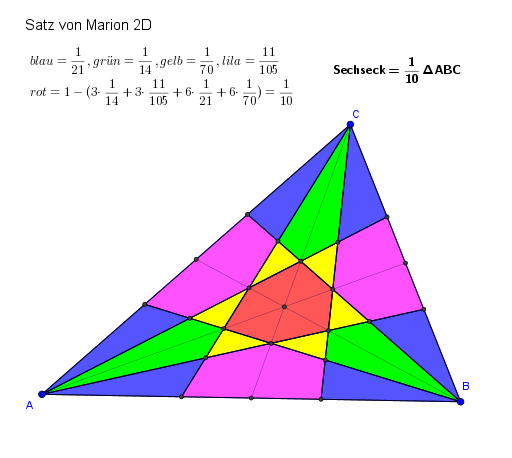
This GeoGebra example visualizes Marion’s Theorem (Theorem von Marion) in a concrete geometric configuration. Starting from a triangle and carefully chosen associated points, the construction uses similarity/transform ideas—often expressible via rotation-like relations—to create correspondences between segments and lines, leading to the theorem’s underlying invariant relationships (commonly expressed through area or equivalent similarity constraints). Key concepts include triangle geometry, similarity transformations (similarity mappings), rotation/rigid angle-preserving behavior, and the way intersections and midpoints enforce the relationships needed for the theorem. Construction-wise, it leverages GeoGebra commands reflected in the construct summary: Polygon to build the primary polygonal/triangular framework from points; Segment to draw the essential connecting sides and derived segments (points such as A, B, C, d1, c, a, b, etc. participate as endpoints); Intersect to compute intersection points that anchor the configuration (points like D, E, F, G, H, I, J, K, L, …); and Midpoint to obtain midpoints that create the metric/structural constraints (objects like d, e, f, g, h, i, n_1, o, etc.). Labels such as Text1 help mark the theorem structure. Suitable for high-school geometry instruction, competition geometry visualization, and guided exploration of how similarity/transformations lead to a named theorem.
GeoGebra Commands & Parameters
Polygon(A, B, C) → d1, c, a, bSegment(D, C) → dSegment(E, C) → eSegment(F, A) → fSegment(G, A) → gSegment(H, B) → hSegment(I, B) → iIntersect(f, i) → JIntersect(e, f) → KIntersect(e, h) → LIntersect(g, h) → MIntersect(d, g) → NIntersect(d, i) → OPolygon(J, K, L, M, N, O) → v2, j, k, l, m, n_1, oMidpoint(c) → PMidpoint(a) → QMidpoint(b) → RSegment(A, Q) → nSegment(C, P) → pSegment(B, R) → qIntersect(n, p) → SIntersect(d, h) → TIntersect(e, g) → UPolygon(C, T, M, U) → v1, c_1, t, m_1, uIntersect(d, f) → VIntersect(g, i) → WPolygon(A, V, O, W) → v3, a_1, v, o_1, wIntersect(e, i) → ZIntersect(f, h) → A_1Polygon(Z, B, A_1, K) → v4, z_1, b_1, r, k_1Polygon(C, H, T) → d2, t_1, c_2, h_1Polygon(C, U, G) → d3, g_1, c_3, u_1Polygon(F, A_1, B) → d4, b_2, f_1, sPolygon(Z, E, B) → d5, b_3, z_2, e_1Polygon(A, D, V) → d6, v_1, a_2, d_1Polygon(I, A, W) → d7, w_1, i_1, a_3Polygon(T, N, M) → d8, m_2, t_2, n_2Polygon(U, M, L) → d9, l_1, u_2, m_3Polygon(N, W, O) → d10, o_2, n_3, w_2Polygon(O, V, J) → d11, j_1, o_3, v_2Polygon(J, Z, K) → d12, k_2, j_2, z_3Polygon(L, K, A_1) → d13, p_1, l_2, k_3Polygon(H, I, W, N, T) → Vieleck1, h_2, i_2, w_3, n_4, t_3Polygon(G, U, L, A_1, F) → Vieleck2, g_2, u_3, l_3, q_1, f_2Polygon(V, D, E, Z, J) → Vieleck3, v_3, d_2, e_2, z_4, j_3
AI Drawing Prompt Reference
Draw a triangle ABC, construct similar triangles and area relationships through points D, E, F, G, H, I using rotation and translation transformations. Connect key points J, K, L, M, N, O to form new triangles, then use midpoints P, Q, R to construct auxiliary line segments n, p, q. Finally, utilize intersection points S, T, U, V, W, Z, A1 to construct multiple triangles and polygons, illustrating the similarity and area relationships in Marion's Theorem.
The prompt above was compiled from the original drawing commands and is for reference only.