
Convert Complex Numbers from Polar to Cartesian (r, θ → x, y)
Loading the math board and drawing, please wait…
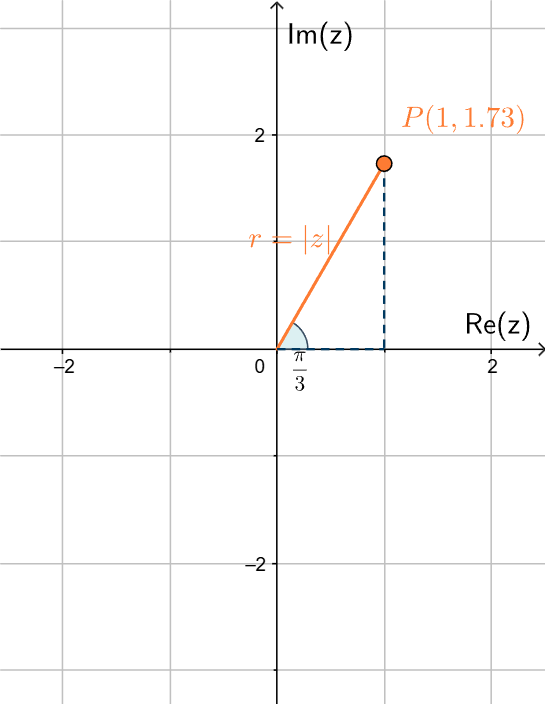
This example visually demonstrates how a complex number’s polar form (with modulus r and argument θ) corresponds to its Cartesian coordinates (x and y) on the coordinate plane. It helps learners see that the same complex number can be represented geometrically in different forms: z=r(cosθ+i sinθ), and equivalently x=r cosθ, y=r sinθ. The construction centers on the relationship between the radius segment from the origin, the marked angle θ, and the right-triangle/trigonometric interpretation of the coordinate projections. In GeoGebra, the build uses Translate (to position points and labels), FractionText (for nicely formatted formula text), Segment (to draw the radius/connection lines such as OP), and Angle (to display and manage the argument θ). Key objects include r and theta, points O and P, the complex label z_{1}, and text/angle decoration objects (e.g., alphaDecor, txtAngle) that link the visual geometry to the algebraic expressions. Suitable for Grade 11–level complex numbers, coordinate geometry, and trigonometry instruction, as well as for classroom demonstrations and guided self-study.
GeoGebra Commands & Parameters
Translate(O, z_{1}) → PFractionText(theta / 12) → text2Segment(O, P) → r1Segment(O, B) → aSegment(P, B) → bAngle((1, 0), O, P) → alphaAngle((1, 0), O, P) → alphaDecor
AI Drawing Prompt Reference
Draw a coordinate plane illustrating the conversion of a complex number from polar to Cartesian form. Start at the origin, draw a segment to a point P representing the modulus r. From the origin, draw a ray along the positive x-axishol and mark the angle θ between this ray and the segment OP. Drop a perpendicular from P to the x-axis, meeting at point B, forming a right triangle. Label point P with the complex number z₁. Display a fraction text showing θ/12. Use an arc to indicate the angle θ, and add a decorative angle marker. The diagram should clearly show the relationships among r, θ, and the Cartesian coordinates x and y.
The prompt above was compiled from the original drawing commands and is for reference only.