
Spanish Technological Centers Logo
Loading the math board and drawing, please wait…
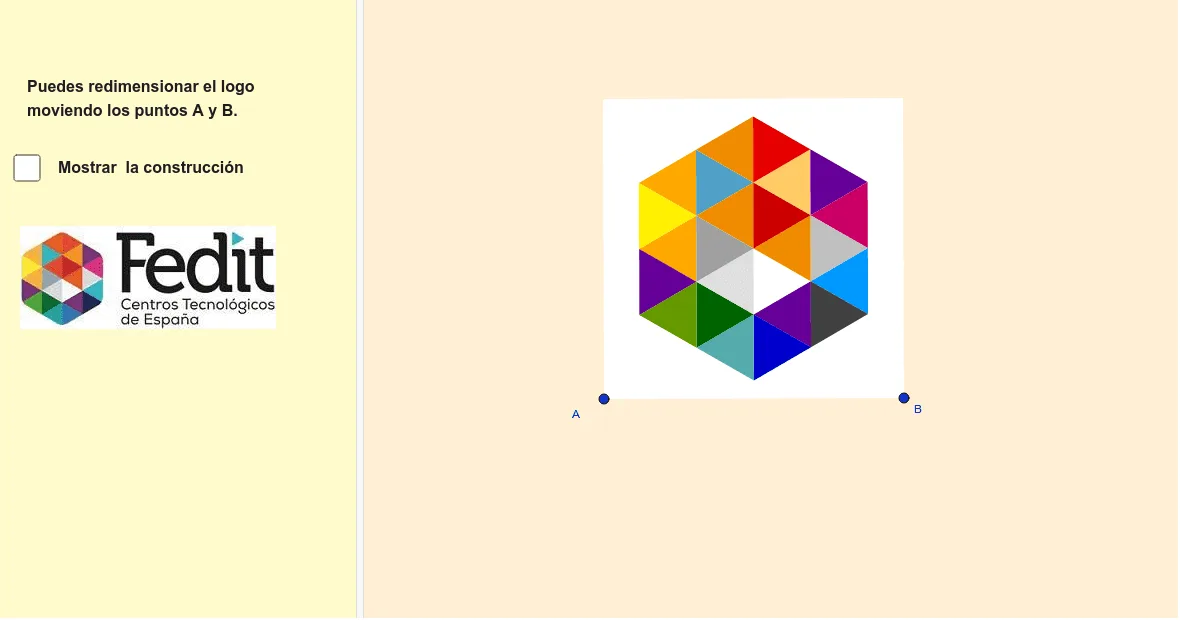
This example demonstrates how to use GeoGebra to draw the logo of Spanish Technological Centers. Key mathematical concepts include polygons and vectors. Using commands like Line, OrthogonalLine, Vector, LineBisector, etc., the various parts of the logo are constructed. Suitable for high school mathematics education and learning.
GeoGebra Commands & Parameters
Line(A, B) → sOrthogonalLine(A, s) → bVector(A, B) → uOrthogonalVector(u) → vOrthogonalLine(F, b) → fLineBisector(A_1, A) → hMirror(f, h) → f'OrthogonalLine(D, s) → iIntersect(i, f) → IOrthogonalLine(B, u, xOyPlane) → gLineBisector(A, B) → mIntersect(m, f) → EMirror(i, m) → i'Intersect(i, f') → JOrthogonalLine(A_1, b) → rIntersect(g, r) → CMirror(J, m) → J'Mirror(J, h) → J'_1Mirror(J', h) → J''Polygon(A, B, C, A_1) → q1, a_1, b_1, c, jLineBisector(A_1, A) → nIntersect(m, f') → KIntersect(m, n) → MSegment(K, M) → kCircle(M, k) → dCircle(K, k) → eIntersect(e, d) → N, O, ,Circle(E, k) → pIntersect(p, d) → P, Q, ,Intersect(e, p) → R, , ,Polygon(O, K, N, Q, E, P) → poly1, o, k_1, n_1, q, e_3, p_1Midpoint(K, N) → SMirror(S, m) → S'Mirror(S, n) → S'_1Mirror(S', n) → S''Intersect(n, p_1) → TIntersect(n, n_1) → WSegment(T, S) → lSegment(S'', W) → tSegment(T, S'_1) → f_1Segment(W, S') → g_1Segment(O, Q) → h_1Segment(P, N) → i_1Intersect(l, g_1) → B_1Intersect(l, h_1) → C_1Intersect(t, h_1) → D_1Intersect(t, f_1) → VIntersect(f_1, i_1) → F_1Intersect(i_1, g_1) → UOrthogonalLine(S', f') → j_1OrthogonalLine(S, f') → l_1Polygon(S', O, C_1) → t1, c_1, s', o_1Polygon(T, C_1, F_1) → t2, m_1, t_1, q_1Polygon(S, B_1, U) → t3, u_1, s_1, r_1Polygon(C_1, B_1, S') → t4, d_1, f_2, g_2Polygon(P, F_1, T) → t5, t_2, p_2, h_2Polygon(V, D_1, S'_1) → t6, s'_1, v_1, i_2Polygon(S, U, N) → t7, n_2, s_2, u_2Polygon(Q, W, D_1) → t8, j_2, q_2, wPolygon(E, S'_1, V) → t9, v_2, e_4, k_2Polygon(V, S'', F_1) → t10, l_2, v_3, s''Polygon(P, S'', F_1) → t11, m_2, p_3, r_2Polygon(S'_1, Q, D_1) → t12, a_2, b_2, q_3Polygon(S'', E, V) → t13, v_4, c_2, e_5Polygon(N, W, U) → t14, u_3, n_3, w_1Polygon(O, T, C_1) → t15, d_2, o_2, t_3Polygon(W, U, D_1) → t16, f_3, w_2, u_4Polygon(V, R, F_1) → t17, g_3, v_5, r_3Polygon(S', K, B_1) → t18, h_3, i_3, k_3Polygon(C_1, B_1, R) → t19, r_4, j_3, l_3Polygon(R, D_1, U) → t20, u_5, r_5, m_3Polygon(F_1, R, C_1) → t21, s_3, a_3, r_6Polygon(R, B_1, U) → t22, u_6, r_7, b_3Polygon(B_1, S, K) → t23, k_4, c_3, s_4