
Linear Function Word Problems: Transforming Text into Functions
Loading the math board and drawing, please wait…
In collections
Mat 1 ESO - IESO LA PAZ
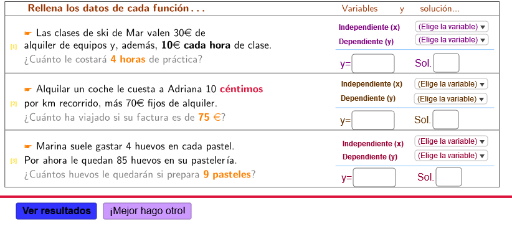
This GeoGebra example demonstrates how to convert real-world word problems into linear function models and solve them through dynamic interaction. The core mathematical concepts include linear functions, slope and intercept, function graphs, and solving equations. Construction highlights: commands such as Random, Shuffle, and Sequence generate random problem data; If, Zip, and Join build conditional logic and text composition; Textfield and TableText create input fields and tables; Segment aids visual representation; Element and RandomElement select random items. Suitable for middle school or early high school students learning applications of linear functions, and useful for teachers creating randomized practice sets or interactive classroom demonstrations.
GeoGebra Commands & Parameters
Element(Forden, 2) → Fnpregunta2Element(Forden, 1) → Fnpregunta1Element(Forden, 3) → Fnpregunta3RandomElement({"peras", "manzanas", "fresas", "naranjas", "mandarinas"}) → F3FrutaRandomElement({3, 4, 5, 6, 7, 8}) → F1pendienteRandom(2, Min[12, abs(F3origen / F3pendiente)] - 1) → F3xRandomElement({2, 3, 4, 5} \ {F4origen}) → F4pendienteRandomElement({2, 3, 4, 5} \ {F6origen}) → F6pendienteRandomElement({10, 15, 20, 25} \ {F7origen}) → F7pendienteRandomElement({2, 3, 4, 5}) → F8pendienteRandomElement({8, 9, 10, 12, 15}) → F9pendienteRandomElement({0.1, 0.12, 0.14, 0.16, 0.08}) → F10pendienteRandomElement({3, 4, 5, 6}) → F11pendienteRandomElement({0.1, 0.2, 0.25, 0.3, 0.35}) → F14pendienteRandomElement({3, 4, 5, 6}) → F17pendienteRandomElement({"claveles", "rosas", "margaritas", "calas", "lirios", "lilas", "tulipanes"}) → F2florShuffle(Join[{nombresHombre, nombresMujer}]) → nombresAzar, {"Reyes", "Helena", "María", "Álvaro", "Raquel", "Víctor", "Adriana", "Julián", "Teresa", "Pedro", "Enrique", "Alicia", "Rosa", "Marina", "Fátima", "Antonio", "Marta", "Isabel", "Lidia", "Luis", "Javier", "Emi", "Sara", "Manuel", "Ana", "José", "Andrea", "Daniel", "Luisa", "Alberto", "Sergio", "Aitana", "Eulalia", "Fernando", "Moisés", "Donato", "Marcos", "Juan", "Lucía", "Mar", "Yumalai"}RandomElement({6, 7, 8, 9, 10, 11, 12, 13, 14, 15}) → F1xRandom(3, Min[12, abs(F2origen / F2pendiente)] - 1) → F2xRandom(2, 10) → F4xRandom(2, 6) → F5xRandom(2, 6) → F6xRandom(3, 8) → F7xRandom(3, 8) → F8xRandom(8, 15) → F9xRandom(3, 10) → F11xRandom(5, 14) → F12xRandom(5, 8) → F13xRandom(9, 17) → F15xRandom(5, 12) → F16xRandom(5, 12) → F17xRandom(5, Min[12, ((-F18origen)) / F18pendiente]) → F18xRandom(6, Min[12, ((-F19origen)) / F19pendiente]) → F19xRandom(6, Min[12, ((-F20origen)) / F20pendiente]) → F20xIf(Element[FtipoPregunta, 3] ≟ 1, Element[Fy, Fnpregunta3], Element[Fx, Fnpregunta3]) → e3solNumeroIf(Element[FtipoPregunta, 2] ≟ 1, Element[Fy, Fnpregunta2], Element[Fx, Fnpregunta2]) → e2solNumeroIf(Element[FtipoPregunta, 1] ≟ 1, Element[Fy, Fnpregunta1], Element[Fx, Fnpregunta1]) → e1solNumeroZip(t ≠ "?" ∧ Max[RemoveUndefined[{0, IndexOf["(", t, 1], IndexOf["/", t, 1]}]] ≤ 1, t, solEscritas) → ListaAnticopiaSequence("\tiny{\gold{[" + (t) + "]}}" + espacioVertical, t, 1, numPreguntas) → numEjercicioRandomElement({2, 2, 2, 2, 2, 2, 2, 2, 3, 3, 3, 3, 3, 4, 4, 4, 5, 5, 6}) → e3factor1Element(nombreFactores, e3factor1) → e3nombreFactor1RandomElement({2, 2, 2, 2, 2, 2, 2, 2, 3, 3, 3, 3, 3, 4, 4, 4, 5, 5} \ {e3factor1, If[e3factor1 ≟ 6, 5, 10]}) → e3factor2Element(nombreFactores, e3factor2) → e3nombreFactor2Sequence(t, t, 24, 38) → edadesPadresSequence(t, t, 2, 16) → edadesHermanosIf(e3PadreHermano, edadesPadres, edadesHermanos) → e3listaEdadesElegirRandomElement(e3listaEdadesUsar) → e3edadInicialPadreRandomElement(Sequence[t, t, Max[{-6, (-e3edadHijoCoincidencia1) + 1, (-e3edadHijoCoincidencia2) + 1}], 6] \ {-1, 0, 1}) → e3edadIncremento1RandomElement({3, 3, 3, 3, 3, 4, 4, 4, 5, 5, 6}) → e1factorElement(nombreFactores, e1factor) → e1nombreFactorRandomElement({2, 2, 2, 2, 2, 2, 2, 2, 3, 3, 3, 3, 3, 4, 4, 4, 5, 5, 6} \ {e1factor}) → e2factorElement(nombreFactores, e2factor) → e2nombreFactorIf(e1PadreHermano, edadesPadres, edadesHermanos) → e1listaEdadesElegirRandomElement(e1listaEdadesUsar) → e1edadInicialPadreIf(e2PadreHermano, edadesPadres, edadesHermanos) → e2listaEdadesElegirRandomElement(e2listaEdadesUsar) → e2edadInicialPadreRandomElement(Sequence[t, t, Max[-6, (-e2edadHijoCoincidencia) + 1], 6] \ {-1, 0, 1}) → e2edadIncrementoZip(yaHechoIndicador ∨ tipoBien ∧ solValida ∧ respuesta ≟ sol, respuesta, {Ftipo1Bien, Ftipo2Bien, Ftipo3Bien}, respuestasUserSistema, sol, listaSoluciones, solValida, ListaAnticopia, yaHechoIndicador, yaHechos, tipoBien) → listaCorrectoZip("" + (If[ejHecho, "\green", "" + (If[¬comprobado, "\phantom", "\gray"])]), ejHecho, yaHechos) → listacolorSolucionZip(TableText[{r}, "vl_00100"], r, respuestasParaMostrar) → respuestasSistematxtZip("" + (If[comprobado ∧ (¬ejBienIndicador), t, "\quad "]), t, txtSolUser_0, ejBienIndicador, yaHechos) → txtSolUserRandom(2, 12) → ec4solIf(¬comprobado, "\phantom", "\gray") → colorSolucionZip("n=" + (If[Element[f, 2] ≟ 1, "" + (Element[f, 1]), "\frac{" + (Element[f, 1]) + "}{" + (Element[f, 2]) + "}"]), f, respuestasUserSistema) → listaFraccionesUserRandomElement({2, 2, 2, 2, 2, 3, 3, 3, 4, 4, 5}) → ej4factorElement({"", "doble", "triple", "cuádruple", "quíntuple"}, ej4factor) → ej4factortxtRandomElement({"un\,\,número\,\,y\,\,su\,\,siguiente", "dos\,\,números\,\,consecutivos"}) → ej4expresionIf(SolConDenom, -8.8, -7) → incrementoyCartelXZip({"\bold{" + (num) + "}" + espacioVertical, "\!\!\!\!\!{" + (expresion) + "\phantom{(^2)}" + "}", col + "{" + (sol) + "}", "" + (solUser)}, num, listacolorSolucion, numEjercicio, expresion, enunciadosEstatico, sol, listaSolucionestxt, solUser, txtSolUser, col) → txtEnunciadosIf(comprobado, {{"", "", "\bold{\orange{Solución}}", "\bold{\purple{Respuesta}}"}}, {{"", "\bold{\brown{Rellena\,\, los \,\,datos \,\,de \,\,cada \,\,función\ldots\phantom{" + (If[comprobado, "", "XXXXXXXXXXXXXXXX"]) + "}}}", "\small{\brown{Variables\phantom{XXX}\,\,y\phantom{XX}\,\,solución...\phantom{XX}}}"}}) → encabezadoTablaJoin({encabezadoTabla, Take[txtEnunciados, 1, Min[numPreguntas, 10]]}) → listaEnunciadoZip("?" ≟ l ∨ (¬Defined[solUser]), solUser, denominadoresUser, l, listaTextosDenominador) → solNoDefinidaDenominadorSegment(extremolinea1, finallinea1) → aTextfield(r12) → c12Textfield(r13) → c13Textfield(r14) → c14Textfield(r15) → c15Textfield(r16) → c16Textfield(r17) → c17Textfield(r18) → c18Textfield(r19) → c19Textfield(r20) → c20Textfield(r1) → c1Textfield(r2) → c2Textfield(r3) → c3Textfield(r4) → c4Textfield(r5) → c5Textfield(r6) → c6Textfield(r7) → c7Textfield(r8) → c8Textfield(r9) → c9Textfield(r10) → c10Textfield(r11) → c11TableText(Take[txtEnunciados, 11, 20], cadenaTablaEnunciado) → enun2Zip("" + (If[nocopia ∧ t ≠ "?", t, "0"]), nocopia, ListaAnticopia, t, solEscritas) → expresionesTableText(listaEnunciado, cadenaTablaEnunciado) → preEnunSegment(origenRaya5, origenRaya5 + (6, 0)) → raya5If(SolConDenom, PosConDenom, PosSinDenom) → OrigenTablaIf(SolConDenom, OrigenCartelXfrac, OrigenCartelXEntero) → OrigenCartelXElement({0, 3.5, 7, 10}, 1 + Sum[Zip[If[l, 1, 0], l, listaCorrecto]]) → totalAppend("(Elige la variable)", If[Element[FordenVariables, 1] ≟ 1, {"" + (Element[Fmagx, Fnpregunta1]), "" + (Element[Fmagy, Fnpregunta1])}, {"" + (Element[Fmagy, Fnpregunta1]), "" + (Element[Fmagx, Fnpregunta1])}]) → Felegir1Append("(Elige la variable)", If[Element[FordenVariables, 2] ≟ 1, {"" + (Element[Fmagx, Fnpregunta2]), "" + (Element[Fmagy, Fnpregunta2])}, {"" + (Element[Fmagy, Fnpregunta2]), "" + (Element[Fmagx, Fnpregunta2])}]) → Felegir2Append("(Elige la variable)", If[Element[FordenVariables, 3] ≟ 1, {"" + (Element[Fmagx, Fnpregunta3]), "" + (Element[Fmagy, Fnpregunta3])}, {"" + (Element[Fmagy, Fnpregunta3]), "" + (Element[Fmagx, Fnpregunta3])}]) → Felegir3Segment(A, B) → separador1Segment(Translate[A, (0, -13.4)], Translate[B, (0, -13.4)]) → separador2Segment(Translate[A, (0, -26.8)], Translate[B, (0, -26.8)]) → separador3Zip(respuesta ≟ sol, respuesta, respuestasUserSistema, sol, listaSoluciones) → listaRespuestasBienShuffle(Sequence[t, t, 1, 20]) → listaInicial, {3, 10, 11, 14, 17, 7, 19, 6, 9, 16, 8, 4, 2, 15, 5, 1, 13, 12, 20, 18}
AI Drawing Prompt Reference
Create a set of linear-function word-problem visuals. Randomly select a fruit or flower label for each of three problems, and assign each problem its own slope and intercept values (derived from the randomly chosen parameters). For each problem, draw the corresponding linear function as a straight line on the coordinate plane, with the line’s direction determined by the slope and its vertical-axis intercept determined by the intercept. Then indicate the specific x-location(s) used for solving and visually relate that point on the line to the numeric answer obtained from the corresponding linear equation. Arrange the three line graphs together with their matching text labels to form an interactive-style practice set.
The prompt above was compiled from the original drawing commands and is for reference only.