
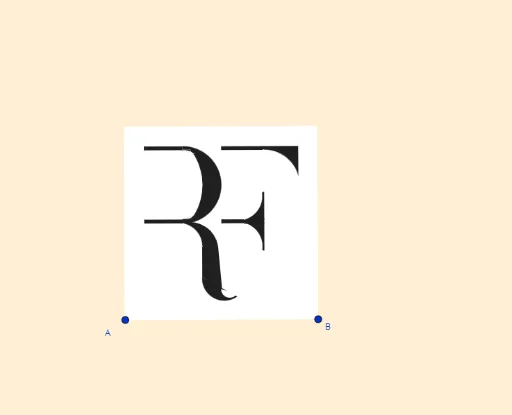
Roger Federer Logo
Loading the math board and drawing, please wait…
This example demonstrates how to use GeoGebra to draw Roger Federer's logo. Key mathematical concepts include vectors, polygons, and circles. Commands such as Line, OrthogonalLine, Vector, and Polygon are used to construct the various parts of the logo. Suitable for high school math education or student practice in geometric construction.
GeoGebra Commands & Parameters
Line(A, B) → sOrthogonalLine(A, s) → bVector(A, B) → uOrthogonalVector(u) → vOrthogonalLine(F, b) → fLineBisector(A, B) → mIntersect(m, f) → MOrthogonalLine(H_2, m) → j_3LineBisector(I, V) → i_3LineBisector(A_1, A) → lIntersect(m, l) → LOrthogonalLine(R, m) → nLineBisector(B_1, V_1) → h_2Intersect(h_2, n) → W_1LineBisector(I_1, B_1) → p_1Intersect(p_1, m) → L_1OrthogonalLine(D, s) → iIntersect(i, l) → POrthogonalLine(B, u, xOyPlane) → gMirror(i, m) → i'OrthogonalLine(A_1, b) → rIntersect(g, r) → CMirror(f, l) → f'Mirror(f, l) → f'_1Mirror(F, l) → F'Intersect(m, f') → SPolygon(A_1, C, B, A) → c4, a_1, c_3, b_2, a_2Intersect(i, f') → EMidpoint(S, L) → HMidpoint(E, S) → KOrthogonalLine(K, r) → hIntersect(h, l) → NLineBisector(K, S) → jOrthogonalLine(H, m) → kIntersect(j, f) → OIntersect(n, j) → TOrthogonalLine(J, b) → pIntersect(i', f') → WOrthogonalLine(C_1, n) → qOrthogonalLine(G, b) → tIntersect(m, t) → E_1Intersect(h, t) → F_1Intersect(q, t) → G_1Polygon(E, K, F_1, G) → c1, e, k_1, f_1, g_1Polygon(S, W, Z, G_1, E_1) → polígono1, s_1, w, z_1, a, cLineBisector(G_1, Z) → dIntersect(d, k) → H_1CircleArc(H_1, Z, G_1) → c_1Intersect(m, p) → J_1Intersect(p, q) → K_1Polygon(B_1, C_1, I_1, V_1) → t1, m_1, n_1, b_1, g_2Polygon(L, C_1, K_1, J_1) → c2, l_1, h_1, i_1, j_1LineBisector(L, J_1) → q_1Mirror(B_1, q_1) → M_1Mirror(C_1, q_1) → N_1Mirror(I_1, q_1) → O_1CircleArc(W_1, V_1, B_1) → d_1Center(d_1) → S_1Intersect(h, p) → T_1Polygon(J, T_1, N, P) → c3, j_2, f_2, n_2, p_2Mirror(d_1, q_1) → r_1Mirror(B_1, q_1) → P_1Mirror(C_1, q_1) → Q_1Mirror(I_1, q_1) → R_1Mirror(V_1, q_1) → Z_1Polygon(P_1, Q_1, R_1, Z_1) → t1', t_1, i_2, k_2, l_2Intersect(j, k) → A_2Mirror(B_2, k) → C_2CircumcircleArc(B_2, A_2, C_2) → d_2Polygon(F_1, B_2, C_2, T_1) → c5, m_2, q_2, r_2, s_2CircumcircleArc(K, H, N) → c_2LineBisector(N, T) → t_2Intersect(t_2, n) → D_2CircleArc(D_2, T, N) → d_3CircumcircleArc(Q, M, U) → e_3CircumcircleArc(N, E_2, R) → f_3LineBisector(R, I) → g_3Intersect(g_3, f) → F_2Intersect(j_3, i_3) → G_2CircleArc(G_2, I, V) → k_3Polygon(N, I_2, R, T) → c6, n_3, l_3, r_3, t_3Polygon(T, R, H_2, Q) → c7, t_4, r_4, m_3, q_3LineBisector(F_1, J_2) → p_3Intersect(p_3, h) → K_2Polygon(F_1, B_2, J_2) → t2, s_3, b_3, f_4CircleArc(K_2, J_2, F_1) → c_4Mirror(F_1, k) → L_2Mirror(B_2, k) → M_2Mirror(J_2, k) → N_2Polygon(L_2, M_2, N_2) → t2', g_4, h_4, i_4Mirror(c_4, k) → d_4Segment(G_1, Z) → h_3Segment(U_1, M_1) → j_4Segment(V_1, B_1) → k_4Segment(N, T) → l_4
AI Drawing Prompt Reference
Draw a Roger Federer logo consisting of vectors, polygons, and circles. Start by creating a line segment and its perpendicular line. Then, define a vector and find its orthogonal direction. Use these elements to construct the various parts of the logo, including intersections of polygons and circles. Determine key positions using midlines and intersections, and combine multiple geometric shapes to form the complex logo.
The prompt above was compiled from the original drawing commands and is for reference only.