
Euler Line in a Cyclic Quadrilateral (Euler-Geraden)
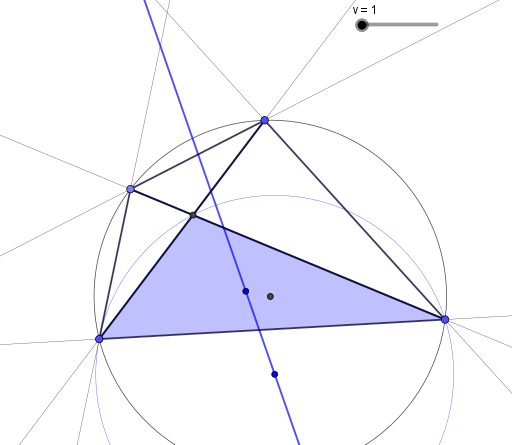
Loading the math board and drawing, please wait…
In collections
Besondere Punkte/Special Points
This example demonstrates how the key centers and the corresponding Euler line relationships arise in a cyclic quadrilateral (a quadrilateral whose vertices lie on a common circle). The main concepts include cyclic quadrilaterals, circle/line intersection geometry, constructing auxiliary lines and intersection points, and using the centroid (Centroid) to obtain central points used in the Euler-geraden configuration. The construction in GeoGebra relies on Circle and its Center to define the circumcircle, Point and Line to model the quadrilateral and supporting chords/lines, Intersect to compute critical intersection points, Polygon to represent the quadrilateral, and Centroid to compute the required center points; final lines are then determined by connecting these constructed points. Suitable for high school to early undergraduate students studying geometric loci/center lines, Euler-type lines, and geometric construction techniques in GeoGebra.
GeoGebra Commands & Parameters
Circle(A, B, C) → cPoint(c) → DCenter(c) → ELine(A, B) → fLine(B, C) → gLine(C, D) → hLine(D, A) → iLine(D, B) → jLine(A, C) → kIntersect(j, k) → FPolygon(A, B, F) → d1, f_1, a, bPolygon(F, B, C) → d2, c_1, f_2, b_1Polygon(F, C, D) → d3, d, f_3, c_2Polygon(A, F, D) → d4, d_1, a_1, f_4Centroid(d1) → GCircle(A, B, F) → eCenter(e) → HLine(G, H) → lCentroid(d2) → ICircle(F, B, C) → pCenter(p) → JLine(I, J) → mCentroid(d3) → KCircle(D, F, C) → qCenter(q) → LLine(L, K) → nCentroid(d4) → MCircle(D, A, F) → rCenter(r) → NLine(N, M) → sIntersect(m, l) → O
AI Drawing Prompt Reference
Draw a circle and place four points on it, connecting them in order to form a cyclic quadrilateral. Find the center of the circumcircle. Draw one diagonal of the quadrilateral, and intersect it with the other diagonal to get a point. Using this point and adjacent vertices, form four smaller triangles. For each triangle, compute its centroid and draw its circumcircle, marking the circle's center. Connect each centroid to its corresponding circumcenter with a line. Take the intersection of two adjacent such lines as the final point.
The prompt above was compiled from the original drawing commands and is for reference only.