
Regular Tessellation {6,3}
Loading the math board and drawing, please wait…
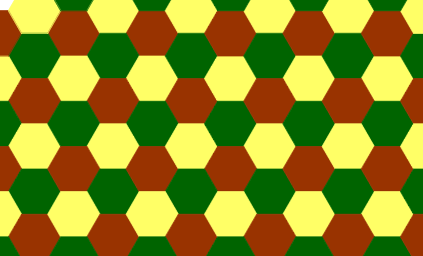
This example demonstrates the regular tessellation of hexagons using triplets. It involves core mathematical concepts like polygon construction, vector operations, and geometric transformations. The construction utilizes GeoGebra commands and objects such as Point, Polygon, Vector, and Translate. It is suitable for high school mathematics education, illustrating plane figure tiling properties and transformation rules.
GeoGebra Commands & Parameters
Point(xAxis) → BPolygon(A, B, 6) → poly1, f, F, g, h, i, j, k, C, D, EPolygon(D, C, 6) → poly2, l, J, m, n, p, q, r, G, H, IPolygon(I, H, 6) → poly3, s, N, t, a, b, c, d, K, L, MPoint(xAxis) → OVector(B, O) → uTranslate(poly1, u) → poly1'Point(yAxis) → PVector(A, P) → vTranslate(poly2, v) → poly2'Translate(poly2, u) → poly2'_{1}Translate(poly1', u) → poly1''Translate(poly2', u) → poly2''Translate(poly3, u) → poly3'Translate(poly1', v) → poly1''_{1}Translate(poly1'', v) → poly1'''Translate(poly1, v) → poly1'_{1}Translate(poly2', v) → poly2''_{1}Translate(poly2'_{1}, u) → poly4Translate(poly2'', u) → poly2'''Translate(poly2''_{1}, u) → poly5Translate(poly5, u) → poly5'Translate(poly1''', u) → poly6Translate(poly1'', u) → poly1'''_{1}Translate(poly4, u) → poly4'Translate(poly3', u) → poly3''Translate(poly2''', u) → poly7Translate(poly1'''_{1}, u) → poly8Translate(poly6, u) → poly6'Translate(poly1'_{1}, v) → poly9Translate(poly2''_{1}, v) → poly10Translate(poly1''_{1}, v) → poly11Translate(poly1''', v) → poly12Translate(poly5, v) → poly5'_{1}Translate(poly9, v) → poly9'Translate(poly10, v) → poly10'Translate(poly11, v) → poly11'Translate(poly5'_{1}, v) → poly13Translate(poly12, v) → poly12'Translate(poly5', v) → poly5''Translate(poly6, v) → poly6'_{1}Translate(poly7, v) → poly7'Translate(poly7', v) → poly7''Translate(poly6'_{1}, v) → poly14Translate(poly5'', v) → poly5'''Translate(poly6', v) → poly6''Translate(poly7'', v) → poly7'''Translate(poly6'', v) → poly6'''Translate(poly6''', v) → poly15Translate(poly9', v) → poly9''Translate(poly10', v) → poly10''Translate(poly11', v) → poly11''Translate(poly13, v) → poly13'Translate(poly12', v) → poly12''Translate(poly5''', v) → poly16Translate(poly14, v) → poly14'Translate(poly7''', v) → poly17Translate(poly4', u) → poly4''Translate(poly7, u) → poly7'_{1}Translate(poly6', u) → poly6''_{1}Translate(poly7', u) → poly7''_{1}Translate(poly6'', u) → poly6'''_{1}Translate(poly7''_{1}, v) → poly18Translate(poly18, v) → poly18'Translate(poly6'''_{1}, v) → poly19Translate(poly19, v) → poly19'Translate(poly18', v) → poly18''Translate(poly8, u) → poly8'Translate(poly9'', v) → poly9'''Translate(poly11'', v) → poly11'''Translate(poly12'', v) → poly12'''Translate(poly14', v) → poly14''Translate(poly15, v) → poly15'Translate(poly19', v) → poly19''Translate(poly7'_{1}, u) → poly20Translate(poly7''_{1}, u) → poly21Translate(poly18, u) → poly18'_{1}Translate(poly4'', u) → poly4'''Translate(poly18'_{1}, v) → poly22Translate(poly22, v) → poly22'Translate(poly8', u) → poly8''Translate(poly8'', v) → poly8'''Translate(poly8''', v) → poly23Translate(poly23, v) → poly23'Translate(poly23', v) → poly23''Translate(poly23'', v) → poly23'''Translate(poly3'', u) → poly3'''Translate(poly3''', u) → poly24
AI Drawing Prompt Reference
Create a regular tessellation {6,3} with hexagons. First, define a base setup on the plane using two reference points (A and B) determined by the axes, then construct a regular 6-sided polygon using A and B. Using the corresponding adjacent vertices, build a second and a third regular hexagon so they sit next to the first one in the same strip-like arrangement. Define two translation directions with vectors: one from B to a point O on the x-axis, and another from A to a point P on the y-axis. Repeatedly translate the constructed hexagons by these two vectors in a grid pattern to extend the tiling, ensuring the translated hexagons fit together edge-to-edge and form multiple rows and columns of the regular hexagon mosaic.
The prompt above was compiled from the original drawing commands and is for reference only.