
Regular Hexagonal Tessellation
Loading the math board and drawing, please wait…
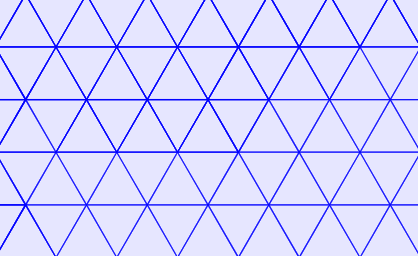
This example demonstrates the construction of a regular hexagonal tessellation. It involves key mathematical concepts such as equilateral triangles and straight lines. Using GeoGebra commands like Intersect, Point, Polygon, Vector, and Translate, a regular hexagonal tessellation can be constructed. Suitable for middle school and above students to learn geometric construction.
GeoGebra Commands & Parameters
Intersect(xAxis, yAxis) → APoint(xAxis) → BPolygon(A, B, 3) → poly1, f, g, h, CPolygon(C, B, 3) → poly2, i, j, k, DPolygon(C, D, 3) → poly3, l, m, n, EPolygon(C, E, 3) → poly4, p, q, r, FPolygon(C, F, 3) → poly5, s, t, a, GPolygon(C, G, 3) → poly6, b, c, d, HPolygon(D, B, 3) → poly7, e, f_1, g_1, IPolygon(D, I, 3) → poly8, h_1, i_1, j_1, JPolygon(D, J, 3) → poly9, k_1, l_1, m_1, KPolygon(D, K, 3) → poly10, n_1, p_1, q_1, LPolygon(J, I, 3) → poly11, r_1, s_1, t_1, MPolygon(J, M, 3) → poly12, a_1, b_1, c_1, NPolygon(J, N, 3) → poly13, d_1, e_1, f_2, OPolygon(J, O, 3) → poly14, g_2, h_2, i_2, PPolygon(N, M, 3) → poly15, j_2, k_2, l_2, QPolygon(N, Q, 3) → poly16, m_2, n_2, p_2, RPolygon(N, R, 3) → poly17, q_2, r_2, s_2, SPolygon(N, S, 3) → poly18, t_2, a_2, b_2, TPolygon(B, A, 3) → poly19, c_2, d_2, e_2, UPolygon(I, B, 3) → poly20, f_3, g_3, h_3, VPolygon(M, I, 3) → poly21, i_3, j_3, k_3, WPolygon(Q, M, 3) → poly22, l_3, m_3, n_3, ZPolygon(W, Z, 3) → poly23, p_3, q_3, r_3, A_1Polygon(V, W, 3) → poly24, s_3, t_3, a_3, B_1Polygon(U, V, 3) → poly25, b_3, c_3, d_3, C_1Polygon(U, A, 3) → poly26, e_3, f_4, g_4, D_1Polygon(A, G, 3) → poly27, h_4, i_4, j_4, E_1Polygon(E_1, D_1, 3) → poly28, k_4, l_4, m_4, F_1Vector(A, U) → uTranslate(poly19, u) → poly19'Translate(poly20, u) → poly20'Translate(poly23, u) → poly23'Translate(poly21, u) → poly21'Translate(poly24, u) → poly24'Translate(poly25, u) → poly25'Translate(poly28, u) → poly28'Translate(poly26, u) → poly26'Translate(poly22, u) → poly22'Translate(poly15, u) → poly15'Translate(poly16, u) → poly16'Translate(poly17, u) → poly17'Translate(poly15', u) → poly15''Translate(poly17', u) → poly17''Translate(poly16', u) → poly16''Translate(poly28', u) → poly28''Translate(poly26', u) → poly26''Translate(poly19', u) → poly19''Translate(poly25', u) → poly25''Translate(poly20', u) → poly20''Translate(poly24', u) → poly24''Translate(poly23', u) → poly23''Translate(poly21', u) → poly21''Translate(poly15'', u) → poly15'''Translate(poly22', u) → poly22''Polygon(S, R, 3) → poly29, n_4, p_4, q_4, G_1Polygon(G_1, R, 3) → poly30, r_4, s_4, t_4, H_1Polygon(H_1, R, 3) → poly31, a_4, b_4, c_4, I_1Polygon(G_1, H_1, 3) → poly32, d_4, e_4, f_5, J_1Polygon(J_1, H_1, 3) → poly33, g_5, h_5, i_5, K_1Polygon(J_1, K_1, 3) → poly34, j_5, k_5, l_5, L_1Translate(poly30, u) → poly30'Translate(poly32, u) → poly32'Translate(poly33, u) → poly33'Translate(poly34, u) → poly34'Translate(poly31, u) → poly31'Translate(poly30', u) → poly30''Translate(poly32', u) → poly32''Translate(poly17'', u) → poly17'''Translate(poly31', u) → poly31''Translate(poly30'', u) → poly30'''Translate(poly16'', u) → poly16'''Translate(poly17''', u) → t1Translate(poly31'', u) → poly31'''Polygon(D_1, E_1, 3) → poly35, m_5, n_5, p_5, M_1Polygon(D_1, M_1, 3) → poly36, q_5, r_5, s_5, N_1Polygon(D_1, N_1, 3) → poly37, t_5, a_5, b_5, O_1Polygon(O_1, N_1, 3) → poly38, c_5, d_5, e_5, P_1Polygon(O_1, P_1, 3) → poly39, f_6, g_6, h_6, Q_1Polygon(G, F, 3) → poly40, i_6, j_6, k_6, R_1Polygon(G, R_1, 3) → poly41, l_6, m_6, n_6, S_1Polygon(G, S_1, 3) → poly42, p_6, q_6, r_6, T_1Polygon(P_1, N_1, 3) → poly44, b_6, c_6, d_6, V_1
AI Drawing Prompt Reference
Draw a regular hexagonal tessellation starting from the origin, with the first equilateral triangle formed by the intersection of the x-axis and y-axis. Expand outward by connecting adjacent triangles at shared vertices, creating a continuous grid of equilateral triangles and regular hexagons, resulting in a seamless pattern of interconnected shapes.
The prompt above was compiled from the original drawing commands and is for reference only.