
Rectangle-Based Prism Surface Area with a Net in GeoGebra
Loading the math board and drawing, please wait…
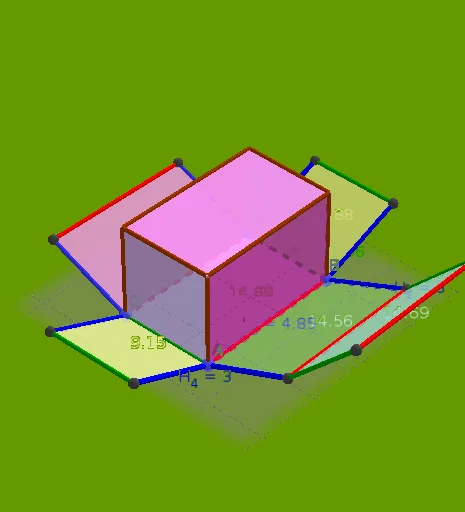
This example demonstrates how to construct a prism-like solid from rectangle faces in GeoGebra and visualize its surface-area “net” so that the total surface area can be understood as the sum of areas of the component rectangles. Key math concepts include solid geometry, rectangle area, surface area as an additive measure across faces, and the correspondence between a solid’s faces and the edges in its unfolded net (geometric construction and consistent adjacency). Construction-wise, the workflow in the GeoGebra command summary uses Polygon and Prism to create the solid and uses Net to unfold it into a planar layout. The involved objects include multiple vertices and dimension parameters (e.g., A, B, C, D; W, L; q1; b) as well as labeled faces such as faceABFE, faceBCGF, faceCDHG, faceADHE, and faceEFGH. Labeled edges (edgeAE, edgeBF, edgeCG, edgeDH, edgeEF, edgeFG, edgeGH, edgeEH) help maintain the correct unfolding connections. Suitable for middle school through early undergraduate geometry lessons, classroom demonstrations, and self-study on surface area via nets.
GeoGebra Commands & Parameters
Polygon(A, B, C, D) → q1, L_3, W_2, c, WPrism(q1, 3) → e, E, edgeAE, edgeBF, edgeCG, edgeDH, edgeEF, edgeFG, edgeGH, edgeEH, F, G, H_1, faceABFE, faceBCGF, faceCDHG, faceADHE, faceEFGHNet(e, f) → g, I, R, S, T, U, V, faceIJKL, L_5, faceJKPO, faceKLRQ, faceILST, J, faceMNUV, L_2, W_1, L, edgeIL, H_4, L_4, H_2, H, edgeOP, K, H_6, edgeKQ, edgeQR, edgeLR, H_5, edgeST, H_3, edgeNU, edgeUV, edgeMV, L_1, M, N, O, P, QPolygon(A_1, B_1, C_1, D_1) → q1_1, L_6, W_3, c_1, W_4Prism(q1_1, 3) → e_1, E_1, edgeAE_1, edgeBF_1, edgeCG_1, edgeDH_1, edgeEF_1, edgeFG_1, edgeGH_1, edgeEH_1, F_1, G_1, H_{13}, faceABFE_1, faceBCGF_1, faceCDHG_1, faceADHE_1, faceEFGH_1Net(e_1, f_1) → g_1, I_1, R_1, S_1, T_1, U_1, V_1, faceIJKL_1, L_9, faceJKPO_1, faceKLRQ_1, faceILST_1, J_1, faceMNUV_1, L_{10}, W_5, L_{11}, edgeIL_1, H_9, L_8, H_7, H_{10}, edgeOP_1, K_1, H_{11}, edgeKQ_1, edgeQR_1, edgeLR_1, H_8, edgeST_1, H_{12}, edgeNU_1, edgeUV_1, edgeMV_1, L_7, M_1, N_1, O_1, P_1, Q_1Polygon(A_2, B_2, C_2, D_2) → q1_2, L_{17}, W_7, c_2, W_8Prism(q1_2, 3) → e_2, E_2, edgeAE_2, edgeBF_2, edgeCG_2, edgeDH_2, edgeEF_2, edgeFG_2, edgeGH_2, edgeEH_2, F_2, G_2, H_{20}, faceABFE_2, faceBCGF_2, faceCDHG_2, faceADHE_2, faceEFGH_2Net(e_2, f_2) → g_2, I_2, R_2, S_2, T_2, U_2, V_2, faceIJKL_2, L_{14}, faceJKPO_2, faceKLRQ_2, faceILST_2, J_2, faceMNUV_2, L_{16}, W_6, L_{15}, edgeIL_2, H_{17}, L_{13}, H_{16}, H_{15}, edgeOP_2, K_2, H_{14}, edgeKQ_2, edgeQR_2, edgeLR_2, H_{18}, edgeST_2, H_{19}, edgeNU_2, edgeUV_2, edgeMV_2, L_{12}, M_2, N_2, O_2, P_2, Q_2
AI Drawing Prompt Reference
Draw a three-dimensional rectangular prism with a rectangular base and vertical edges, height of 3 units. Then unfold this prism into a flat net showing all six rectangular faces: top, bottom, and four sides, with adjacent faces connected along corresponding edges. Create two additional prisms with the same structure but different dimensions, each with its own unfolded net, totaling three prisms and their nets. Clearly illustrate how the total surface area equals the sum of the areas of all component rectangles.
The prompt above was compiled from the original drawing commands and is for reference only.