
Geometric Proof of Pythagoras: Polygon Decomposition and Area Equality
Loading the math board and drawing, please wait…
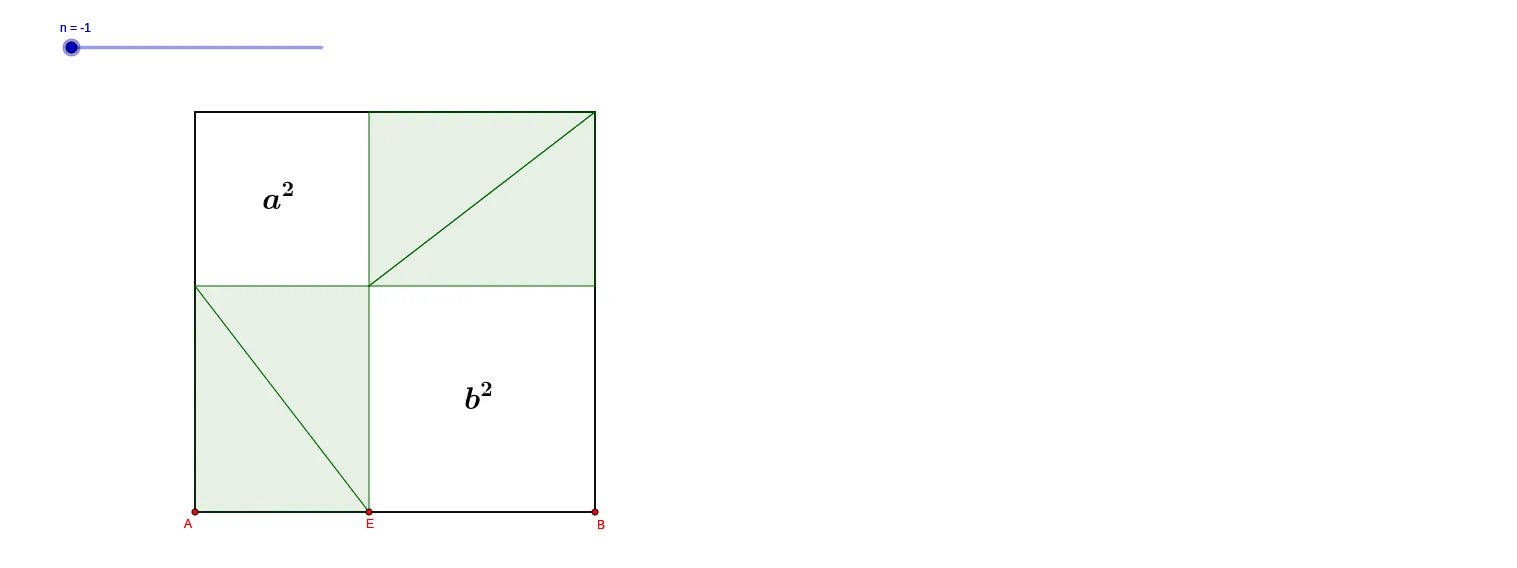
This example visually demonstrates the Pythagorean theorem in a right triangle by building and rearranging several polygons through rotations and translations, revealing an area/length equivalence that corresponds to a² + b² = c². The core mathematical ideas are the Pythagorean theorem, right angles, orthogonality, and the invariance of relationships under geometric transformations. Construction highlights from the GeoGebra command list include: creating key points and polygonal regions with Polygon and Point (wielokąt1 through wielokąt4 and their primed variants), using Rotate to reposition parts around pivot points, using Translate to shift pieces into a new configuration, employing OrthogonalLine to construct the perpendicular/orthogonal structure, using Intersect to determine intersection vertices, and using Midpoint to place reference points for symmetry or scaling. Text labels are added with Text to track quantities such as a, b, c, h and auxiliary lengths/parameters (e, f, n, n1, n2, n3, etc.). Suitable for middle/high school geometry lessons, classroom demonstrations, and self-study focused on understanding proofs via geometric constructions and rearrangement.
GeoGebra Commands & Parameters
Polygon(A, B, 4) → wielokąt1, a, b, c, d, C, DPoint(a) → ERotate(E, 270°, B) → E'OrthogonalLine(E', b) → eOrthogonalLine(E, a) → fIntersect(e, f) → FIntersect(f, c) → GIntersect(e, d) → HIf(n < 0, 0, If[n ≤ 1, n, 1]) → n1If(n < 1, 0, If[n ≥ 2, 1, n - 1]) → n2Polygon(H, E, A) → wielokąt2, a_1, h, e_1If(n < 2, 0, If[n ≥ 3, 1, n - 2]) → n3Translate(F, Vector[(n1 * Vector[G, D])]) → F'Translate(G, Vector[(n1 * Vector[G, D])]) → G'Translate(C, Vector[(n1 * Vector[G, D])]) → C'Polygon(F', G', C') → wielokąt3, c', f', g'Translate(F, Vector[(n2 * Vector[F, E])]) → F'_1Translate(C, Vector[(n2 * Vector[F, E])]) → C'_1Translate(F, Vector[(n2 * Vector[F, E])]) → F'_2Translate(C, Vector[(n2 * Vector[F, E])]) → C'_2Translate(E', Vector[(n2 * Vector[F, E])]) → E''Polygon(F'_2, C'_2, E'') → wielokąt4, e'', f'_2, c'_2Translate(H, Vector[(n3 * Vector[F, C])]) → H'Translate(F, Vector[(n3 * Vector[F, C])]) → F'_3Translate(E, Vector[(n3 * Vector[F, C])]) → E'_1Polygon(H', F'_3, E'_1) → wielokąt5, e'_1, h', f'_3Midpoint(H, G) → IMidpoint(F, B) → JText(tekst1, I + u, false, true) → tekst2Text(tekst3, J + v, false, true) → tekst4Midpoint(A, C) → KText(tekst5, K + w, false, true) → tekst6
AI Drawing Prompt Reference
This is a geometric proof of the Pythagorean theorem. The figure includes a right triangle and multiple polygons constructed through rotations and translations. Key points include triangle vertices, intersection points, auxiliary line segments, and text labels. The construction order starts from an initial polygon, then rotates and intersects to determine key points, followed by translating polygons to new positions, and finally adding text annotations to indicate length relationships. The figure aims to visually demonstrate the area equality corresponding to a² + b² = c².
The prompt above was compiled from the original drawing commands and is for reference only.