
Pythagorean Theorem Generalization on Polygons
Loading the math board and drawing, please wait…
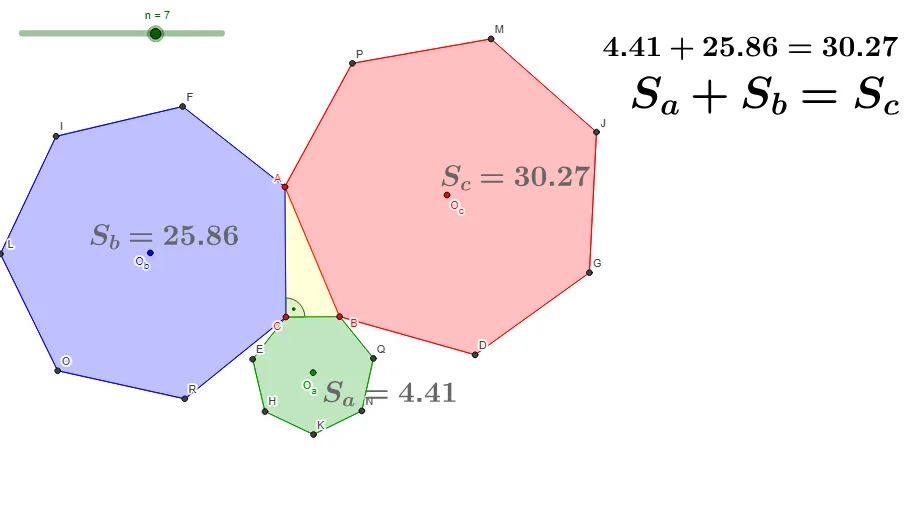
This example demonstrates the generalization of the Pythagorean theorem on polygons. By constructing regular polygons, observe the relationships between their sides and diagonals. Commands used include Midpoint, Circle, Polygon, LineBisector, etc. Suitable for middle school and above students to learn geometric transformations and polygon properties.
GeoGebra Commands & Parameters
Midpoint(B, A) → M_cCircle(M_c, B) → c_1Point(c_1) → CPolygon(B, A, C) → righttriangle, c, a, bPolygon(A, B, n) → polyc, d_1, J, M, P, a_1, g, j, m, r, b_1, D, GPolygon(B, C, n) → polya, e_1, K, N, Q, b_2, h, k, p, s, g_1, E, HPolygon(C, A, n) → polyb, f_1, L, O, R, c_3, i, l, q, t, h_1, F, ILineBisector(c) → dLineBisector(a) → eLineBisector(b) → fAngle(B, C, A) → αRotate(B, 90° - (180 * ° / n), A) → B'Line(A, B') → i_1Intersect(d, i_1) → O_cRotate(A, 90° - (180 * ° / n), C) → A'Line(C, A') → j_1Intersect(e, j_1) → O_bRotate(C, 90° - (180 * ° / n), B) → C'Line(B, C') → k_1Intersect(f, k_1) → O_aSegment(A, O_c) → l_1Segment(B, O_c) → m_1Segment(M_c, O_c) → n_1Angle(M_c, O_c, B) → βSegment(A, O_b) → p_1Segment(C, O_b) → q_1Midpoint(C, A) → M_bSegment(M_b, O_b) → r_1Angle(C, O_b, M_b) → γSegment(C, O_a) → s_1Segment(B, O_a) → t_1Midpoint(B, C) → M_aSegment(M_a, O_a) → a_2Angle(B, O_a, M_a) → δ