
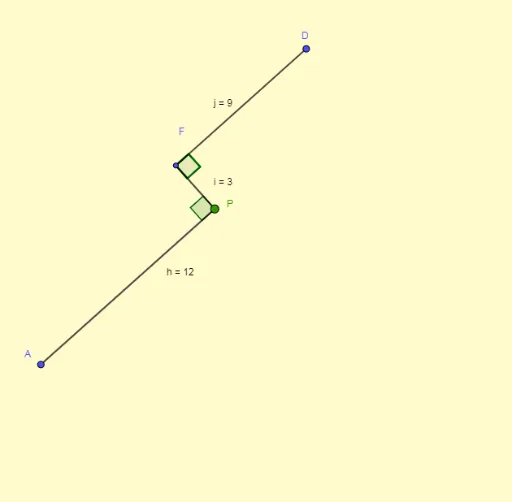
Polygonal Problem 12, 3, 9
Loading the math board and drawing, please wait…
This example demonstrates a geometric problem involving polygons, vectors, and rotations. Key math concepts include 2D vectors, algebra, angles, geometry, rotation, hypergeometric distribution, plane figures, correlation, and scalene triangles. Construction highlights the use of GeoGebra commands such as Circle, Point, Tangent, Intersect, If, Rotate, Vector, Segment, Polygon, Angle, Translate, and LineBisector. Suitable for high school mathematics students and educators.
GeoGebra Commands & Parameters
Circle(A, 12) → cPoint(c) → PTangent(P, c) → f,Circle(P, 3) → dIntersect(d, f) → F, D_1If(0 ≤ k ≤ (1 / 6 * π), 0, k - (1 / 6 * π)) → μIf(0 ≤ k ≤ (1 / 6 * π), k, (1 / 6 * π)) → λRotate(F, (-λ), A) → F'Rotate(P, (-λ), A) → P'Vector(F', P') → vTangent(F, d) → g,Circle(F, 9) → eIntersect(e, g) → E, DSegment(A, P) → hSegment(P, F) → iSegment(F, D) → jPolygon(A, B, D, C) → c1, a, g_1, f_1, h_1Angle(F, P, A) → αAngle(P, F, D) → β_1Polygon(A, B, D, C) → c2, a_1, g_2, f_2, h_2Segment(A, D) → mRotate(D, (-λ), A) → D'Segment(A, P') → h'Segment(F', P') → i'Segment(F', D') → j'Segment(A, D') → m'Translate(F', Vector[(λ / 3 * (0, -1))]) → F''_1Vector(F', D') → uTranslate(F', Vector[((1.5 * μ) * u)]) → P'_1Translate(F', Vector[((1.5 * μ) * v)]) → F''Translate(D', Vector[((1.5 * μ) * v)]) → D''Segment(F'', D'') → qTranslate(P', Vector[((1.5 * μ) * u)]) → P''Segment(P'_1, P'') → nLineBisector(A, D') → pIntersect(p, m') → GCircle(G, A) → rIntersect(r, p) → H, IPolygon(I, D', H, A) → c3, i_1, d', h_3, a_2
AI Drawing Prompt Reference
Draw a large circle centered at A with radius 12. Pick a point P on this circle and draw the tangent line at P. With P as center, draw a circle of radius 3; this tangent intersects the small circle at two points, choose one as F. Rotate points F and P about A by an angle that depends on a variable k, obtaining F' and P', and connect F' to P' to form a vector. Through F, draw a tangent to the small circle, and with F as center draw a circle of radius 9; this tangent meets the circle at point D. Connect A, P, F, D to form a polygon, and measure the angles at F and P. Rotate D about A by the same angle to get D', and connect A to D'. Then translate F', P', and D' by vectors derived from the rotation angle and the vector F'D' or F'P', constructing additional segments. Finally, construct the perpendicular bisector of A and D', intersect it with segment A D' to get G, draw a circle centered at G through A, intersect this circle with the bisector to get H and I, and form the quadrilateral I, D', H, A.
The prompt above was compiled from the original drawing commands and is for reference only.