
Parallelogram Template
Loading the math board and drawing, please wait…
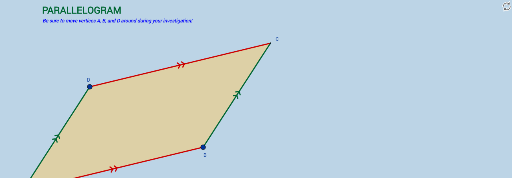
This example demonstrates the geometric construction and fundamental properties of a parallelogram. Key math concepts include the definition of a parallelogram, parallel and equal opposite sides, and bisecting diagonals. It is constructed using GeoGebra commands like Segment, Line, Intersect, and Polygon, involving objects such as A, B, a, D, b, c, d, C, e, text1, f, text2, poly1, a_1, b_1, c_1, d_1. Suitable for middle school and above students to explore parallelogram properties and serve as a teaching aid.
GeoGebra Commands & Parameters
Segment(A, B) → aSegment(A, D) → bLine(D, a) → cLine(B, b) → dIntersect(c, d) → CSegment(D, C) → eSegment(B, C) → fPolygon(A, B, C, D) → poly1, a_1, b_1, c_1, d_1
AI Drawing Prompt Reference
Draw a parallelogram to demonstrate that its opposite sides are parallel and equal in length, and that its diagonals bisect each other. Start by drawing two adjacent line segments, then draw two more line segments parallel to these, connecting them to form the parallelogram. Label the vertices and sides, highlighting the properties of parallel opposite sides, equal opposite sides, and bisecting diagonals.
The prompt above was compiled from the original drawing commands and is for reference only.