
Parallelogram Sides Investigation
Loading the math board and drawing, please wait…
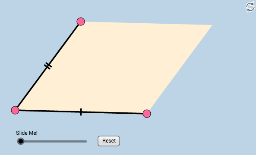
This example demonstrates the properties of parallelogram sides through 3 quick investigative applets. Key math concepts include opposite sides equality, vector operations, and coordinate geometry. GeoGebra commands and objects used in construction are Line, Slope, PointIn, Vector, Translate, Segment, Polygon, and Dilate. Suitable for high school students to review and reinforce parallelogram properties, enhancing geometric intuition and computational skills.
GeoGebra Commands & Parameters
Line(A, B) → aSlope(a) → mPointIn(c) → CLine(C, a) → eVector(A, B) → uTranslate(C, u) → C'Segment(A, B) → hSegment(A, C) → dPolygon(A, B, C') → poly1, c', a_1, b_1Polygon(A, C', C) → poly2, c_1, a_2, c'_1Dilate(A, If[0 < k ≤ 1, 1 - k, 0], C) → A'Vector(A, A') → vTranslate(A, v) → A'_1Translate(B, v) → B'Segment(A'_1, B') → h'Dilate(C, If[1 < k ≤ 2, 2 - k, 0], C') → C'_1Vector(C, C'_1) → wTranslate(A, w) → A'_2Translate(C, w) → C'_2Segment(A'_2, C'_2) → d'Polygon(A, B, C', C) → poly3, a_3, b_2, c'_2, c_2
AI Drawing Prompt Reference
Draw a parallelogram investigation diagram. Start with a base segment and a point outside it. Construct a line through that point parallel to the base. Translate the point by the base vector to get the fourth vertex. Connect the base endpoints and the translated point to form two triangles and a full parallelogram. Then place moving points on the base and side, and use scaling and translation to create auxiliary segments parallel to the base and side, demonstrating equal and parallel opposite sides. Include a coordinate grid background to highlight vector and geometric relationships.
The prompt above was compiled from the original drawing commands and is for reference only.