
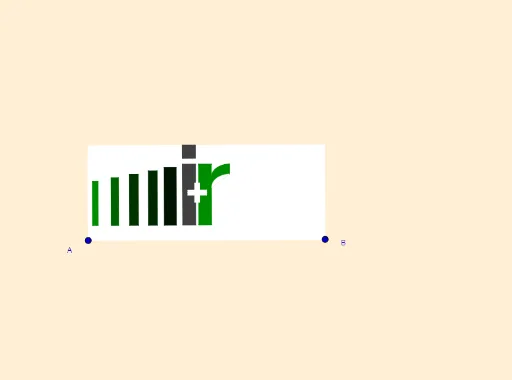
Logo of Rioja Innovation System
Loading the math board and drawing, please wait…
This GeoGebra example demonstrates the geometric construction of the Rioja Innovation System logo. Key mathematical concepts include vectors, similarity transformations, and polygons. Using commands like LineBisector, Vector, and Polygon, the various parts of the logo can be constructed. Suitable for high school geometry lessons to help students understand geometric construction and transformations.
GeoGebra Commands & Parameters
LineBisector(A, B) → mVector(A, B) → uOrthogonalVector(u) → vMidpoint(A_1, A) → JOrthogonalLine(J, m) → iOrthogonalLine(K, i) → lOrthogonalLine(F, l) → nIntersect(m, n) → HLine(A, B) → sOrthogonalLine(A, s) → bOrthogonalLine(G, l) → pIntersect(l, n) → QLine(D, b) → fIntersect(f, i) → H_1OrthogonalLine(B, u, xOyPlane) → gMirror(J, m) → J'OrthogonalLine(R, s) → j_4OrthogonalLine(L, i) → tOrthogonalLine(A_1, b) → rIntersect(g, r) → CPolygon(A_1, C, B, A) → q1, a_1, c, b_1, a_2Intersect(j_4, i) → PMidpoint(P, R) → SMirror(H_1, i) → Z_1OrthogonalLine(V_1, s) → hOrthogonalLine(E, i) → jOrthogonalLine(I, i) → kOrthogonalLine(N, i) → qOrthogonalLine(O, n) → aOrthogonalLine(T, s) → dOrthogonalLine(M, n) → eOrthogonalLine(U, i) → f_1OrthogonalLine(V, i) → g_1OrthogonalLine(W, n) → h_1Intersect(e, r) → ZIntersect(f_1, r) → B_1Polygon(Z, B_1, 4) → poly1, i_1, j_1, k_1, l_1, C_1, D_1Mirror(poly1, r) → poly1'Line(E_1, r) → m_1Line(F_1, r) → n_1Line(G_1, r) → p_1Line(I_1, r) → q_1Line(J_1, r) → r_1Line(K_1, r) → s_1Line(K_1, m_1) → t_1Line(K_1, m_1) → c_1OrthogonalLine(L_1, i) → d_1Intersect(l, s_1) → M_1Intersect(j_4, s_1) → N_1Polygon(M_1, N_1, R, Q) → q2, e_1, f_2, r_2, q_2Intersect(t, r_1) → O_1Intersect(f, r_1) → P_1Polygon(O_1, P_1, D, L) → q3, o_1, g_2, d_2, l_2Intersect(h, q_1) → Q_1Intersect(j, q_1) → R_1Polygon(Q_1, R_1, E, V_1) → q4, h_2, i_2, j_2, k_2Intersect(k, p_1) → S_1Intersect(q, p_1) → T_1Polygon(S_1, T_1, N, I) → q5, m_2, n_2, p_2, s_2Intersect(a, n_1) → U_1Intersect(d, n_1) → W_1Polygon(U_1, W_1, T, O) → q6, t_2, b_2, c_2, e_2Intersect(e, m_1) → A_2Intersect(m_1, f_1) → B_2Intersect(g_1, m_1) → C_2Intersect(h_1, m_1) → D_2Polygon(A_2, B_2, U, M) → q7, f_3, g_3, h_3, i_3Polygon(C_2, D_2, W, V) → q8, j_3, k_3, l_3, m_3Intersect(d_1, m_1) → E_2Intersect(h_1, r_1) → G_2Intersect(d_1, q_1) → F_2CurveCartesian(((1 - t)^(3) * H_2) + (((3 * (1 - t)^(2)) * t) * G_2) + (((3 * (1 - t)) * t^(2)) * K_2) + (t^(3) * F_2), t, 0, 1) → u_1Intersect(h_1, n_1) → L_2CurveCartesian(((1 - t)^(3) * G_2) + (((3 * (1 - t)^(2)) * t) * L_2) + (((3 * (1 - t)) * t^(2)) * I_2) + (t^(3) * E_2), t, 0, 1) → wPolygon(G_2, H_2, J_2, E_2) → q9, n_3, p_3, q_3, r_3LineBisector(U, V) → s_3Mirror(m, s_3) → m'Line(M_2, i) → a_3Mirror(a_3, i) → t_3Intersect(m', a_3) → N_2Intersect(m, a_3) → O_2Intersect(m, t_3) → P_2Intersect(m', t_3) → Q_2Intersect(s_3, a_3) → R_2Intersect(s_3, t_3) → T_2OrthogonalLine(S_2, a_3) → b_3Intersect(b_3, t_3) → U_2Polygon(S_2, R_2, T_2, U_2) → q10, c_3, d_3, e_3, u_2Mirror(S_2, s_3) → V_2Mirror(R_2, s_3) → W_2Mirror(T_2, s_3) → Z_2Mirror(U_2, s_3) → A_3Polygon(V_2, W_2, Z_2, A_3) → q10', v_2, w_2, z_2, f_4Mirror(V_2, f_4) → B_3Intersect(m, i) → C_3OrthogonalLine(D_3, m') → g_4Intersect(m', g_4) → E_3Intersect(m', i) → F_3Polygon(E_3, D_3, C_3, F_3) → q11, h_4, i_4, k_4, l_4Mirror(E_3, i) → G_3Mirror(D_3, i) → H_3Mirror(C_3, i) → I_3Mirror(F_3, i) → J_3Polygon(G_3, H_3, I_3, J_3) → q11', m_4, n_4, p_4, q_4
AI Drawing Prompt Reference
Draw the Rioja Innovation System logo by first drawing the perpendicular bisector m of line AB, then drawing vector u, and subsequently drawing the orthogonal vector v. Find point J and draw the orthogonal line i through J, and continue in this manner to construct the various parts of the logo, ultimately forming a polygon composed of multiple orthogonal and perpendicular lines.
The prompt above was compiled from the original drawing commands and is for reference only.