
Icosidodecahedron Construction
Loading the math board and drawing, please wait…
In collections
Archimedean Solids
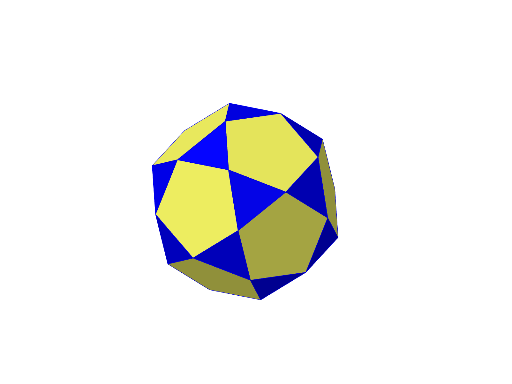
This example demonstrates the geometric construction and properties of the icosidodecahedron, a polyhedron with faces that are both triangular and pentagonal. It involves core mathematical concepts like polygons, solid geometry, intersecting lines, and area calculations. The construction uses commands such as Polygon, Icosahedron, Sphere, Intersect, and Segment in GeoGebra. It is suitable for high school and above students to understand complex polyhedral structures and relationships.
GeoGebra Commands & Parameters
Polygon(A, B, 3) → poly1, f, g, h, CIcosahedron(A, B, C) → a, D, faceABC, faceACF, faceAFG, faceADG, faceABD, faceBDH, faceBEH, faceBCE, faceCEI, faceCFI, E, faceEHK, faceEIK, faceIKL, faceFIL, faceHJK, faceJKL, faceGJL, faceFGL, faceDHJ, faceDGJ, F, edgeAC, edgeAB, edgeBC, edgeAF, edgeCF, edgeAG, edgeFG, edgeAD, edgeDG, edgeBD, G, edgeBH, edgeDH, edgeBE, edgeEH, edgeCE, edgeCI, edgeEI, edgeFI, edgeEK, edgeHK, H, edgeIK, edgeIL, edgeKL, edgeFL, edgeJK, edgeHJ, edgeJL, edgeGL, edgeGJ, edgeDJ, I, J, K, LSphere(J, m) → bIntersect(edgeJK, b, 1) → MIntersect(edgeJL, b, 1) → NIntersect(edgeHJ, b, 1) → OIntersect(edgeGJ, b, 1) → PIntersect(edgeDJ, b, 1) → QSphere(K, m) → cIntersect(edgeKL, c) → R, I_2Intersect(edgeIK, c) → S, J_2Intersect(edgeJK, c) → T, K_2Intersect(edgeHK, c) → U, L_2Intersect(edgeEK, c) → V, M_2Sphere(I, m) → dIntersect(edgeIL, d) → W, N_2Intersect(edgeIK, d) → Z, O_2Intersect(edgeFI, d) → A_1, P_2Intersect(edgeCI, d) → B_1, Q_2Intersect(edgeEI, d) → C_1, R_2Sphere(F, m) → eIntersect(edgeFG, e) → D_1, S_2Intersect(edgeAF, e) → E_1, T_2Intersect(edgeFI, e, 1) → F_1Intersect(edgeFL, e, 1) → G_1Intersect(edgeCF, e, 1) → H_1Sphere(G, m) → iIntersect(edgeGJ, i, 1) → I_1Intersect(edgeAG, i, 1) → J_1Intersect(edgeDG, i, 1) → K_1Intersect(edgeFG, i, 1) → L_1Intersect(edgeGL, i, 1) → M_1Sphere(L, m) → jIntersect(edgeIL, j, 1) → N_1Intersect(edgeKL, j, 1) → O_1Intersect(edgeJL, j, 1) → P_1Intersect(edgeGL, j, 1) → Q_1Intersect(edgeFL, j, 1) → R_1Sphere(E, m) → kIntersect(edgeEK, k, 1) → S_1Intersect(edgeEH, k, 1) → T_1Intersect(edgeBE, k, 1) → U_1Intersect(edgeEI, k, 1) → V_1Intersect(edgeCE, k, 1) → W_1Sphere(D, m) → lIntersect(edgeDG, l) → Z_1, U_2Intersect(edgeAD, l) → A_2, V_2Intersect(edgeBD, l) → B_2, W_2Intersect(edgeDH, l) → C_2, Z_2Intersect(edgeDJ, l) → D_2, A_3Sphere(A, m) → nIntersect(edgeAD, n, 1) → E_2Intersect(edgeAG, n, 1) → F_2Intersect(edgeAF, n, 1) → G_2Sphere(B, m) → oIntersect(edgeBH, o, 1) → H_2Sphere(H, m) → pIntersect(edgeHJ, p, 1) → B_3Intersect(edgeDH, p, 1) → C_3Intersect(edgeBH, p, 1) → D_3Intersect(edgeHK, p, 1) → E_3Intersect(edgeEH, p, 1) → F_3Polygon(C_3, D_3, F_3, E_3, B_3) → poly2, c_3, d_3, f_3, e_3, b_3Polygon(U_1, W_1, V_1, S_1, T_1) → poly3, u_1, w_1, v_1, s_1, t_1Polygon(C_1, B_1, A_1, W, Z) → poly4, c_1, b_1, a_1, w, z_1Polygon(P, Q, O, M, N) → poly5, p_1, q, o_1, m_1, n_1Segment(L, G) → sPolygon(T, U, V, S, R) → poly6, t, u, v, s_2, r_1Intersect(edgeBD, o, 1) → G_3Intersect(edgeBE, o, 1) → H_3Intersect(s, j, 1) → I_3Polygon(N_1, R_1, I_3, P_1, O_1) → poly7, f_1, g_1, i_3, h_1, i_1Intersect(edgeFG, i, 1) → J_3Intersect(s, i) → K_3, P_3Polygon(J_3, J_1, K_1, I_1, K_3) → poly8, j_3, j_1, k_1, l_1, k_3Polygon(Z_1, A_2, B_2, C_2, D_2) → poly9, q_1, a_2, b_2, c_2, d_2Intersect(edgeBC, o) → L_3, Q_3Intersect(edgeAB, o) → M_3, R_3Polygon(M_3, L_3, H_3, H_2, G_3) → poly10, m_3, l_3, h_3, h_2, g_3Polygon(F_1, H_1, E_1, D_1, G_1) → poly11, d_1, e_1, f_2, g_2, i_2Intersect(edgeAC, n) → N_3, S_3Intersect(edgeAB, n) → O_3, T_3Polygon(N_3, O_3, E_2, F_2, G_2) → poly12, n_3, o_3, e_2, j_2, k_2Sphere(C, m) → l_2Intersect(edgeCF, l_2, 1) → U_3Intersect(edgeCE, l_2, 1) → V_3Intersect(edgeBC, l_2, 1) → W_3Intersect(edgeAC, l_2, 1) → Z_3Intersect(edgeCI, l_2, 1) → A_4Polygon(W_3, V_3, A_4, U_3, Z_3) → poly13, w_3, v_3, a_4, u_3, z_3Polygon(M, T, R, O_1, P_1, N) → poly14, m_2, t_2, r_2, n_2, p_2, n_4Polygon(O, B_3, E_3, U, T, M) → poly15, o_2, q_2, p_3, u_2, t_3, m_4Polygon(E_3, F_3, T_1, S_1, V, U) → poly16, q_3, r_3, s_3, a_3, v_2, u_4Polygon(V, S_1, V_1, C_1, Z, S) → poly17, v_4, f_4, g_4, h_4, z_2, s_4Polygon(R, O_1, N_1, W, Z, S) → poly18, r_4, i_4, j_4, w_2, z_4, s_5Polygon(V_1, W_1, V_3, A_4, B_1, C_1) → poly19, k_4, l_4, p_4, q_4, t_4, b_4Polygon(B_1, A_4, U_3, H_1, F_1, A_1) → poly20, c_4, d_4, e_4, f_5, g_5, h_5Polygon(W, A_1, F_1, G_1, R_1, N_1) → poly21, w_4, i_5, j_5, k_5, l_5, m_5Polygon(R_1, G_1, D_1, J_3, K_3, I_3) → poly22, n_5, p_5, q_5, r_5, t_5, a_5Polygon(P_1, I_3, K_3, I_1, P, N) → poly23, b_5, c_5, d_5, e_5, p_6, n_6Polygon(P, I_1, K_1, Z_1, D_2, Q) → poly24, p_7, f_6, g_6, h_6, i_6, q_6Polygon(Q, D_2, C_2, C_3, B_3, O) → poly25, q_7, j_6, k_6, l_6, m_6, o_4Polygon(C_2, B_2, G_3, H_2, D_3, C_3) → poly26, r_6, s_6, t_6, a_6, b_6, c_6Polygon(D_3, F_3, T_1, U_1, H_3, H_2) → poly27, d_6, e_6, f_7, g_7, h_7, i_7Polygon(V_3, W_1, U_1, H_3, L_3, W_3) → poly28, j_7, k_7, l_7, m_7, n_7, r_7Polygon(Z_3, N_3, O_3, M_3, L_3, W_3) → poly29, s_7, t_7, a_7, b_7, c_7, d_7Polygon(H_1, U_3, Z_3, N_3, G_2, E_1) → poly30, e_7, f_8, g_8, h_8, i_8, j_8Polygon(J_3, J_1, F_2, G_2, E_1, D_1) → poly31, k_8, l_8, m_8, n_8, p_8, q_8Polygon(J_1, F_2, E_2, A_2, Z_1, K_1) → poly32, r_8, s_8, t_8, a_8, b_8, c_8Polygon(E_2, O_3, M_3, G_3, B_2, A_2) → poly33, d_8, e_8, f_9, g_9, h_9, i_9
AI Drawing Prompt Reference
Draw an icosidodecahedron by first drawing triangle ABC, then constructing a dodecahedron with A, B, and C as vertices. Next, draw a sphere centered at J and find the intersections with edges JK, JL, HJ, GJ, and DJ to get points M, N, O, P, and Q. Then, draw a sphere centered at K and find the intersections with edges KL, IK, JK, and HK to get points R, S, T, and U. Continue this process to construct all vertices and edges of the icosidodecahedron.
The prompt above was compiled from the original drawing commands and is for reference only.