
Frequency and Relative Frequency Distributions by David Gurney
Loading the math board and drawing, please wait…
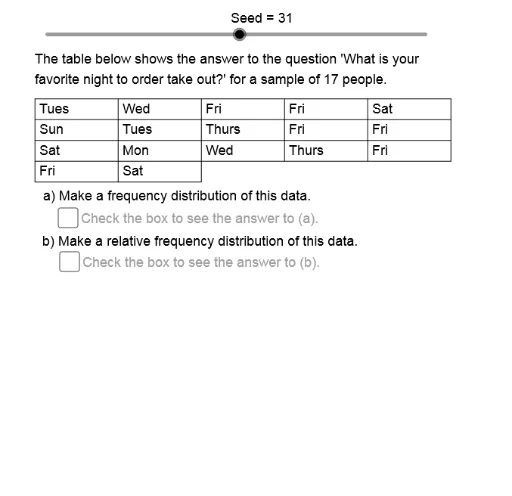
This example demonstrates statistical concepts of frequency and relative frequency distributions using GeoGebra. Key mathematical concepts include statistics, geometric construction, and data visualization. Construction involves using commands like Sequence, Element, Mod, CountIf to build data sequences, combined with objects like RtSq and Sq3 to generate graphs. Suitable for high school students learning statistics fundamentals and geometric construction techniques.
GeoGebra Commands & Parameters
Sequence(If[k < 56, If[k < 20, If[k < 8, 1, 2], 3], 4], k, 1, 100) → Sq3Sequence(If[k < 71, If[k < 39, If[k < 26, If[k < 13, 1, 2], 3], 4], 5], k, 1, 100) → Sq2Sequence(If[k < 97, If[k < 90, If[k < 79, If[k < 53, 1, 2], 3], 4], 5], k, 1, 100) → Sq1Sequence(If[k < 80, If[k < 45, If[k < 40, If[k < 25, If[k < 12, If[k < 7, 1, 2], 3], 4], 5], 6], 7], k, 1, 100) → Sq4Element(RtSq, Mod[Seed, 13] + 1) → RateMod(Seed, 7) → StartElement(DataSq, DtNm) → DataMeasSequence(Element[DataMeas, Mod[Start + (Rate * k), 100] + 1], k, 1, Size) → DataACountIf(x ≟ 7, DataA) → Frq7CountIf(x ≟ 6, DataA) → Frq6CountIf(x ≟ 5, DataA) → Frq5CountIf(x ≟ 4, DataA) → Frq4CountIf(x ≟ 3, DataA) → Frq3CountIf(x ≟ 2, DataA) → Frq2CountIf(x ≟ 1, DataA) → Frq1Element(DtCnvSq, DtNm) → DtCnvSequence(Element[DtCnv, Element[DataA, k]], k, 1, Size) → DataBSequence(Text[Element[DataB, k], (1 + ((k - 1) * CW), 13)], k, 1, 5) → DtRw1Sequence(Text[Element[DataB, k], (1 + ((k - 6) * CW), 12.5)], k, 6, 10) → DtRw2Sequence(Text[Element[DataB, k], (1 + ((k - 11) * CW), 12)], k, 11, 15) → DtRw3Segment((0.9, 13.35 - (4 * CH)), (0.9 + (SzNm * CW), 13.35 - (4 * CH))) → BtmLnSequence(Segment[(0.9 + (k * CW), 13.35), (0.9 + (k * CW), If[SzNm ≥ k, 13.35 - (4 * CH), 13.35 - (3 * CH)])], k, 0, 5) → VrtLnsSequence(Text[Element[DataB, k], (1 + ((k - 16) * CW), 11.5)], k, 16, 15 + SzNm) → DtRw4Element(DtLng, DtNm) → CtNmASequence(If[Element[FrqSqA, k] > 0, Element[DtCnv, k], "?"], k, 1, CtNmA) → CtSqARemove(CtSqA, {"?", "?", "?", "?", "?"}) → CtSqBCountIf(x ≠ 0, FrqSqA) → ClsCntRemove(FrqSqA, {0, 0, 0, 0, 0, 0}) → FrqSqBSequence(Element[FrqSqB, k] / Size, k, 1, ClsCnt) → RlFrqSqSequence(Text[Element[CtSqB, k], (1.5, 8.3 - (k * CH))], k, 1, ClsCnt) → ClsTxSequence(Segment[(0.9, 13.35 - (CH * k)), (0.9 + (5 * CW), 13.35 - (CH * k))], k, 0, 3) → HrzLnsSequence(Text[Element[FrqSqB, k], (3.6, 8.3 - (k * CH))], k, 1, ClsCnt) → FrqTxText("Freq.", (3.5, 8.3)) → FrqLbSequence(Text[Element[RlFrqSq, k], (4.7, 8.3 - (k * CH))], k, 1, ClsCnt) → RlFrqTxSequence(Text[Element[FrqSqB, k], (6.1, 8.3 - (k * CH))], k, 1, ClsCnt) → RFClcSqSequence(Text["/", (6.5, 8.3 - (k * CH))], k, 1, ClsCnt) → DvdSqSequence(Text[Size, (6.65, 8.3 - (k * CH))], k, 1, ClsCnt) → SzSq