
Dice Roll Simulation
Loading the math board and drawing, please wait…
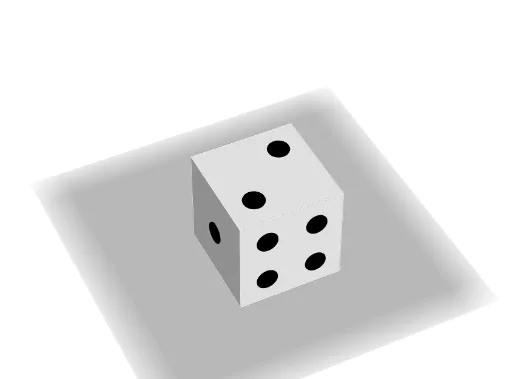
This example demonstrates the rolling process of a six-sided die and its probability distribution. It involves core mathematical concepts such as Probability & Statistics, Geometry Transformation, and Solid Geometry. The construction uses GeoGebra commands and objects like Point, Cube, Circle, Line, and Rotate. Suitable for high school students learning probability statistics and solid geometry, or for mathematical modeling education.
GeoGebra Commands & Parameters
Point(Circle[(0, 0, 1), Distance[(0, 0, 0), (0, 0, 1)], Segment[(0, 0, 0), (0, 0, 1)]]) → ACube((0, 0, 0), (0, 0, 1), A) → a, B, faceABFE, faceCDEF, edge2, edge1, edge4, edgeAB, edge3, edgeBF, edgeCF, edgeCD, C, edge5, edgeDE, edgeAE, edgeEF, D, E, F, face1, face3, face2, face4Circle((0.5, -0.01, 0.5), p, yAxis) → cCircle((1.01, 0.5 + s, 0.5 - s), p, xAxis) → c_1Circle((1.01, 0.5 - s, 0.5 - s), p, xAxis) → d_1Circle((d, 1.01, 3 / 6), p, yAxis) → eCircle((1.01, 0.5 - s, 0.5 + s), p, xAxis) → e_1Circle((d, 1.01, 0.5 - s), p, yAxis) → fCircle((-0.01, 0.5 - s, 0.5 + s), p, xAxis) → f_1Circle((d, 1.01, 0.5 + s), p, yAxis) → gCircle((-0.01, 0.5 + s, 0.5 - s), p, xAxis) → g_1Circle((1 - d, 1.01, 0.5), p, yAxis) → hCircle((1 - d, 1.01, 0.5 + s), p, yAxis) → kCircle((0.5 + s, 0.5 + s, -0.01), p, zAxis) → k_1Circle((0.5 - s, 0.5 - s, -0.01), p, zAxis) → p_1Circle((1 - d, 1.01, 0.5 - s), p, yAxis) → qCircle((0.5 - s, 0.5 - s, 1.01), p, zAxis) → q_1Circle((1.01, 0.5, 0.5), p, xAxis) → rCircle((0.5 - s, 0.5 + s, 1.01), p, zAxis) → r_1Circle((0.5 + s, 0.5 + s, 1.01), p, zAxis) → s_1Circle((1.01, 0.5 + s, 0.5 + s), p, xAxis) → tCircle((0.5 + s, 0.5 - s, 1.01), p, zAxis) → t_1Circle((0.5, 0.5, -0.01), p, zAxis) → h_1Line(M, yAxis) → iLine(M, xAxis) → jLine(M, zAxis) → lRotate(Rotate[Rotate[a, α, i], β, j], γ, l) → bRotate(Rotate[Rotate[c, α, i], β, j], γ, l) → c_2Rotate(Rotate[Rotate[c_1, α, i], β, j], γ, l) → d_2Rotate(Rotate[Rotate[d_1, α, i], β, j], γ, l) → e_2Rotate(Rotate[Rotate[e, α, i], β, j], γ, l) → f_2Rotate(Rotate[Rotate[e_1, α, i], β, j], γ, l) → g_2Rotate(Rotate[Rotate[f, α, i], β, j], γ, l) → h_2Rotate(Rotate[Rotate[f_1, α, i], β, j], γ, l) → k_2Rotate(Rotate[Rotate[g, α, i], β, j], γ, l) → p_2Rotate(Rotate[Rotate[g_1, α, i], β, j], γ, l) → q_2Rotate(Rotate[Rotate[h, α, i], β, j], γ, l) → r_2Rotate(Rotate[Rotate[h_1, α, i], β, j], γ, l) → s_2Rotate(Rotate[Rotate[k, α, i], β, j], γ, l) → t_2Rotate(Rotate[Rotate[k_1, α, i], β, j], γ, l) → c_3Rotate(Rotate[Rotate[p_1, α, i], β, j], γ, l) → d_3Rotate(Rotate[Rotate[q, α, i], β, j], γ, l) → e_3Rotate(Rotate[Rotate[q_1, α, i], β, j], γ, l) → f_3Rotate(Rotate[Rotate[r, α, i], β, j], γ, l) → g_3Rotate(Rotate[Rotate[r_1, α, i], β, j], γ, l) → h_3Rotate(Rotate[Rotate[s_1, α, i], β, j], γ, l) → k_3Rotate(Rotate[Rotate[t, α, i], β, j], γ, l) → p_3Rotate(Rotate[Rotate[t_1, α, i], β, j], γ, l) → q_3