
Cube to Pyramids
Loading the math board and drawing, please wait…
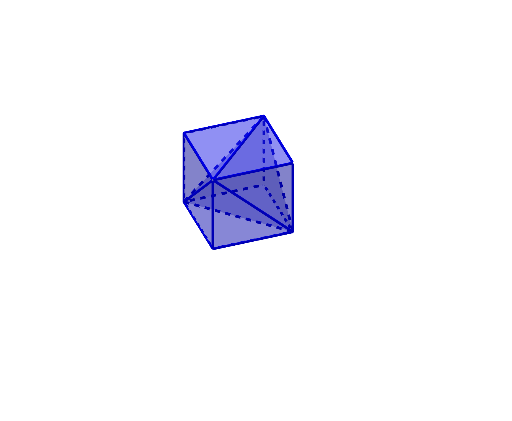
This example demonstrates the dissection of a cube into pyramids, involving core mathematical concepts like solid geometry, congruence, equations, special points, median lines, and vectors. It utilizes GeoGebra commands and objects such as points, cubes, midpoints, segments, pyramids, circles, intersections, vectors, and translations as outlined in the construction summary. Ideal for high school students learning about 3D shapes and geometric constructions.
GeoGebra Commands & Parameters
Point(Circle[B, Distance[A, B], Segment[A, B]]) → CCube(A, B, C) → a, D, faceCDHG, faceEFGH, edgeAD_{1}, edgeAB_{1}, edgeBC_{1}, edgeCD_{1}, edgeAE_{1}, edgeDH_{1}, edgeEH_{1}, edgeEF_{1}, E, edgeBF_{1}, edgeFG_{1}, edgeCG_{1}, edgeGH_{1}, F, G, H, faceABCD, faceADHE, faceABFE, faceBCGFMidpoint(edgeFG_{1}) → IMidpoint(edgeEF_{1}) → JMidpoint(edgeCG_{1}) → KMidpoint(edgeCD_{1}) → LMidpoint(edgeAD_{1}) → MMidpoint(edgeAE_{1}) → NSegment(F, C) → fSegment(F, A) → gSegment(C, A) → hSegment(F, H) → iSegment(H, C) → jSegment(H, A) → kPyramid(C, H, A, D) → b, faceACH, edgeAD, faceCDH, faceADH, faceACD, edgeCH_{1}, edgeAH_{1}, edgeAC_{1}, edgeCD, edgeDHPyramid(H, F, A, E) → c, faceAFH, edgeAE, faceEFH, faceAEF, faceAEH, edgeFH_{1}, edgeAF_{1}, edgeAH, edgeEH, edgeEFPyramid(F, H, C, G) → d, faceCFH, edgeCG, faceFGH, faceCGH, faceCFG, edgeFH, edgeCH, edgeCF_{1}, edgeFG, edgeGHPyramid(A, C, F, B) → e, faceACF, edgeBF, faceABC, faceBCF, faceABF, edgeAC, edgeCF, edgeAF, edgeAB, edgeBCCircle(A, l, xOyPlane) → qIntersect(p, q) → O, PVector(A, O) → uVector(A, P) → vTranslate(c, u) → c'Translate(d, v) → d'Intersect(q, yAxis, 2) → QVector(A, Q) → wTranslate(b, w) → b'Intersect(r, q) → R, SVector(A, S) → mTranslate(e, m) → e'
AI Drawing Prompt Reference
Construct a 3D cube and label its key vertices and faces. Determine several midpoints on selected cube edges, then use the related vertex pairs to define connecting segments that set up the shared dissection structure. Build four pyramids by choosing appropriate cube vertices as the apex and using pairs of cube vertices as base corners, so the pyramids together represent a dissection of the cube into pyramid solids. Introduce a circle in the plane through two reference points, find its intersections with the axes, and use those intersections to set translation directions. Translate the appropriate pyramids along these vector directions to obtain the corresponding copied pieces.
The prompt above was compiled from the original drawing commands and is for reference only.