
Cork Plug Volume Calculation
Loading the math board and drawing, please wait…
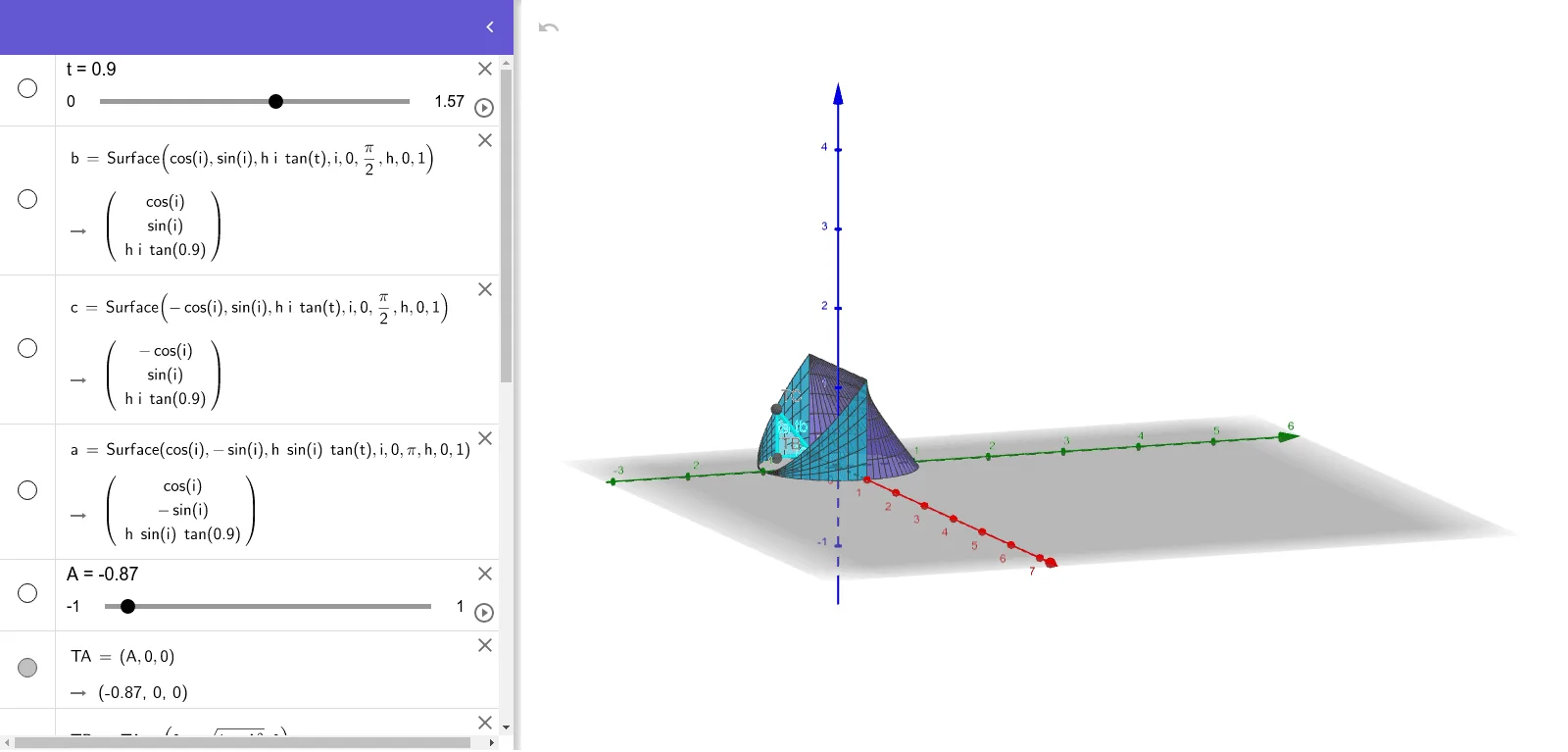
This example demonstrates how to calculate the volume of a cork plug by constructing its surface and polygons. Key math concepts include volume calculation, parallelogram, cube, square, polygons, and circumcircle. Construction highlights involve commands like Surface and Polygon in GeoGebra. Suitable for high school solid geometry teaching or self-study to understand volume calculation of complex geometric bodies.
GeoGebra Commands & Parameters
Surface(cos(i), sin(i), ((h * i) * tan(t)), i, 0, π / 2, h, 0, 1) → bSurface((-cos(i)), sin(i), ((h * i) * tan(t)), i, 0, π / 2, h, 0, 1) → cSurface(cos(i), (-sin(i)), ((h * sin(i)) * tan(t)), i, 0, π, h, 0, 1) → aPolygon(TA, TB, TC) → t1, tc, ta, tbSurface(cos(i), ((1 - h) * sin(i)), (h * tan(t)), i, 0, π, h, 0, 1) → dSurface(cos(i), (-sin(i)), ((1 - sin(i)) * h), i, 0, π, h, 0, tan(t)) → e
AI Drawing Prompt Reference
Draw a geometric body composed of four surfaces: a cone with its vertex at the origin, a symmetrical cone, a cylinder with a circular base, and an inclined cylinder. Below the geometric body, draw a cube with a square base that is tangent to the inclined cylinder. On top of the cube, draw a triangle formed by three line segments connecting the vertices of the cube.
The prompt above was compiled from the original drawing commands and is for reference only.