
Sphere Net Construction: Exploring Spherical Geometry and Similarity Transformat
Loading the math board and drawing, please wait…
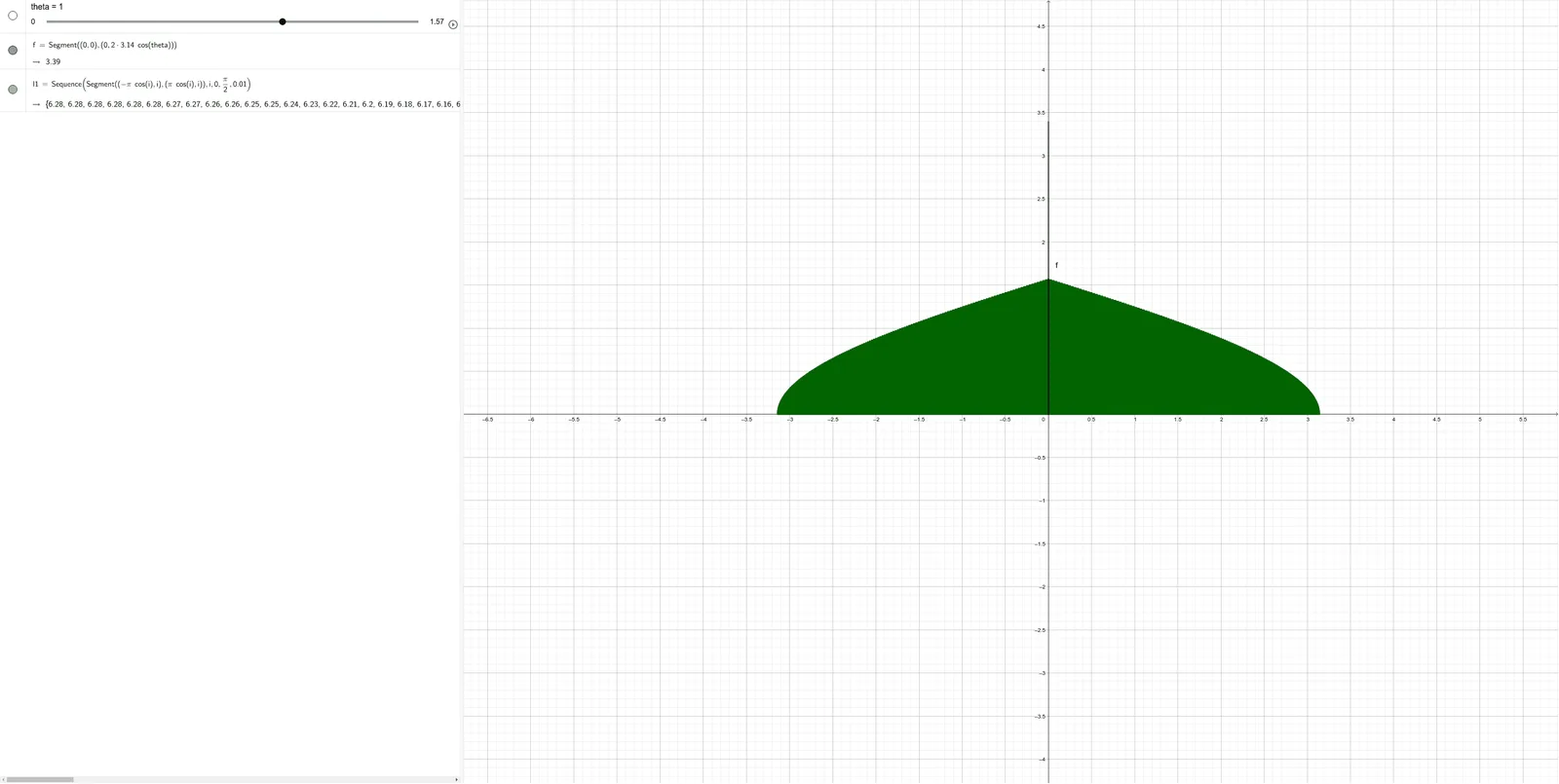
This example demonstrates how to construct a spherical network to explore continuity, exponential relationships, and similarity transformation principles in spherical geometry. Key mathematical concepts include spherical geometry, continuity, exponential functions, and similarity transformations. The construction involves using GeoGebra commands Segment, Sequence, theta, f, and l1 to dynamically generate spherical network graphics. Suitable for high school students or college undergraduates to understand solid geometry and transformation theory, applicable to mathematical modeling and geometric construction practices.
GeoGebra Commands & Parameters
Segment((0, 0), (0, ((2 * 3.14) * cos(theta)))) → fSequence(Segment[(((-π) * cos(i)), i), ((π * cos(i)), i)], i, 0, π / 2, 0.01) → l1
AI Drawing Prompt Reference
Draw a spherical network to illustrate spherical geometry, continuity, exponential relationships, and similarity transformations. Start by creating a line segment from the origin to a point vertically aligned with the y-axis, with its length varying with angle theta. Then, within the range of 0 to π/2, draw line segments at intervals of 0.01 radians from -πcos(i) to πcos(i) along the y-axis, forming a grid-like structure to explore continuity and similarity transformations on the sphere.
The prompt above was compiled from the original drawing commands and is for reference only.