
Compass on a Sphere: Drawing Great and Small Circles on a Curved Surface
Loading the math board and drawing, please wait…
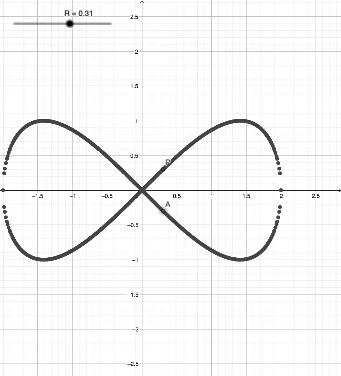
This GeoGebra example demonstrates how to draw circular paths on a spherical surface using a compass-like construction. The core mathematical concepts involve spherical geometry, parametric curves, and locus of points on curved surfaces. Construction details: Using parametric equations to define circles on the sphere, with objects a (angle parameter), R (radius of great circle), r (radius of small circle), P (sphere center), and A (moving point on circle) controlling the generation and transformation of curves. This visualization shows the geometric difference between great circles (intersection of plane through sphere center) and small circles (intersection of plane not through center). Ideal for high school and college students studying solid geometry and coordinate geometry, serving as an interactive teaching tool for understanding parametric curves on spherical surfaces.
GeoGebra Commands & Parameters
1 = x^(2) / 4 + y^(2) / x^(2)Numeric R(0.305)sqrt(R^(2) - R^(4) / 4)(R, r)(R, (-r))
AI Drawing Prompt Reference
Describe the process of drawing circular paths on a sphere. Show the comparison between great circles and small circles using parametric equations. Key objects include the sphere center, radius parameters, and a moving point. The construction order starts from the sphere center, defines parameters, then generates the circles.
The prompt above was compiled from the original drawing commands and is for reference only.